
… and sustainable development
The story to now.
It all started in 2024 with the release of the paper describing Real Capital as an approach to speaking science to policy. This came from being one of Professor Steve Keen’s students on learning where economics has gone wrong. I realised that economists can give very bad advice for policy as a result. So the Real Capital approach is a series of steps to take your scientific insight and turn it into a policy brief. I later called it the Real Capital Framework (RCF).
Key concepts of the RCF are
- Identifying real capital employed in providing for human needs
- Identifying the built capital impacting natural capital and human capital
- Understanding materiality of involvement in provisioning of human needs
- Working with normatives
- Presenting the situation mathematically in terms of Asset-Liability- Equity tables
- Visualising gaps – present status and normative
- Adding BAT Best Available Technology and CIrcular Economy Parameters
- Showing allocation – which companies are using which capitals to serve which people
- Preparing targeted briefs for the authorities and private actors involved with clear “asks”
- See the full glossary here
Later, I released som AI chat prompts that do most of the work for you!
Having read Charlie Gardner et al’s paper on science and activism I produced a booklet on how to use the RCF for activism. And I tried it out personally for issues I was working on with my local nature conservancy group. Here again there are AI prompts to do the heavy lifting.
Then came MMT – Modern Monetary Theory. If a government can spend money as long as resources are available, then surely resource availability could be quantified and qualified using the Real Capital Framework? I explore this in several blog posts.
This brought me to start exploring Doughnut Economics, which encompasses both Planetary Boundaries and fulfilling minimum social needs. I have to thank early readers for pushing me there!
That brought me to consider the mathematics of Real Capital. The basics are quite clear:
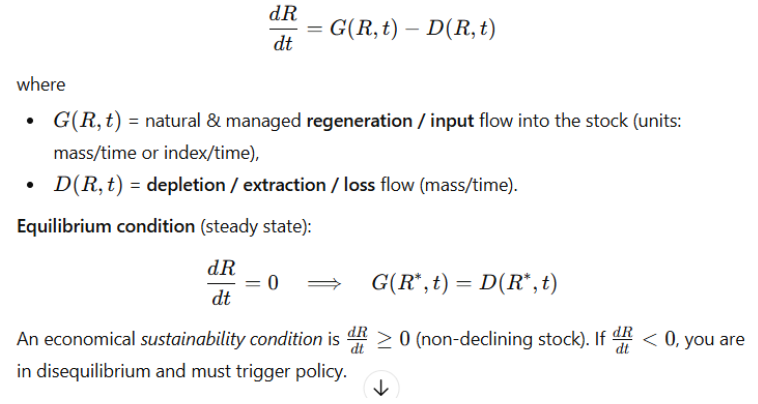
For natural capital, ANY business activity that degrades natural capital must factor this into their accounts. A disequilibrium that will degrade the capital to a point where it cannot function must trigger economic policy.
This brought me to the fundamental observation of MMT, Modern Monetary Theory: that if a nation can do something it can pay for it. That means that in theory, a national budget should be based on the Natural, Built, Social and Human capital functions and capacity for the coming year. I started to wonder why national budgeting only looks at money.
That brought me to consider my local municipality, where I am on the local council. Our budgets are fixed, but our responsibility to ensure the Paris Agreement carbon emissions is given by the government. The question became, if you don’t own the capital in the municipality, and you have a limited budget, how can you exercise prudent management?
This is the start to answering that one.
That is when I discovered ISO 55001. An international standard that gives best practice for asset management. To manage effectively you need to identify and register the assets that are salient to your purpose, relevant for the delivery of value that is expected by your organisation.
The RCF provides an intellectual basis for this: as it asks you to identify the real capital that is involved in the value creation process. Real Capital and Assets are similar enough concepts. Anyway, the main capital that both depletes natural capital and is used to provide for human needs is built capital. The nature, performance, and use of built capital is central to Doughnut Economics then.
This led me to my latest conclusion: economics is too narrow. If we are to “change the direction of this huge ship we call the provision and transaction system” we need a new discipline. I like to think of it as the study of human provisions systems.
If you find this at least a little bit fascinating, do sign up as a free member of this discord.
I can’t do this alone. Let me know if you’d like to be part of creating this new discipline by putting your email in the comments. We’ll set up a discord group to get started.
 Stephen Hinton Consulting