
People seem to be asking about this a lot, so here goes: An explanation of how the economy actually works dressed as a tale at five-year olds level with adult language. For those of you who think I’m not explaining this accurately, I’ll be back with a list of references to back everything up. But for now:
The story of the Weighty Bunt: how one nation invented its money.
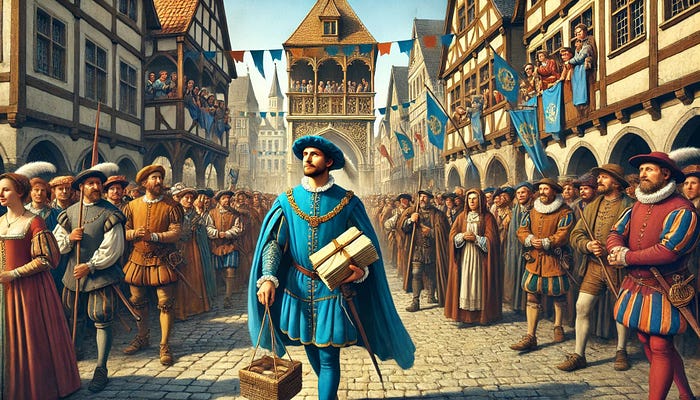
CHAPTER ONE: THEY PRODUCE A BUDGET AND PRINT MONEY
Get comfy. Here is tale you won’t want to miss. Once upon a time, there was a country ruled by two clans, commonly known as the Blues and Reds. They took turns to be in power depending on what the people felt like. Both clans wanted to win the people’s love, to gain their trust. In public, they put on airs. They held themselves in a way to portray that they knew exactly what they were doing. In fact, they went through a lot of training, all of them learned to look like they had ‘a safe pair of hands’. They smiled kindly, dressed nicely and spoke using important words. Most people didn’t understand what they were saying, but they nodded along. “They seem to know what they are talking about, that is the most important thing,” people said.
The clans introduced a system of national payment. They printed a certain number of paper notes before the beginning of the financial year. These notes were transported to a heavily-guarded fort called the Treasury. The notes would be used to pay for all government spending, national and local.
To great fanfare and ceremony, the clans would walk through the streets in long procession. At the front was the ruling clan’s finance minister carrying a weighty bunt of papers. This weighty bunt contained a long list of everything they were going to spend the notes on. They called the notes ‘money’. And the list they called ‘the budget’. The number of paper note printed corresponded exactly to the expected expenditure of the coming year, as detailed in the weighty bunt.
Of course, flooding the nation with money like this could cause problems, so the budget included a way to get the notes back to the treasury: every citizen above the age of 18 would pay taxes.
It all seemed to work fine. Government started spending on building roads, running schools and hospitals and every month people would pay their taxes. However, the smooth operations of the economy were not to last for long.
CHAPTER TWO: PEOPLE START TO WORRY ABOUT NATIONAL DEBT
One day, a question began to spread throughout the country. It was one of those questions that seem simple at first, but the more you talk about it, the more confused you get.
“Could we as a country really handle not getting all those notes back at the end of the year? Surely that means that the nation will spend more money than it has?”
“What about NEXT year?”
People heard this question being asked everywhere. What started off slowly, with a few people discussing the technicalities of the annual budget, spread like a forest wildfire to nearly everyone. People started to panic! “No, no, no! It’s not possible!” they said. From the butcher to baker to the teacher — “If we do that, we’ll get into DEBT. And with debt the whole country will go under! Debt is the darkest thing there is next to sin.” People anticipated with horror the possibility of living in a country with debt. Their very freedom felt threatened.
“Those who are in debt are not free. We the people need to be FREE!”
At first, the Red and Blue leaders had a hard time understanding this popular unrest. Surely, people wanted their government to ensure free doctors, good roads and railways and excellent schools for their children. They could just print more money to ensure society functioned. Every paper note printed created work, too.
It would all come back in tax. At least, most of it. Some money in the hands of the population could surely do no harm?
The Red and Blue leaders understood that they did not have to take back every note they spent by the end of the year. For the next year, they would print what was needed. People had whipped themselves into such a frenzy that the clans were wondering if they really themselves understood how money worked.
They consulted with some experts who called themselves economists. After listening to several presentations which consisted of talks, without diagrams and pictures which would have been helpful, none of the clan representatives understood what the economists were saying. They decided anyway to follow the economists advice on balance. They had to do something.
The economist explained that the money the government prints and spends should be clawed back in taxes during the following 18 months that the budget is agreed. They explained that for the next 12 months, the government should only print the amount of money corresponding to the planned increase in spending the next year.
They were warning the government that the amount of money in circulation determines the health of the economy and that the spending and taxation should balance.
CHAPTER THREE: THE CLANS PROMISE BALANCE
To reassure their subjects, representatives from the Blue and Red Clans stepped down onto the town square. They called the people to assemble, and then read from a long scroll. The leader of the Blues, the ruling clan at the time, proclaimed solemnly: “Fear not! We have a plan that will save you from this horror scenario. We as a country will never spend more than we get back as taxes. We call this the “balanced budget.”
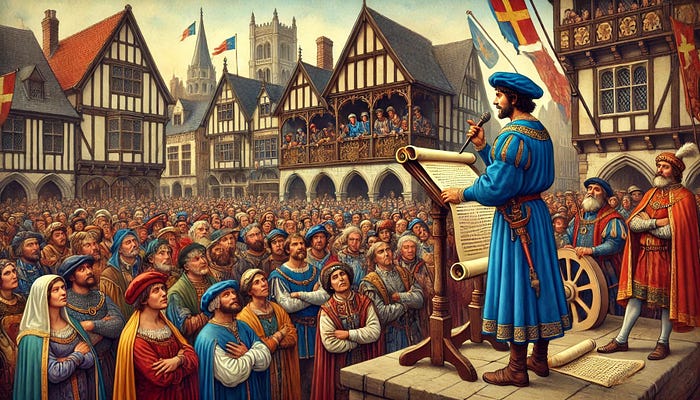
“We will tally up the money coming in from taxes on a regular basis. If money is not coming in as expected, we will cut our spending.”
The people on the square applauded. “Hooray! Now we are out of debt,” they exclaimed. Actually they did not really understand what they were being told, but it sounded good coming from the safe hands of the Blue clan, with the Red clan in agreement.
Overlooking the square was a tall, luxurious palace. High up in their palace, hidden behind golden curtains, sat some of the richest men and women in the land. They sat sipping their wine, eating hors d’oeuvres and chuckling, sharing their ingenious plans. “We’ll never pay those taxes,” they laughed. “We’ll just send our money to a little island far away, where no-one can find it. There, in our dear tax haven, our money is safe from all those rules that the Blue and Reds try to impose on us.”
And just as the rich had planned, the country received less tax. With less tax coming in than the government had planned to spend, the Blue clan soon found that not enough money had come in from taxes for them to pay for all the important things that were needed including hospitals, schools and police. People found out. Panic spread again.
Voices were heard down on the square: “how dare they stop medical treatments and food for the poor? We thought they were a safe pair of hands”.
The government called an emergency meeting of the budget committee. Before the meeting could start, a dark figure appeared from behind the curtains in the meeting room. “Honourable Gentlemen and Ladies”, he said. My name is “Cash Da Fecit”.
I work for you in the department of national debt, and I am the economist in control of the country’s economic system. Cash Da Fecit looked around the room and said: “Don’t worry! We can solve this!”
The committee were all ears, you could hear a pin drop before Da Fecit continued.
“We will print up some beautiful paper, which we call ‘government paper’. The papers will be edged with gold! We will sell these to the banks, who will use their own money and money of their rich clients to pay for them. With the money we get from the sale, you can pay for what the people need”.
“But why should the Banks be interested in buying these bits of paper?” a confused committee member asked.
“Well,” said Da Fecit, “We’ll pay money to the banks every month, a percentage of the value on the paper. “We’ll even call this money ‘interest’”.
And then the next year, we print more money and raise taxes higher to get the notes to come back to us to balance everything out.
CHAPTER FOUR: RICH PEOPLE ARE ONE STEP AHEAD
A messenger, who was listening to the conversation from outside the door, ran to the palace where the rich people were gathered. As he entered the room he heard the exuberant chatting. He saw several bankers were mingling with the other rich people. The room fell silent when they saw the messenger.
The messenger told them of what Cash Da Fecit had proposed.
There was a moment of silence, then the room erupted into laughter. Not the kind of when you hear something funny, but contemptful, derisive laughter.
One banker said: “This is cheap money, we buy this paper and get the interest as income, and when we are done we sell the paper and get our money back!”
The banks were overjoyed. And so were the rich. Because the rich could ask the banks to use the money in their accounts to buy the paper, and get a share of the interest. “This is fantastic!” one rich man said scornfully. “We send our money to an island so we don’t have to pay taxes, and then we buy government paper that gives us even more money in the form of interest. We make money both ways!”
With a loud haughty laugh one of the rich men blurted out: “How come the government — the Blues and the Reds for that matter are so stupid?” One of the Bankers whispered in his ear: “It’s not that they are stupid, it’s that they are clever enough to listen to us and do what we ask. We find many ways of rewarding them. We started the wave of questioning the spending more than tax. Then we suggested they should listen to Da Fecit and his ideas”.
A few years passed and the people of the country continued to praise their leaders for their fantastic ‘balance target’. And that they kept essential services funded. “Think how good they are,” the people said. “They make sure we don’t have debt and that everything runs smoothly.”
The people were, unfortunately, seeing everything getting more expensive, but they blamed other things. Like immigrants, or foreign trade.
They didn’t understand that, with their own tax money, they were helping to pay the interest to the rich — the same people who had hidden their money on a small island far, far away.
CHAPTER FIVE: THE GOVERNMENT STARTS ASKING QUESTIONS
Some members of the government however started to become suspicious. They summoned Cash Da Fecit to a meeting.
“What have you done?” they asked the economist sternly.
Cash Da Fecit smiled calmly. “I have helped you keep the balance target, just as you wanted. We sell government bonds to the rich and get money, so you can continue to pay for everything important.”
“But now we have even more debt. To the bankers! And interest to pay next year!” shouted one of the leaders.
“That’s no problem,” replied the Cash Da Fecit. “That’s next year’s problem. And if you need more money, you can always raise taxes on ordinary people. Put it all in the weighty bunt”
“But why not let the rich pay more?” asked one of the leaders.
“Oh, that’s not possible,” replied Cash Da Fecit, smiling his most trusting smile. “They’ve hidden their money on that secret island. You can’t reach it there. Let ordinary people pay, they love the balance target!”
But please, Wizard Da Fecit, if we hadn’t had the balance target, could we have paid out more than we took in, and not raised taxes, and not had to give the rich the interest?
Yes, said the Cash Da Fecit, but you can’t change now, it doesn’t look competent. You’ll lose face if you say the balance target was a false thing!
And so the country continued to function, with the balance target as their great pride. The rich got richer, the people paid, and no one seemed to understand how they had all been fooled by the big story of the weighty bunt with its balance target and the little secret island.
At the same time, in a medium-sized building in the centre of town, a group of learned men, who called themselves tax experts, were working. They had been following the development of the weighty bunt, calculating the printing of notes and their return to the treasury. They all looked at each other: “This can’t be right, we have to do something!” one of them said.
Another voice: “But the clans can’t lose face. We have to find a way to get out of this mess”.
But that, dear readers, is another story for another day.
 Stephen Hinton Consulting