
The term insolvency is normally used in finance. A company is insolvent when it can no longer pay its debts. What if we applied this concept ecologically?
Sweden’s forestry industry is in a state of ecological insolvency. It cannot meet the environmental obligations that come with responsible land stewardship. The industry is profitable and not financially insolvent. However, it fails to maintain biodiversity, soil fertility, water quality, and climate stability—its ecological “debts” continue to grow. This is a perfect example of where Real Capital – the forest ecosystem – is extracted and degraded and converted into money. It is becoming so degraded that it may even lose its material-producing capability.
The Illusion of Surplus
On paper, Sweden’s forestry sector is a success. It generates revenue, provides jobs, and feeds global markets with wood, pulp, and bioenergy. But this economic surplus masks a growing environmental deficit. The model of large-scale clear-felling (kalhygge) depletes ecosystems faster than they can regenerate. Indeed, once clear-felled, a forest needs hundreds,maybe thousands, of years for the full range of species to return.
Key ecological services—such as carbon storage, flood regulation, and habitat provision—are systematically degraded. These services aren’t “nice to have.” They’re essential for long-term resilience, both for nature and for society.
And as restoration comes with a cost, there is hardly enough money in the industry to invest in restoring damage. That would require putting up prices massively. On the other hand, industries that use materials from the forest add huge markups to prices. The money is there. But can we take the money from them? These industries in themselves are essential as they provide essential goods and services, jobs, and contribute to GDP. So, can this circle be squared?
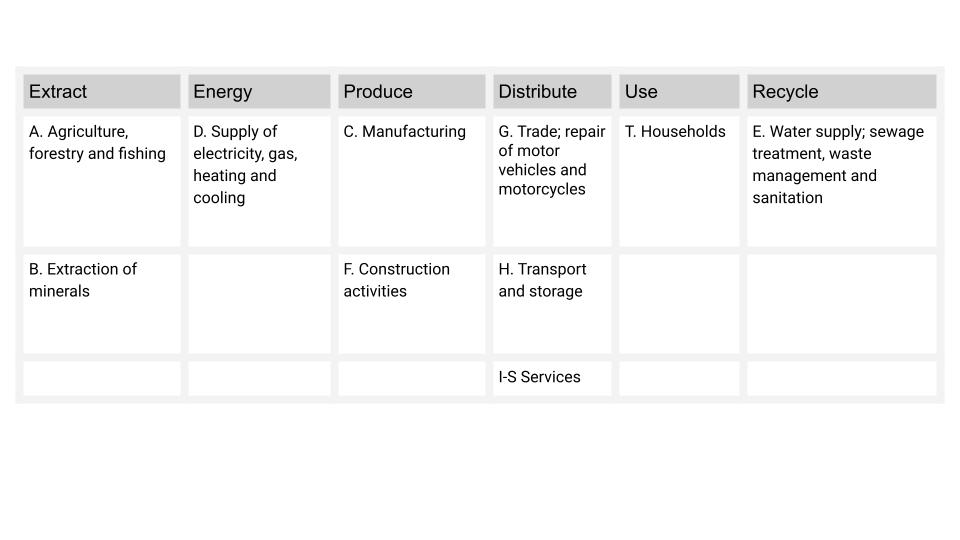
To understand this structural error, one should look at the statistics for each industry. The Swedish Standard (SNI 2007) gives each industry a letter. And SCB – the Swedish Statistics Authority – collects statistics according to SNI. The industries that extract and produce raw materials are A and B, while the industries that make money from these materials (C to T).
The gap between pollution and profits
According to SNI 2007, Sweden’s economy can be divided into two groups: Extraction (A&B) and material use (C,D, E, F, G, H, I-U)
Material producers (A, B):
These industries are characterized by:
- High pollution: Agriculture (A1), forestry (A3) and mining (B) account for significant emissions, biodiversity loss and soil degradation.
- Low GDP contribution: Together they account for less than 2% of Sweden’s GDP (SCB 2023).
Weak pricing power: These industries have narrow margins and cannot afford to internalize environmental costs.
Material users (C to T – manufacturing, technology, services):
What characterizes most of these industries is that they all use materials from extractives in one way or another.
- High profits: Industries such as automotive (C29), pharmaceuticals (C21) and IT (J) use cheap raw materials to create high-value products.
- Low direct pollution: Apart from C and H, the climate impact is smaller, but major environmental damage occurs upstream in the extraction of materials.
- Dominant GDP share: These sectors account for over 80% of Sweden’s GDP but avoid paying for the entire environmental impact in their supply chains.
Which industries contribute to biodiversity loss?

According to statistics from Statistics Sweden, the Swedish Environmental Protection Agency, etc., it is industries within A (mainly agriculture and forestry) that account for almost 80% of the pressure on biodiversity. The rest of the industries together account for 20%. The A3 industries (forestry) account for 20-30% of the impact on biodiversity and the rest of the industries use the material.
Which industries pollute, which make money?

The diagram shows how different industries affect different aspects of the economy. Particularly noteworthy is how industries that create environmental problems take up a smaller share of GDP.
Why is this a problem?
- Forestry companies cannot afford to make the environmental investments that are needed
- User industries and retail trade make big profits but do not pay for the long-term health of forests
- Biodiversity is threatened while the profits are distributed unevenly
To correct this imbalance, there are several options available.
Change the rules for the material extraction industry. Require circular responsibility. For example, mineral materials should always be the responsibility of the industry. The material is only rented by the producers. For biomaterials, the ecosystems that produce the material should always be kept at the same high status.
Extend producer responsibility (EPR): Ensure that industries that use raw materials (e.g. wood, metals, agricultural products) pay for the environmental impact of the entire life cycle.
Pollution fees in supply chains: Introduce an additional fee on VAT that forms a fund for nature restoration.
Redistribute subsidies: Stop supporting unsustainable material extraction (e.g. mining, intensive forestry) and invest in the circular economy instead.
Sustainability reporting requirements: Force large companies (especially in manufacturing and technology) to report and compensate for environmental damage in their supply chains.
When Overshoot Becomes Business-as-Usual
Ecological insolvency is a form of overshoot: using more of natural capital than can be replenished. It’s comparable to under-spending on maintenance, counting on a future windfall to cover the gap before your machinery stops working. In forestry, that future never comes. Soils are compacted, species vanish, and the climate and biodiversity buffer of intact forests is eroded.
What’s worse, this ecological overshoot has been institutionalized. Clear-felling is still the dominant model. Short rotation cycles and monocultures leave ecosystems brittle and vulnerable. And policies often reward volume over value, ignoring the longer-term environmental costs.
Remedies Exist—and They Work
The tragedy is not just the damage being done. It’s that the alternatives are known and viable.
Ecological forestry methods—including continuous cover forestry, selective logging, and restoration of mixed-species stands—have proven benefits. They maintain forest functions while providing timber. They improve biodiversity, retain more carbon, and support local water systems.
What’s missing is the political will and policy reform needed to shift incentives. The current economic framework externalizes environmental costs. In other words, ecological debt is treated as someone else’s problem—often future generations.
A Paradigm Shift Is Overdue
We need to flip the question. Not: “How can we make forestry more efficient?” but rather: “What kind of forestry serves life, now and in the future?”
Ecological accounting must become integral to economic decisions. This includes recognizing forests as living systems, Natural Capital, not just timber stocks. It means managing forests as commons—with rights for communities, species, and future generations.
Sweden has the knowledge, tools, and public awareness to lead this transition. What it lacks is the courage to confront a dominant industry and an outdated paradigm.
The good news? Ecological solvency is within reach. It starts with seeing forests not as commodities, but as partners in survival.
 Stephen Hinton Consulting