
As a local politician I’ve been involved in dialogue around strategy for 2025. The process will result in a plan to be agreed in September this year (2024) for next year. My group is responsible for the built environment – in Sweden the municipality has a monopoly on built environment planning as well as domestic waste, which brings great responsibility with it. Faced with the fact that warnings from the IPCC have gone unheeded, (use of fossil fuels has increased year on year) we concluded that our #1 priority is to prepare for the consequences of 1.5 degrees. Ideas on pursuing “progress” seem so last century. But how do you put a management system in place to achieve preparedness? How do you ensure a place is good one to live in? Can we have prosperity as our aim?
My thoughts arising from the cross-party workshop
This post arises from the dialogue session I attended with the other political parties. I will share my distinctly personal and general conclusions that in no way reflect the views of my political party or the views of the municipality or the council.
The diagram below explains how I see things. At the top are the challenges we see on the horizon, we depict them as icebergs. Below that are the municipal goals.
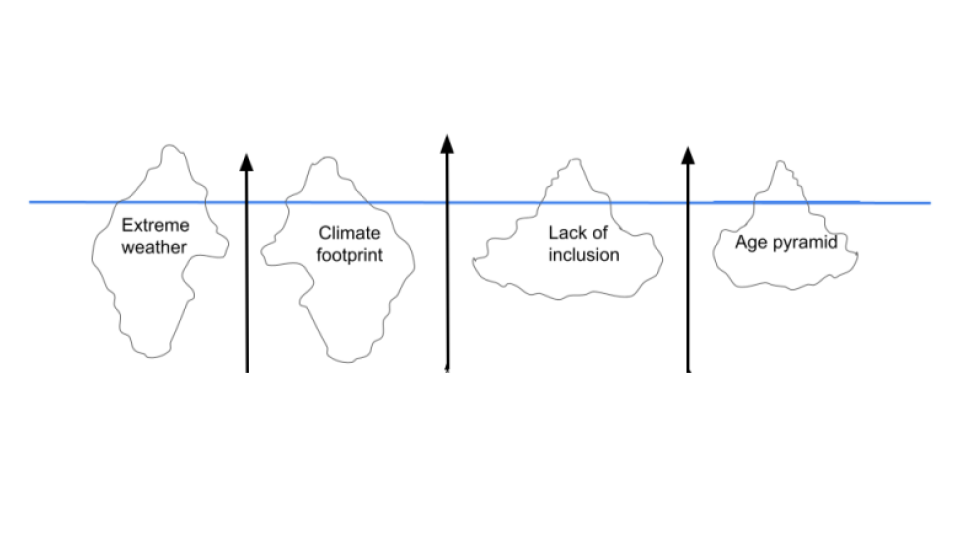

To me it seems like we must be conservative – to ensure nature can protect us, and we protect nature by eliminating fossil fuel climate contribution. And we should be promoting integration and inclusion. We should be thinking holistically. Some of the dangers to avoid contribute to avoiding others. For example:
- By reducing tree-felling we can both increase CO2 uptake and guard against floods.
- By involving ethnic groups in planning, we can help make the place inclusive and a better place to live.
- Green spaces in towns can help cool them as well as increase their attractiveness.
Setting visionary goals is inappropriate in a tight situation
Managements in many organizations have adopted goals as an organizing and management tool. The idea being to evaluate measures against how well they support the goals. Every staff member is expected to organize their work to contribute to goals, and importantly, avoid going against the goal.
Management by goals might be appropriate when an organization is improving, pursuing a vision of progress. I would however argue that when you are faced with a sea of icebergs, like the captain of the Titanic, leadership should concentrate on steering past them. The goal if you like, becomes to keep the organization in safe waters.
Indeed the Titanic analogy is apt:
Firstly, we risk crashing on the ice, and secondly we are all on the same boat, and whatever happens we should enjoy our lives as long as we can. An enjoyable life depends on your social situation, and how people are with each other.
A culture of supporting each other would help make the time we have left more enjoyable. Regardless of if our mobile phones are working or not!
So, we are starting to frame the narrative. To stick to our areas of responsibility we need to understand now where the built environment comes in.
The built environment determines a community’s environmental and social performance
Much of how society performs environmentally is down to how its built environment performs. For example, if a fleet of fossil-powered vehicles operates in the area, it will emit carbon dioxide. If homes are poorly insulated, they will drive energy use, especially during the cold months.
And the largest investment is one in built environment, including investment in health care, schooling, housing, etc. So decisions on investment in the built environment is one of the biggest factors in determining how that infrastructure performs.
The built environment also contributes to the social functioning – for example, areas are more attractive if basic amenities like libraries, day car, shops, parks etc. are available close to where people live.
The capability of the infrastructure contributes to its ability to withstand weather system instability. Weather conditions in another part of the world may affect may affect food production which in turn will affect food availability if citizens depend on imported food.
Should food production to compensate import shortfall not be possible in the municipality, shortages can be expected.
The Titanic analogy is apt as a leadership principle too. With the 1.5 degree limit goal clearly out of sight, and climate tipping points expected to happen, we might be in for many local disasters like food shortages, floods, fire and droughts. The aim must be to, as long as it is possible, make sure the environment onboard is as good as possible. That ties in nicely with having the goal of making the place a great place to live. A great place to live might not need technological advances. Much of what makes a place great to live is related to affordability of housing, security and amenities. And how we are with each other.
What is a small investment in terms of money, but brings a large return in terms of social cohesion, is how we are with each other – and how our social organisations are. We should be aiming to have appropriate infrastructure, social institutions that support a culture of inclusion and mutual support, with the best possible social outcome.
What about the other goals?
Despite the immigration influx, the age pyramid looms. The baby-boom years after the war have left a large proportion of pensioners who require more and more help and health care. Already the municipality is having difficulty recruiting to all of the positions involved. The municipality is the largest employer engaging up to 10% of the local workforce.
So how do we as local politicians know if we are going in the right direction?
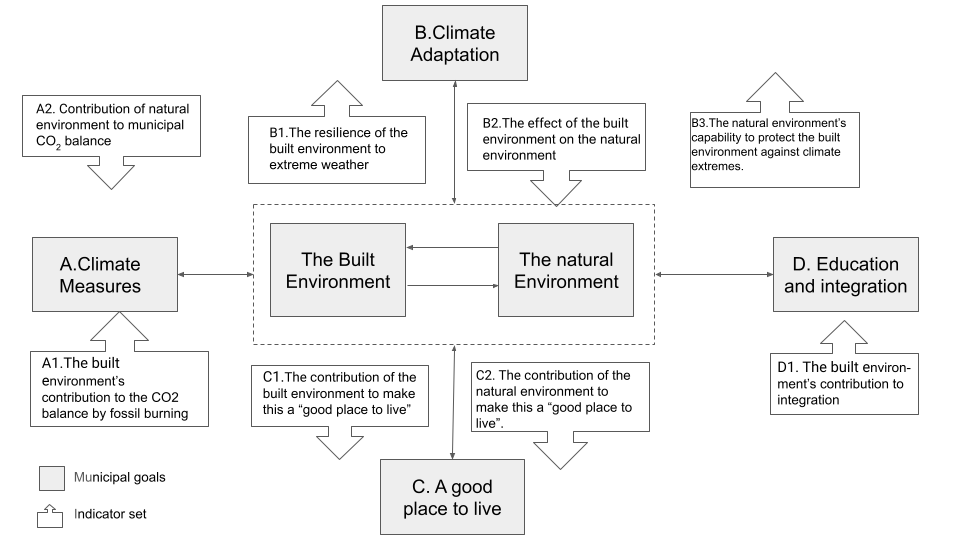
The proposal is to create a set of indicators, depicted above. The status should be presented regularly, rather like the budget figures. There should be 1-3 indicator sets for each goal. As our council has responsibility for the built and natural environment, the appropriate thing would be to look for how the environment is affecting the municipality’s ability to ” miss the icebergs” and “make the ship a great place to sail on”.
| Goal | Description of indicator |
| A. Take measures to reduce climate impact | A1.The built environment’s contribution to the CO2 balance by fossil burning |
| A2. Contribution of natural environment to municipal CO2 balance | |
| B. Adapt to be resilient to extreme weather | B1.The resilience of the built environment to extreme weather |
| B2.The effect of the built environment on the natural environment | |
| B3.The natural environment’s capability to protect the built environment against climate extremes | |
| C. Keep/make it a great place to live | C1.The contribution of the built environment to make this a “good place to live |
| C2. The contribution of the natural environment to make this a “good place to live” | |
| D. Integrate through education and inclusion | D1. The built environment’s contribution to integration |
How we are doing could be presented in the form of a dashboard or simple trend and traffic light table. As politicians, we need to be brought in when we are off course. And management needs to keep developments on course.

How can we politicians act on the indicators
We can imagine a situation where we discover from satellite data and felling applications that the forests are taking up less CO2 (A2). Should this indicator show red, the council will explore options to, for example:
- Defer felling
- Plant more trees on municipal property
- Look into decreasing fossil burning
Perhaps a survey of the built environment identifies buildings that are too hot in summer. (B1). Here the council has options to pursue:
- Prioritising the different uses of buildings (age care, kindergarten, low cost residency for example)
- Creating a plan and a fund to execute the plan
Finding common ground for the indicators
I have not yet gone into how the indicator sets are to be put together, and what data to collect. Even though I have some ideas, I think that this should be the role of the municipal management. They should design the indicators and present them to the council for approval.
Having said that, there are some areas that should be fairly straightforward, I’ll go through them below.
A1.The built environment’s contribution to the CO2 balance by fossil burning
- Amount of fossil fuel sold in the municipality
A2. Contribution of natural environment to municipal CO2 balance
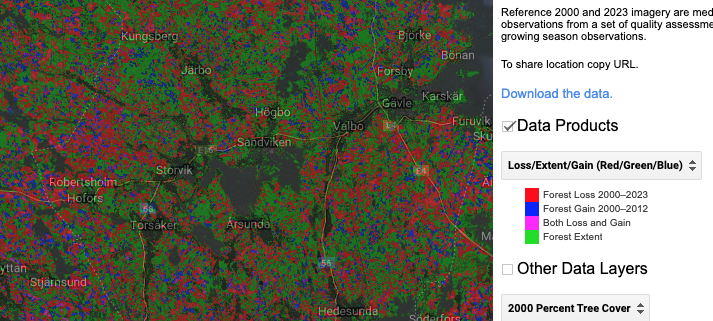
Satellite services that monitor loss of tree cover over time.
Hansen balance: example below.
B1.The resilience of the built environment to extreme weather
- Ongoing adaptation of risk areas
- Ability to produce food locally
B2.The effect of the built environment on the natural environment
- Phosphorous and nitrogen levels in the surface water
- Planetary Boundaries, biogeochemical flows of P, N
B3.The natural environment’s capability to protect the built environment against climate extremes
- Global Goals on adaptation UAE Framework on Adaptation
C1.The contribution of the built environment to make this a “good place to live
- Variety of types of accommodation available
- Amenities and their availability
- Availability of jobs
C2. The contribution of the natural environment to make this a “good place to live”.
- Green areas nature and availability
D1. The built environment’s contribution to integration
- Inclusive Housing Areas:
- Access to Community Services:
- Shared Outdoor Spaces:
- Involve Residents in City Planning:
However the municipality plans to go ahead, department-wide scenario analysis will be needed, to identify where the challenges might come from to improve readiness. This is covered in my earlier article.
For example, we may see an immigration influx if crops fail in some parts of the world, or at least a food price increase which will affect many of the lower-income families.
Local farmers are already struggling with flooding and drought, we need to think about ensuring their livelihoods and production levels.
Do comment below on how you are thinking about local adaptation to weather challenges.
 Stephen Hinton Consulting