
This is great advice from an entrepreneur and investor whom I admire greatly. And it’s good advice for those looking to create sustainable businesses as well.
Author: stephenhinton
If climate change were a comet about to hit earth how would you plan?
Video of Professor Krumdieck answering the question “the largest challenge”
The Professor create the Global Association for Transition Engineering, an academic group to effectively manage the risks of un-sustainable resource use and environmental impacts by implementing changes and adaptations in existing engineered systems
Water Data – The World’s Water
Red warning lights
Great analysis from Micheal Robert’s blog on the economic situation in the EU.

Speaking at the close of the G20 summit of world leaders in Brisbane Australia, British Prime Minister David Cameron exclaimed that “red warning lights are flashing on the dashboard of the global economy”, threatening another recession.
Of course, Cameron was not talking about the UK economy, which is going great guns, according to the British government, with six months to go a general election. Instead, he was covering his back, so that if any downturn in the British economy took place it could be blamed on the rest of the world. You see, as Cameron put it in an article for the Guardian, don’t blame me, you lefty liberals. If things go wrong from here, it will be because of the Eurozone that you all like so much. “The Eurozone is teetering on the brink of a possible third recession, with high unemployment, falling growth and the real risk…
View original post 1,068 more words
Economists: Make sure to look in the right direction
As a Brit living in a country that drives on the other side, I still have a moment of hesitation crossing the road; looking both ways, both sides. I was about to cross the road yesterday to go to a conference on banking, and as I stopped the thought crossed my mind that maybe economists in the mainstream are so used to one way of doing things that they are not looking in the right direction either. I couldn’t shake the feeling something has been missing. Why have the warnings about climate change not changed anything? How are things different now that the IPCC has put its foot down and stated clearly that we need to exit fossil fuel burning and transition to clean, renewable energy? Maybe low inflation is not the answer, but HIGH inflation? Continue reading “Economists: Make sure to look in the right direction”
We have to do something else with what we have left
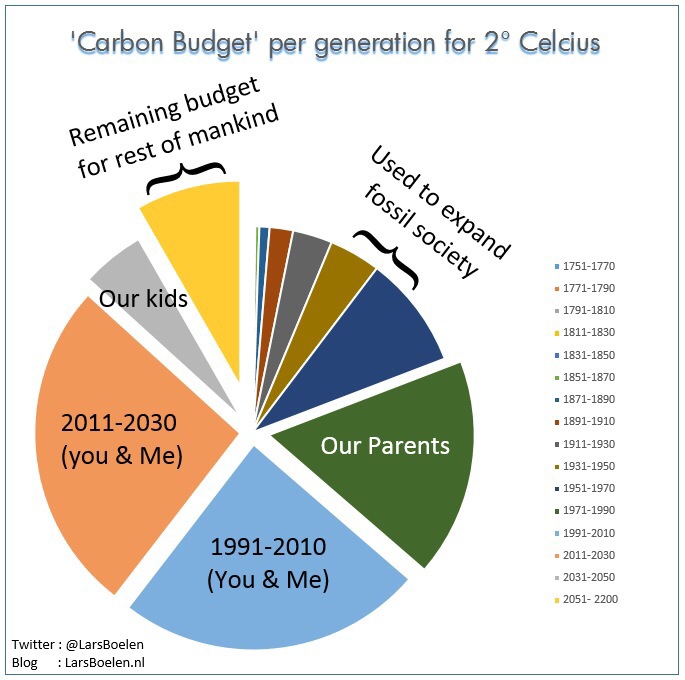
In order to ensure that the climate does not flip to a situation where human life would be drastically reduced, we need to keep warming under 2 degrees. To do that we need to restrict release of climate gasses into the air. Stopping the burgeoning of fossil fuels is one major part of that. But there is some wiggle room, we could maybe burn a little more……. The question is, what are we going to burn it doing?
If you ask me, ( a few do), I would say we need to use it to create sustainable communities that are far less dependent on transportation of goods to and from them. These communities need to have their own renewable sources of energy, and be designed so food and fiber production is carried out close by without the need to burn fossil fuel.
The diagram below explains how much is left. Anyone got a detailed idea of what we could do with it?
Can social media help drive local community development toward sustainability?
These are the notes from the SACRED VALLEY DIALOGUE held on Mallorca 23-26 November, 2014 in the open space group that discussed social media (SM) and how it might be possible to use SM to drive local development. Continue reading “Can social media help drive local community development toward sustainability?”
Fees on raw materials can create circular economy
 Just released, the latest version of the Swedish Sustainable Economy Foundation’s White paper presents in detail how nations can usher in the zero emission, no waste society using a special fee mechanism on raw materials. Download the paper from the Foundation’s web site
People get worried that we should reduce consumerism, as our way of life is driving resource use and emissions. Just reducing will collapse the economy. Instead, the Foundation proposes fees on introduction of raw materials into the economy. These fees are raised until the consumption and emission of materials ceases. But the money is redirected into the economy – paid out equally to all taxpayers. This ensures people have money to buy what they need.
The paper is the result of several years’ work, including projects with the Nordic Council of Ministers on Carbon fees and fees on phosphorous and nitrogen.
It is essential reading for those working with the transition of society away from the resource-hungry to the equitable, sustainable future many long for. It provides a sound basis for practical approaches to pricing and managing pollution.
The paper, along with other versions and the short summary can be downloaded here.
The circular economy can be ushered this way: substances that are not biological of origin ( iron, other metals, mined substances etc.) cost to enter the system, and the price is raised until they do not leave it. Biological nutrients circulate too, but enter and leave the economy without burdening recipient or reducing ecological maturity of the source. At the same time, money to enable these transactions circulates freely in the opposite direction.
LEARN MORE
The TSSEF website http://tssef.se
Embedded energy and the future of product design

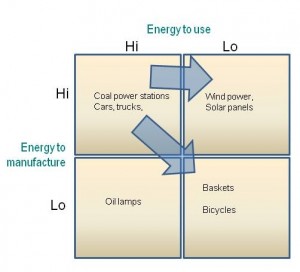
This matrix divides products and services up depending on energy required to make and run them. What will happen as energy prices rise or fossil fuel becomes scarce? Products that require a lot of energy to make and run will less affordable. These “make once, run expensively” types of products will migrate to the quadrants on the right. The “make once, run cheaply” or “make cheaply, use cheaply” will take over. Continue reading “Embedded energy and the future of product design”
The falling oil price may presage a future recession
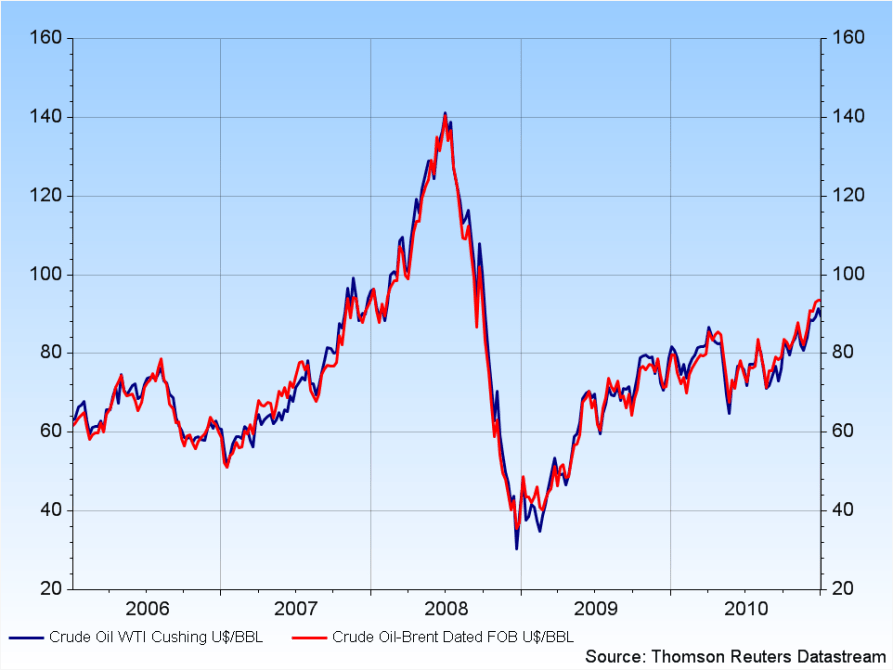
Reproduced from Prof. Aleklett’s blog. He explains the signs that we’re on the edge of a new recession. The reason is the lack of energy to drive the economy. And the lack of demand to drive up oil prices.

(This is the English translation of my article in the Swedish newspaper Svenska Dagbladet, Fallande oljepris ett tecken på recession)

Since July the price of Brent crude oil has fallen from $113 per barrel to $85.62 (on October 14). Historically we saw a similarly rapid fall in the in the oil price in late 2008 followed by the start of the global recession the year after. In 2008 the fall from July to December was from $140 down to $40 per barrel. At the moment we see no slowing of the price decline and we do not know how low the price will fall.
The fact that increased global energy consumption is a measure of economic growth means that these recent trends are pointing to an economic contraction. Many economists continue to expect that we will recover from the recession of 2009 and, of course, “growth” was also the…
View original post 896 more words
 Stephen Hinton Consulting