John D. Liu was speaking at the recent conference Nature Based Solutions for Water and Peace. The UN Water Conference March 22-24, 2023, at the UN Headquarters New York.
He pointed out that the basis of the economy is buying and selling, but the basis of life is nature. And without life, there is no economy.
Given the warming already locked in, as well as the lack of measures in place, municipalities should prepare for weather pattern instability as well as to be ready for fast changes in political will. The work of Igor Ansoff gives guidance.
ABSTRACT
This report looks at the consequences of the recent IPCC synthesis for municipal authorities in their longer-term planning. Although the main focus is Sweden, the report should be relevant to municipalities in other countries. It suggests that given the warming already locked in, as well as the lack of measures in place, municipalities should prepare for weather pattern instability as well as to be ready for fast changes in political will. The report suggests following the advice of strategist Igor Ansoff to set up capabilities to deal with a turbulent operating environment. This includes capability to monitor the situation, work with a range of scenarios and to ensure the organisation is agile enough to deal with unexpected changes, be they physical, social or political. The report suggests municipalities address three basic strategic questions covering global inaction, energy transition and food provision. It proposes a holistic approach analysing each measure to address climate instability on several dimensions to avoid, among other things, adaptation putting unfair pressure on the poorest.
I heard that Marx struggled at the end of his life to learn enough mathematics to demonstrate his insights as calculations. He didn’t make it. But it is understandable. Society runs on expert calculation. We see them every day about the effects of interest rates and output and unemployment, estimates of share prices etc. The problem is, we are dealing with complexity and treating it like a simple case of “doing the maths” when mathematics is poorly equipped to do that.
You would expect that material flows would present their own logic for whether they are best handled in your own home or at a global level. Or scales in between. Factors like material density, value and frequency of use and transport would be obvious candidates.
This article focusses on the municipality and looks specifically at the material flows that contain carbon. And we’ll take a practical example: the area called Västra Gästrikland (VG) in the north of Sweden. This is an area comprising three municipalities in cooperation.
We need a philosophy because we need help and guidance to a way of living that is peaceful with the Earth and coming generations.
Circular economy seems to be a more technical subject – about how we circulate atoms and how the monetary system works with that circulation. We might ask ourselves why have we embarked on describing the philosophy of the circular economy?
The circular economy for us is one of the plausible off-ramps away from material-use expansion and economic growth. It is therefore salient to major changes in our lives coming up. Now: our emotions are highly connected to our beliefs, and hearing about the need to transition away from fossil fuels, and feeling unsure of the future, it is likely that talk of this transition will wake up many emotions.
This is the first draft of a carbon accounting model that looks at the world’s forests, and their owners, as one of the mechanisms to increase carbon uptake as one of the strategies to mitigate current levels of carbon in the atmosphere.
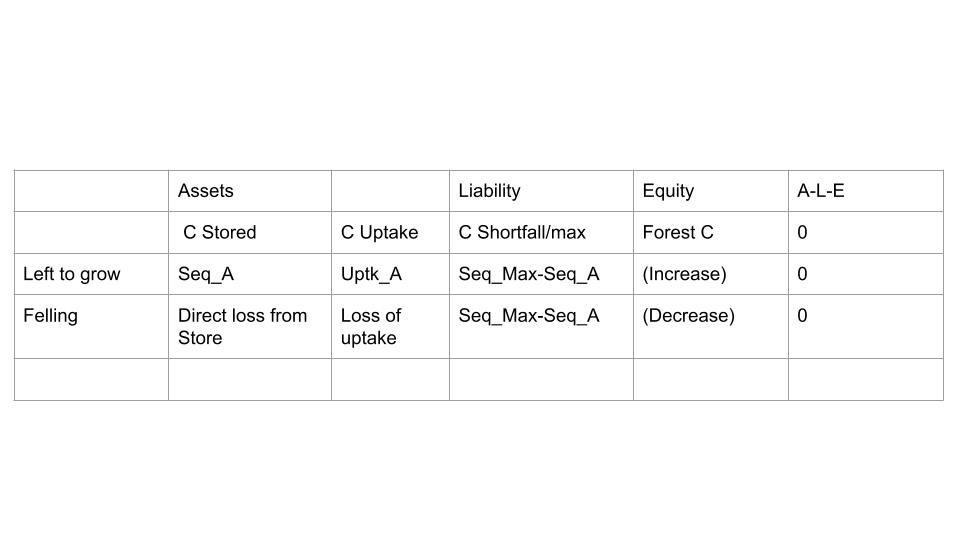
We are using the double accounting method Assets, Liabilities and Equity in order to be able to put the model into the minsky software. Minsky is a system dynamics modelling software that easily allows “what if” calculations. The ulterior motive is to help policy makers understand the role of the forest in carbon mitigation. It also aims to connect carbon and money so that policy makers can explore the role of economic instruments to encourage forest owners to participate in the great carbon sequestration needed.
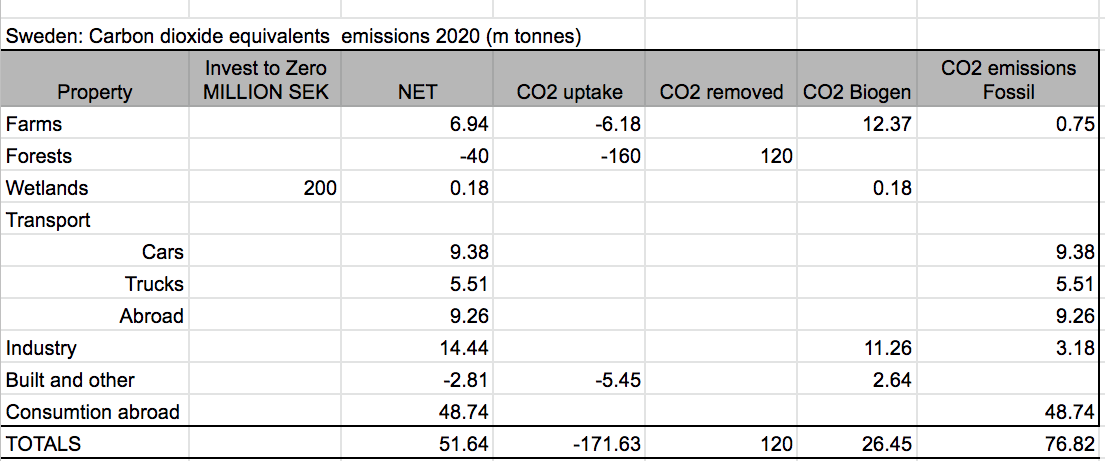
Million tonnes of CO2 equivalent
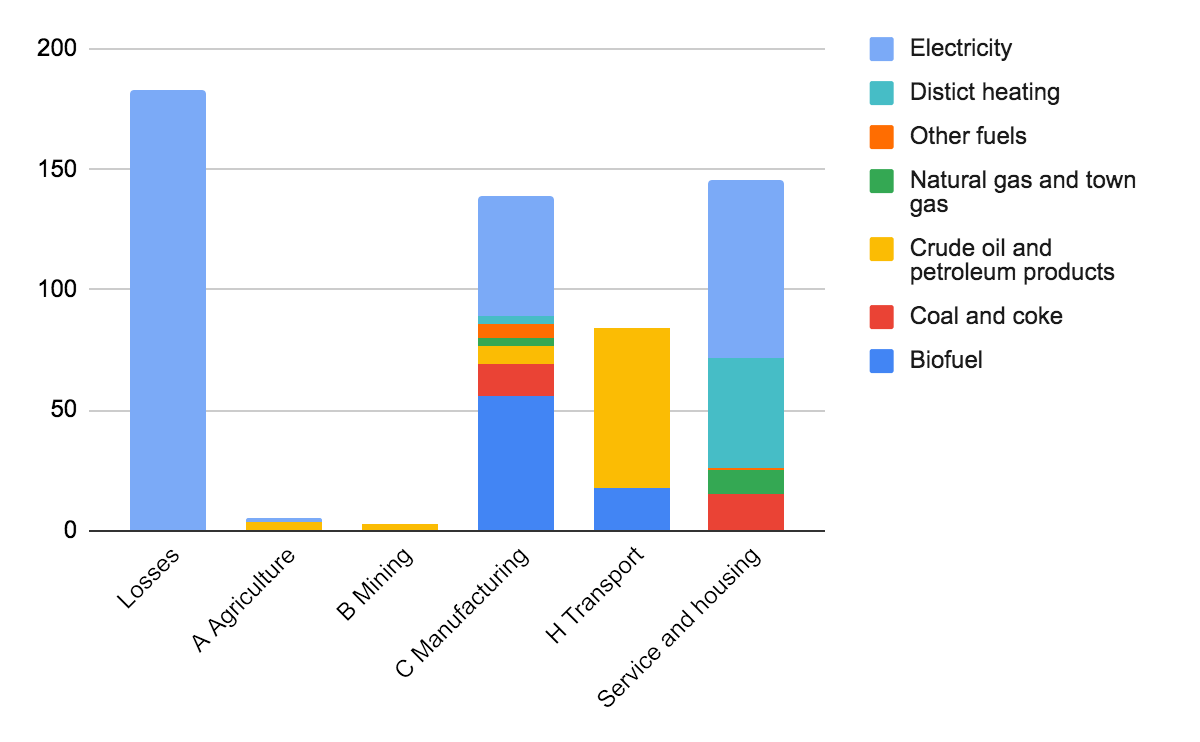
As you see from the above, net forest carbon absorption is nearly as large as the carbon emitted by consumption abroad. Whilst this is no easy subject, full of complications, it may help policy to have a helicopter view. Note that emissions from burning wood come mostly under industry, biogen, 11.26 million tonnes
This is just a draft, written to encourage systems thinkers and forest ecologists alike to contribute. Note to simplify we use the units of metric tons of carbon throughout.
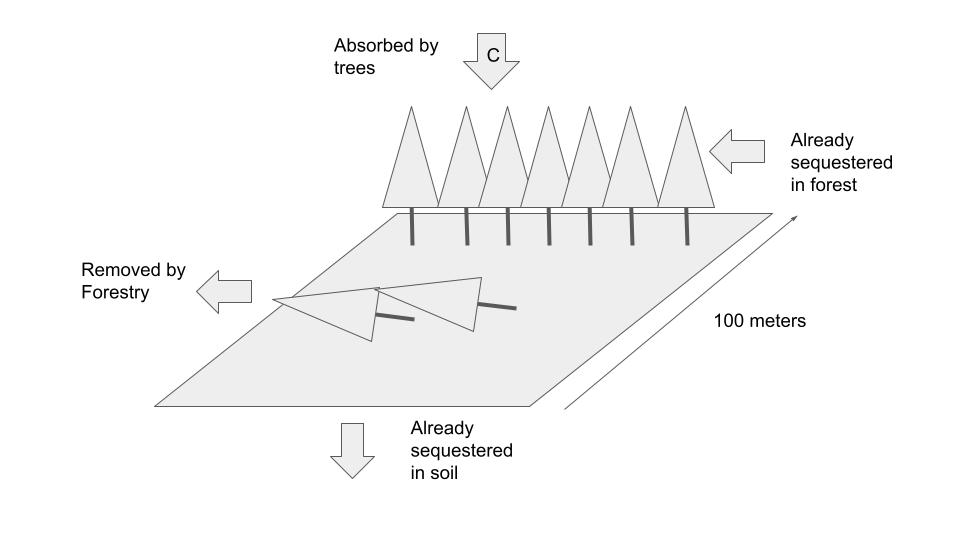
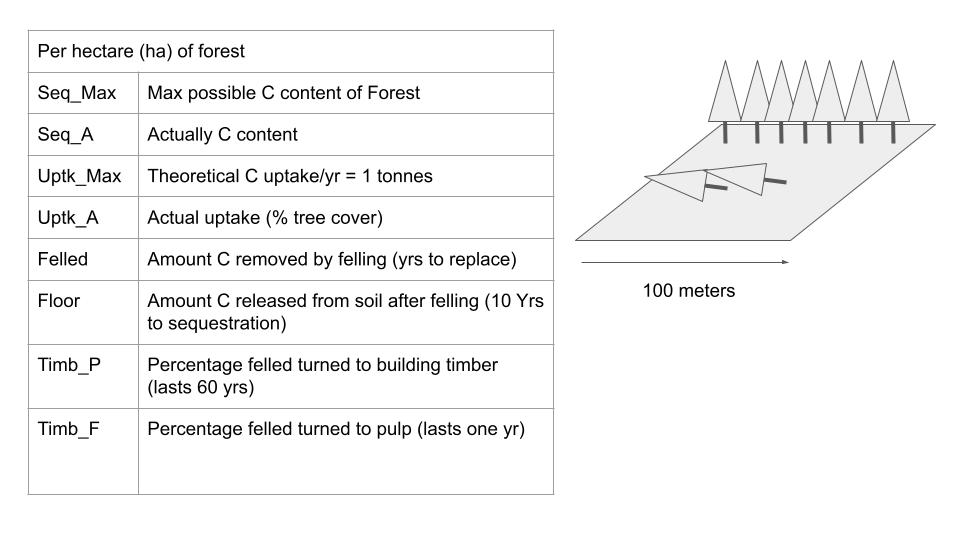
The diagram above shows the basic concept. One hectare of forest has:
A theoretical maximum C uptake – depending on the percentage of cover. 100% cover gives maximum uptake.
An actual uptake, and reduced uptake and C content after felling.
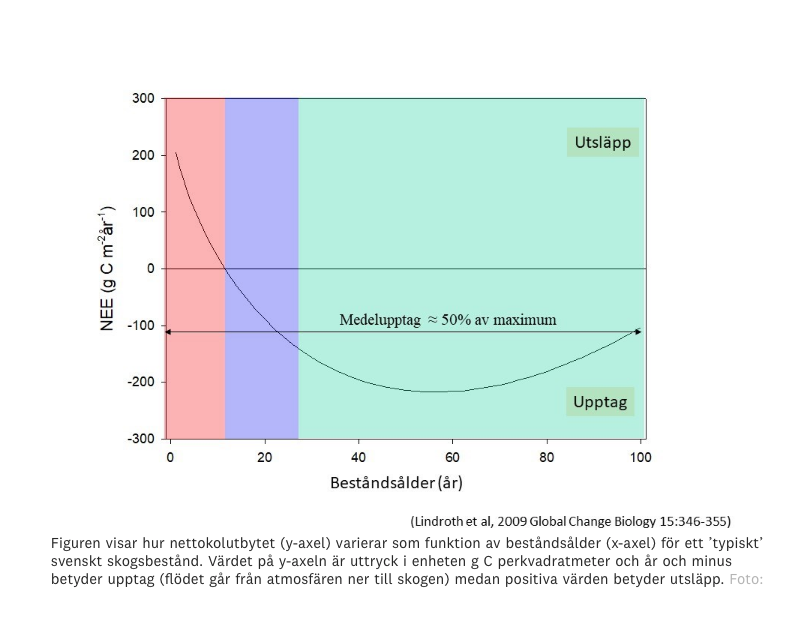
Note that the forest floor, the soil, contains more carbon than the trees, and felling the trees results in a release of carbon for some ten years until the forest has started to grow back.
Full functionality is achieved, at least in Swedish forests after trees reach 60-70 years. They go on taking up carbon until they reach 200 years old.
In terms of releasing carbon to the air, some 15% of timber harvests is used in building, with a half-life of 30 years.
The rest has a life of about one year before being combusted. This means 85% of the harvested forest ends up as atmospheric carbon the year after.
If we see the shortfall in carbon uptake by the forest as a liability (on humanity) and the actual uptake as equity, we can start to model this in accounting terms.
List of parameters
Carbon in forest 110 tonnes per hectare
Carbon in forest soil 160 tonnes per hectare
Carbon sequestered in mature forest (at least) 1 tonne ha 1 year1 ha
Carbon lost 1 tonne ha-1 yr-1
Other input information needed:
The area of the property in ha
The % forest cover
The % forest planned for felling
Lo
Hi
Text
0.4t ha-1year-1 ha
1 t ha−1 year−1 ha
Mature forest stands Carbon uptake tons per hectare /yr
?
1.77 t ha−1 year−1 ha
Mature forest soils Carbon uptake tons per hectare /yr
1t ha-1
4t ha-1
Average C emission of felled forest under 10 years, includes soil loss
Business leaders understand that it is essential that the culture of the corporation fits the market and wider context the corporation operates in. They also understand how the culture of the corporation needs to adapt and evolve with the changes in the business environment. Its corporate culture ensures the organisation can thrive. Can one draw a parallel to the development of national culture?
Factual, concise and hard-hitting. This new website from Sweden shows the ACTUAL state of Swedish forests and the almost impossible challenge of preventing total biodiversity loss.
The fact that a large percentage of forests have already been clear-felled means that there is little chance these areas can recover their biodiversity. That just a few percentage of biologically and ecologically valuable forest has protected status has locked endangered species into such a small area reduces the chances of these species spreading.
The site also takes up the carbon sequestration function of Swedish forests and the challenge to have old growth continue to absorb carbon.
it is deeply instructive to take a look at Swedish numbers to see how they match the vision of Net Zero. An essay:
Sweden wants to be world-leading in the race to net-zero. Or at least that is the rhetoric you can find on official websites. For those interested in having an actual climate-safe future, it is deeply instructive to take a look at the numbers to see how they match the vision.





 Stephen Hinton Consulting