
Swedish forests are being clear-cut at such a rate that alarms bells are ringing about dramatic loss of biodiversity and old-growth forest. Once clear cut, it is unlikely that biodiversity and old-growth forest will return. Activists are calling for the preservation of the last remaining patches of bio-diverse forest. This must happen. However, we need to look at the demand side. What is driving this demand and are there demand-strategies available?
Continue reading “A demand-side strategy for saving Swedish forests”Category: Articles in-depth
2023: Looking Back in Anger-the realization it is too late to avoid hardship
2023 – the year I realised we are looking at the end of industrial civilisation as we know it.
Last year, some realizations hit me hard. For me, 2023 really saw the beginning of the end of what we might call the industrial way of life. For many years I have advocated transitioning to sustainability. Below I outline why I now think it is too late, instead the focus should be on mitigating the effects of destabilized weather patterns. It looks like several tipping points may be inevitable. At least we must prepare.
Continue reading “2023: Looking Back in Anger-the realization it is too late to avoid hardship”The Tax and Dividend mechanism. A simulation

One way to reduce fossil fuel in products is to, as suggested by The Swedish Sustainable Economy Foundation, introduce a progressive tax and dividend on fossil fuel.
Continue reading “The Tax and Dividend mechanism. A simulation”146 clubs use neighbour power to force businesses to be planet friendly
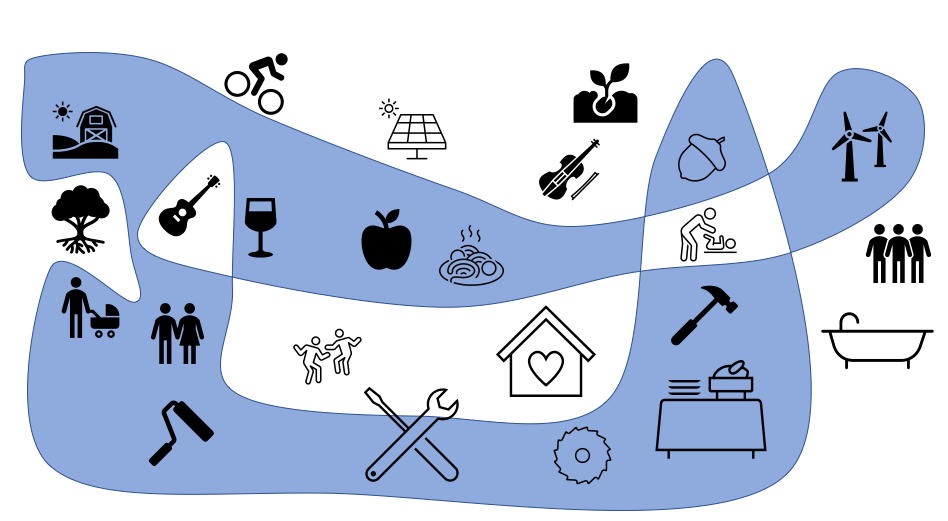
Pivot Projects is a global project set up to bring actionable insights to COP26. Working with some colleagues from Pivot Projects we asked ourselves what the smallest unit could be of individuals working from the bottom up to bring societal functioning inside the doughnut framework.
Continue reading “146 clubs use neighbour power to force businesses to be planet friendly”This is what a regenerative economy looks like

Imagine. You buy an orange from the store and trigger a whole chain of positive reactions. Staff get paid, public infrastructure gets repaired, rebuilt and improved, the land the oranges grow on gets fertilised and new orange trees get planted. It is not such a stretch of the imagination as you might think, because that is the way nature operates. By feeding, creatures actually steward and improve the eco-system. You could say their feeding, moving through and manuring nature regenerates the capability of the eco-system.
Continue reading “This is what a regenerative economy looks like”Greening the desert will help us. In many ways.
A group based in the Netherlands, called The Weather Makers, are rolling out an ambitious plan to turn the Sinai desert green. Apart from stabilising weather in the region and possibly an even wider area, the initiative hopes to bring livelihoods to the area, reducing the risk of conflicts among the troubled people who live in the area. The project literally has biblical proportions as it is the site of what ancient scripts refer to as the land of milk and honey.
Continue reading “Greening the desert will help us. In many ways.”Why the doughnut needs the bathtub – economic models for real change
Kate Raworth’s Doughnut model of the way an economy should perform is excellent. But it needs an idea of how to control that economy so it performs to requirements. Enter the bath tub.
Kate Raworth has a wonderfully clear and simple concept – that we should arrange the way we run society on the principle that we do not exceed planetary boundaries – in our relation to nature – on one hand, and that we set things up to avoid people suffering and that everyone’s basic needs get fulfilled – the human dimension – on the other. She draws it like a doughnut.
In her excellent book, Doughnut Economics, Kate shows how this task is essentially one for the economy and a question for economics. Doughnut economics gives us a very clear set of requirements for how an economy should work. That immediately brings one to think of money, investments, taxes, banks businesses etc. And that is where the model needs a little help .
Continue reading “Why the doughnut needs the bathtub – economic models for real change”Shop your way to fossil freedom
Sixteen-year old Greta Thunberg is asking good questions like “why are we doing nothing about climate change?” She tells it like it is as we stand unmoving – no group wanting to give anything away. Unions rightly take the stance that workers should not pay with lowered standards. Some want to play with small tax adjustments to see the poor OK.
The New Green Deal says “never mind the economics of it – we’ll just invest in the planet we want.” That is good, but you need to make sure people have the money to pay for those new high speed rail services and electric buses.
So. No easy solution? Perhaps there is.
Continue reading “Shop your way to fossil freedom”Swedish Climate Parliament passes motion for true carbon budget
Just as budgets steer every household and every corporation, so should every nation signed up to the Paris Agreement be steered by a carbon budget. This carbon budget should be treated like a monetary budget, the actions of the Swedish Government (even with the Green Party in power) up to now can only be described as fraudulent. This message comes from Climate Scientist Kevin Anderson, most recently in his presentation to the Swedish Climate Folk Parliament on the 5th May 2018 as it passed a motion to adopt such a budget. Continue reading “Swedish Climate Parliament passes motion for true carbon budget”
EXPLAINER: capital, sustainable development and peace
As world population expands, and the demand for a better standard of living drives the world economy, it is becoming clearer to many that using up the world’s resources will actually put us at risk of ending up with a lower standard of living. It could even drive conflicts. Insecurity and lack of the capability to produce the basics are likely to fan the flames of conflict and undermine peace in the world. We urgently need a new mindset – one that focusses on bringing security of the basics to everyone whilst preserving and indeed increasing the capability of society to provide.
Part of this new mindset requires us to rethink capital. This article breaks down the importance of capital to society, and how the economy should manage capital if we are to transition to a sustainable and peaceful future. Continue reading “EXPLAINER: capital, sustainable development and peace”
 Stephen Hinton Consulting