
Swedish forests are being clear-cut at such a rate that alarms bells are ringing about dramatic loss of biodiversity and old-growth forest. Once clear cut, it is unlikely that biodiversity and old-growth forest will return. Activists are calling for the preservation of the last remaining patches of bio-diverse forest. This must happen. However, we need to look at the demand side. What is driving this demand and are there demand-strategies available?
Continue reading “A demand-side strategy for saving Swedish forests”Category: Energy constrained
2023: Looking Back in Anger-the realization it is too late to avoid hardship
2023 – the year I realised we are looking at the end of industrial civilisation as we know it.
Last year, some realizations hit me hard. For me, 2023 really saw the beginning of the end of what we might call the industrial way of life. For many years I have advocated transitioning to sustainability. Below I outline why I now think it is too late, instead the focus should be on mitigating the effects of destabilized weather patterns. It looks like several tipping points may be inevitable. At least we must prepare.
Continue reading “2023: Looking Back in Anger-the realization it is too late to avoid hardship”Swedish Climate Parliament passes motion for true carbon budget
Just as budgets steer every household and every corporation, so should every nation signed up to the Paris Agreement be steered by a carbon budget. This carbon budget should be treated like a monetary budget, the actions of the Swedish Government (even with the Green Party in power) up to now can only be described as fraudulent. This message comes from Climate Scientist Kevin Anderson, most recently in his presentation to the Swedish Climate Folk Parliament on the 5th May 2018 as it passed a motion to adopt such a budget. Continue reading “Swedish Climate Parliament passes motion for true carbon budget”
We have to do something else with what we have left
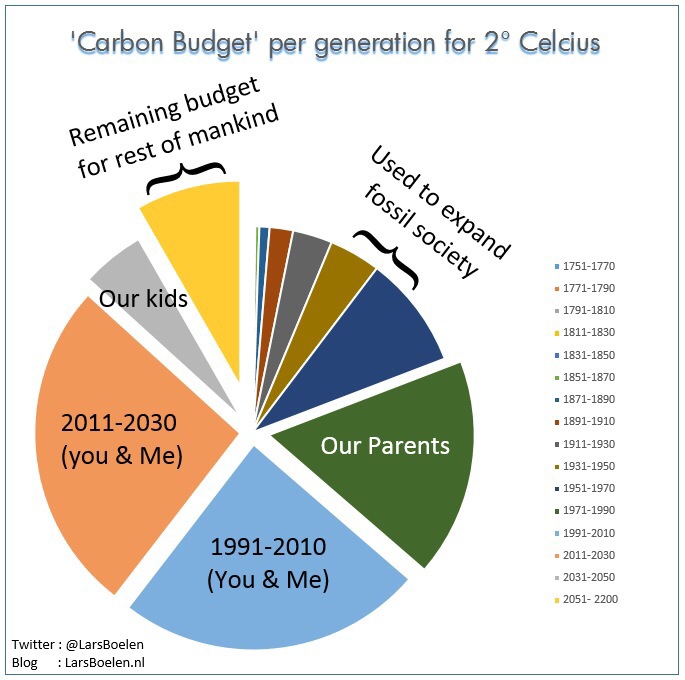
In order to ensure that the climate does not flip to a situation where human life would be drastically reduced, we need to keep warming under 2 degrees. To do that we need to restrict release of climate gasses into the air. Stopping the burgeoning of fossil fuels is one major part of that. But there is some wiggle room, we could maybe burn a little more……. The question is, what are we going to burn it doing?
If you ask me, ( a few do), I would say we need to use it to create sustainable communities that are far less dependent on transportation of goods to and from them. These communities need to have their own renewable sources of energy, and be designed so food and fiber production is carried out close by without the need to burn fossil fuel.
The diagram below explains how much is left. Anyone got a detailed idea of what we could do with it?
Embedded energy and the future of product design

This matrix divides products and services up depending on energy required to make and run them. What will happen as energy prices rise or fossil fuel becomes scarce? Products that require a lot of energy to make and run will less affordable. These “make once, run expensively” types of products will migrate to the quadrants on the right. The “make once, run cheaply” or “make cheaply, use cheaply” will take over. Continue reading “Embedded energy and the future of product design”
 Stephen Hinton Consulting