Is big data and the big network helping humanity reach new heights?

Amid the signals that capitalism is failing and the climate collapsing I wonder if there is not something very positive happening, too.

Something to do with how all the data and the networking we are experiencing are raising our consciousness and understanding. Continue reading “Is big data and the big network helping humanity reach new heights?”

Economists: Make sure to look in the right direction

As a Brit living in a country that drives on the other side, I still have a moment of hesitation crossing the road; looking both ways, both sides. I was about to cross the road yesterday to go to a conference on banking, and as I stopped the thought crossed my mind that maybe economists in the mainstream are so used to one way of doing things that they are not looking in the right direction either. I couldn’t shake the feeling something has been missing. Why have the warnings about climate change not changed anything? How are things different now that the IPCC has put its foot down and stated clearly that we need to exit fossil fuel burning and transition to clean, renewable energy? Maybe low inflation is not the answer, but HIGH inflation? Continue reading “Economists: Make sure to look in the right direction”

We have to do something else with what we have left

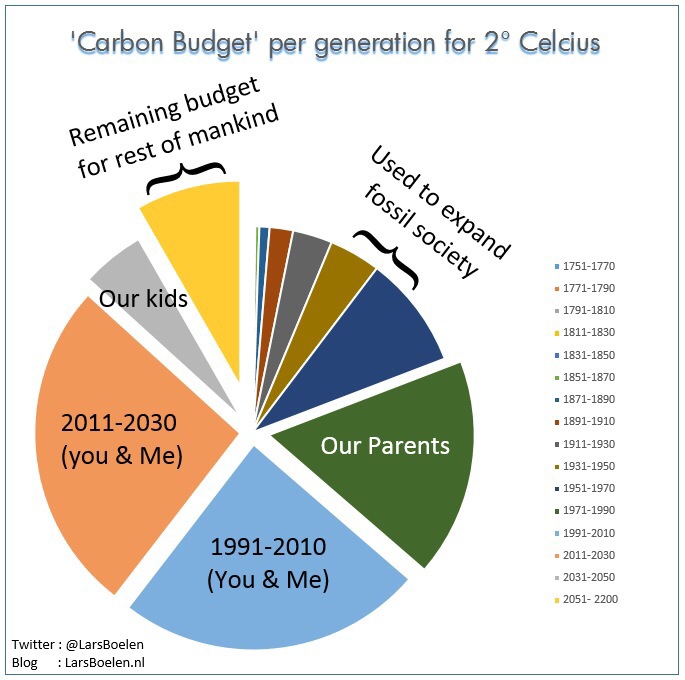
In order to ensure that the climate does not flip to a situation where human life would be drastically reduced, we need to keep warming under 2 degrees. To do that we need to restrict release of climate  gasses into the air. Stopping the burgeoning of fossil fuels is one major part of that. But there is some wiggle room, we could maybe burn a little more……. The question is, what are we going to burn it doing?

If you ask me, ( a few do), I would say we need to use it to create sustainable communities that are far less dependent on transportation of goods to and from them. These communities need to have their own renewable sources of energy, and be designed so food and fiber production is carried out close by without the need to burn fossil fuel.

The diagram below explains how much is left. Anyone got a detailed idea of what we could do with it?

Carbon budget

Fees on raw materials can create circular economy

Just released, the latest version of the Swedish Sustainable Economy Foundation’s White paper presents in detail how nations can usher in the zero emission, no waste society using a special fee mechanism on raw materials. Download the paper from the Foundation’s web site

  People get worried that we should reduce consumerism, as our way of life is driving resource use and emissions. Just reducing will collapse the economy. Instead, the Foundation proposes fees on introduction of raw materials into the economy.  These fees are raised until the consumption and emission of materials ceases. But the money is redirected into  the economy – paid out equally to all taxpayers. This ensures people have money to buy what they need.

The paper is the result of several years’ work, including projects with the Nordic Council of Ministers on Carbon fees and fees on phosphorous and nitrogen.

It is essential reading for those working with the transition of society away from the resource-hungry to the equitable, sustainable future many long for. It provides a sound basis for practical approaches to pricing and managing pollution.

The paper, along with other versions and  the short summary can be downloaded here.

The circular economy can be ushered this way: substances that are not biological of origin ( iron, other metals,  mined substances etc.) cost to enter the system, and the price is raised until they do not leave it. Biological nutrients circulate too, but enter and leave the economy without burdening recipient or reducing ecological maturity of the source. At the same time, money to enable these transactions circulates freely in the opposite direction.


LEARN MORE
The TSSEF website http://tssef.se

Flexible fees, short video

Embedded energy and the future of product design

productmatrix

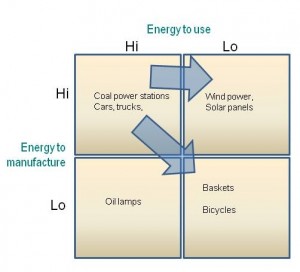
This matrix divides products and services up depending on energy required to make and run them. What will happen as energy prices rise or fossil fuel becomes scarce? Products that require a lot of energy to make and run will less affordable. These “make once, run expensively” types of products will migrate to the quadrants on the right. The “make once, run cheaply” or “make cheaply, use cheaply” will take over. Continue reading “Embedded energy and the future of product design”

CSR means contributing to a world where everyone is fed

To make a real difference in the world, corporations could start supporting food and water security. If everyone contributed to create a food secure world, entrepreneurship, prosperity and then ultimately peace would flourish.

Volunteers for organisations working with food security, like the Water and Food Award, are often told that; “our business isn’t in water and food” so we are not interested in supporting your cause. Continue reading “CSR means contributing to a world where everyone is fed”