

For decades, our economic discourse has been trapped in a false choice between two unsatisfying futures. On one side stands the familiar model of endless economic growth. This path that relentlessly consumes natural resources and risks environmental devastation. On the other is the alternative of degrowth, a concept often perceived as a narrative of reduction, scarcity, and diminished quality of life. This document introduces a third, more inspiring path forward: the pursuit of Real Capital Maturity. This vision reframes our ultimate economic goal not as perpetual expansion, but as the achievement of a stable, high-quality, and regenerative state where the fundamental needs of everyone are met with sufficiency and efficiency.
The Flawed Lens: Why Our Economic Compass is Broken
In policymaking, the framework used to understand the world is not just an academic exercise—it is the compass that guides national and global decisions. A flawed framework, even when paired with the best intentions, can lead to disastrous outcomes. For too long, policymaker have relied on the the practice of economics. Whilst we must always take care of the pennies, prioritizing monetary value above all else, creates a dangerous blind spot for the very systems that support life and society.
This limitation is starkly illustrated by the Nobel Prize-winning work of William Nordhaus, whose economic models concluded that a 3-degree Celsius temperature rise would have only a minimal effect on GDP. This stands in sharp contrast to the dire warnings from the IPCC, which projects devastation if we exceed a 1.5-degree rise. This isn’t an academic disagreement; it’s a catastrophic risk miscalculation embedded in our current economic practice, prioritizing abstract numbers over a habitable planet.
When conventional economics acts as the primary “gatekeeper” for policy, crucial scientific and social insights are often filtered out or dismissed. This reliance on a limited toolkit risks missing the full picture, leading to decisions that are detrimental to society and counter to the very intentions of the policy. To make better decisions, we urgently need a more comprehensive framework that can account for the real world in all its complexity.
A New Framework: Understanding Our “Real Capital”
To build a better, more sustainable future, we must first have an accurate inventory of what we truly possess. The Real Capital Framework (RCF) provides this holistic measurement system, moving beyond purely financial metrics to give a complete picture of our societal wealth. It is built on a clear and powerful definition of capital.
“Something that is used in the production of goods and services to society, but not used up.”
The definition of real capital
This framework categorizes our collective assets into four distinct types, each essential for a functioning and prosperous society:
• Natural Capital: The living layer we all rely on as well as the layer beneath our feet with the minerals and other substances from the lithosphere, natural systems like the climate and water cycle.
• Built Capital: All man-made things that are used to provide our basic needs: houses, roads, factories, equipment, tools etc. This includes systems like telecoms, payments, etc.
• Social Capital: Our organisations and institutions including the knowledge and capability that is in these organisations (i.e., the operational capacity and collective knowledge of our society).
• Human Capital: What we as humans command in terms of strength, knowledge, insights, attitude, capabilities etc. (i.e., the health, skills, and potential of our population).
This isn’t just an accounting exercise; it is the first comprehensive balance sheet of our collective capacity to thrive. Understanding these capitals is the first step toward our ultimate goal: developing them to a state of resilient sufficiency, or “Maturity.”
The Destination: Shifting Our Goal from Growth to Maturity
In nature and in life, growth is a phase, not a permanent state. The logical and desirable state that follows growth is Maturity. Instead of pursuing an endless, undefined, and ultimately unsustainable path of economic expansion, our goal should be to guide our society toward a state of Real Capital Maturity.
Real Capital Maturity is achieved “when it is developed to a stage that it can provide the services needed by the population it is intended to serve.” In other words, it is a state where our collective assets are sufficient to provide for our needs. This shifts the focus from quantity to quality, from expansion to stability, and from accumulation to stewardship.
For example, there are enough houses for all, there are enough food production areas to feed all, the economic system is rigged to people have enough money to live on and so on…
And not just capital to fulfill human needs, but human values as well. If we value nature then there are sufficient habits that are sufficiently protected to ensure biodiversity and protection of vulnerable species.
A Vision of Real Capital at Maturity
| Natural Capital | Built Capital | Social Capital | Human Capital |
| • Fully functioning Natural cycles • Productive and biodiverse forests • Healthy soils • Functioning eco-systems • Minerals, Metals from earth available to all | Infrastructure providing for all, safe, efficient and comfortable: • Housing • Transport • Energy • Food production and distribution • Health and education | Organisations offering: • Gainful, productive employment • Good standard social goods and service • Repositories of know-how and technology • Resilience • Democratic governance • Healthy inclusion | Healthy, productive, skilled, strong, happy, generous, peace-loving & balanced people |
Maturity is a measurable state. It can be expressed as a percentage, where 100% represents a state of sufficiency and responsible stewardship. For example, in the case of mineral capital, maturity is reached “If 100% of metals…that have been mined are either in products (and can be recycled) or in stocks ready for re-use.” This provides a clear, quantifiable target for policy and investment. The critical question, then, is how to bridge the gap between our current state and this inspiring vision of a world at maturity.
The Path Forward: Building a Regenerative Economy
The gap between the current status of our Real Capital and the desired 100% maturity level is not a cause for despair. This gap defines the strategic work plan for the 21st century: a targeted investment program to build our societal wealth to a state of universal sufficiency. The engine for closing this gap is a Regenerative Economy.
A Regenerative Economy is one that “operates to regenerate capital to maturity to ensure that services are sufficient for needs, available for future use and indeed future generations.”
This framework fundamentally changes the task of policymakers. Instead of simply managing growth, their role becomes one of strategic investment to build up our capitals. It allows for a clear identification of where our capitals are degraded or insufficient, enabling policy to steer investment and activities toward capital regeneration and decisively away from capital degeneration. However, this ambitious vision inevitably raises a crucial and practical question that often halts progress before it begins: how can we possibly afford it?
Funding the Future: Why “Affordability” Is Not the Real Constraint
The question of “How do we pay for this?” is the most common and powerful obstacle to transformative change. However, this question is often based on a flawed understanding of government finance. A clearer perspective reveals that the primary constraints on our ability to build a better world are not financial, but physical.
The core insight, clarified by Modern Monetary Theory (MMT), is that a government that issues its own currency has a different set of constraints than a household or a business. As economist Stephanie Kelton states:
“According to MMT, government can spend on what it wants as long as the resources needed to do it are available.”
Stephanie Kelton
For a currency-issuing government, the true limit on spending is not the amount of money it can tax or borrow, but the risk of inflation. Inflation occurs when spending outpaces the real productive capacity of the economy—when there is too much money chasing too few real resources (labour, capital, and natural resources).
This is where the two frameworks lock together to form a new paradigm. MMT teaches us that the real limit is resources, not money. The Real Capital Framework provides, for the first time, the comprehensive national balance sheet of those very resources. RCF is the diagnostic tool that tells us what we can afford to do in real terms; MMT is the financial reality that confirms we can pay for it. The question is no longer “Can we afford it?” but “Do we have the materials, the skills, and the political will to build it?”
A More Compelling Vision: Maturity vs. Degrowth
The graph below (a figurative example) shows what an overall assessment of the state of maturity of real capital might look like for a nation or region, where 100% represents sufficient to meet needs.
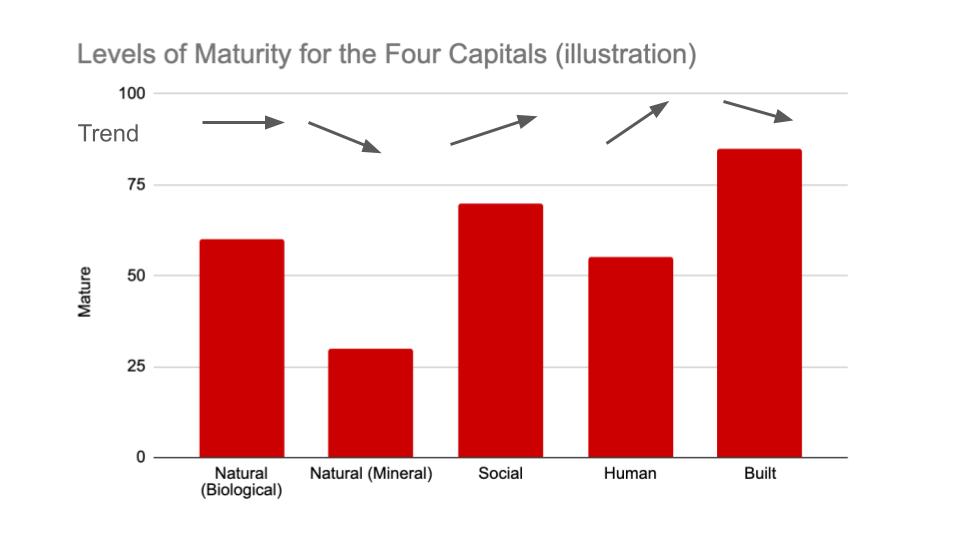
The diagram shows how realcapital based analysis can help policy and prioritisation: It might well be (in the fictive example above) that immature capital that is declining would be more of a priority than the more mature capital that is increasing. Although, context would inform this more. At least there is a basis for discussion and further investigations.
Armed with a clear goal and a correct understanding of our constraints, the vision of Capital Maturity emerges as a far more compelling and proactive alternative to Degrowth. While both concepts challenge the paradigm of endless growth, their framing, focus, and ultimate appeal are worlds apart.
| Degrowth | Capital Maturity | |
| Vision | A vision often focused on reduction, shrinking, and having less. | A vision focused on sufficiency, quality, and having enough for everyone. |
| Posture | A reactive posture, responding to scarcity and ecological limits. | A proactive, goal-oriented posture, building toward a defined state of stability and well-being. |
| Political Framing | Often struggles to build broad coalitions due to a perception of austerity. | Offers a unifying and politically viable vision of prosperity, quality, and security. |
Maturity is not about having less; it is about having enough for everyone. It is about building our Built Capital to a level of sufficiency where everyone has access to safe housing, efficient transport, and quality health and education, powered by clean energy. It is about regenerating our Natural Capital so that it can sustainably provide for generations to come. This aligns perfectly with the wisdom of systems thinker Donella Meadows:
“Development indicators must begin to reflect quality, equity, efficiency, and sufficiency. They must shift emphasis from money to physical units and from quantity of material throughput to quality of life.”
The vision of Real Capital Maturity offers a hopeful, actionable, and inspiring path forward—one that promises not scarcity, but shared and lasting prosperity.
Conclusion: Choosing Sufficiency and Prosperity
We stand at a crossroads, caught between an unsustainable past and an uncertain future. The debate between endless growth and reactive degrowth presents a false choice that has paralyzed progress. By shifting our economic goal from infinite expansion to Real Capital Maturity, we can define a clear, desirable, and achievable destination. By understanding that our true capacity is based on real resources, not arbitrary financial limits, we unlock the means to get there. The choice is ours: to continue managing a system geared for predictable collapse, or to pick up the tools, consult the blueprint, and begin building a regenerative world of shared and lasting prosperity.
There is a discussion on this topic going on at the Swedish Sustainable Economy Foundation, you are welcome to join in.
 Stephen Hinton Consulting