At first glance, Modern Monetary Theory and Doughnut Economics might appear to come from different worlds. MMT is a macroeconomic framework focused on understanding the monetary operations of currency-issuing governments, while Doughnut Economics is a visual framework for sustainable development that balances social foundations against ecological ceilings. Yet beneath these differences lies a profound inter-relatedness that, properly understood, offers a complete framework for addressing the defining challenges of our time.
The development of the Real Capital Framework (RCF) has evolved from a conceptual tool designed to bridge the gap between scientific research and public policy into a rigorous, operational system for managing regional resilience.
Phase 1: Bridging the Science-to-Policy Gap
The initial spark for the Real Capital Framework came from a fundamental frustration with how society translates scientific insights into action. Historically, scientists operated descriptively rather than normatively; they would identify environmental crises but refrain from dictating the exact levels of public investment or policy changes required to solve them. They expected politicians and civil servants to instinctively translate their findings into action.
In reality, these insights rarely reached decision-makers in a format they could understand. RCF was originally developed to bridge this gap, providing a systematic way for local groups to relate their ground-level realities directly to scientific data, allowing information to flow seamlessly “from science to policy and back again”.
Phase 2: Incorporating Modern Monetary Theory (MMT) and Resource Ontology
As the framework developed, we integrated insights from Modern Monetary Theory (MMT), heavily inspired by the realization that the primary constraint in any economy is not monetary wealth, but physical, real-world resources.
To bring precision to this space, RCF established a strict distinction between “capital” and “resources”:
Capital Stocks are assets that are used but not used up in production (such as a power station and its transmission grid).
Resources are the flows that emanate from those capital stocks (such as the electricity transmitting through the lines).
By tying RCF to MMT, the framework expanded beyond a mere scientific communication tool and became a practical methodology for national budgeting and resource-constrained planning.
Phase 3: Partnering with Permaculture and Establishing “Two Ledgers”
As RCF matured, it became clear that while it excelled at measurement, it needed a design counterpart. This led to a conceptual partnership with Permaculture. In this synthesis:
Permaculture serves as the design language, offering heuristics to create permanent, productive social-ecological systems.
RCF serves as the accounting language, defining stocks, maturity, and systemic performance.
During this phase, the framework also solidified its stance on economic accounting. It argued that financial accounting and real capital accounting are complementary, non-competing systems. While financial accounting tracks transactions, monetary claims, and obligations (“What changed in money?”), RCF tracks the actual physical state, condition, and capacity of the region’s stocks—such as soil health, forest maturity, and social trust (“What changed in reality?”).
Phase 4: Merging with ISO 55001 to Create a “Canonical Asset Model”
To move the framework from a high-level policy philosophy to a credible, operational asset management discipline, RCF integrated the structures of ISO 55001. While ISO standardizes the management of physical infrastructure (like roads and bridges), RCF adapted these rules to biological, human, and social assets.
This integration yielded the Canonical Asset Model, ensuring every natural or social asset is treated as a distinct, manageable unit with an explicit register record:
Asset Identity: Unique ID, location, and custodian.
Asset Function: The ecosystem services or human services it provides.
Condition/Maturity: Its current health status relative to its target resilience standard.
Pressures: Tracking both internal degradation (e.g., invasive species) and external degradation (e.g., upstream runoff).
Pressuring Assets: The specific physical infrastructure or entities causing the pressure, creating clear traceability.
Material Actors: The legal owners or operators responsible for those pressuring assets, showing policymakers exactly who needs to be engaged.
Restoration Requirements: A calculated “maintenance backlog” detailing the necessary intervention steps and costs.
Asset Relationships: A map of the ecological interdependences of the asset network.
Phase 5: Designing the Diagnostic Architecture (The Four-Pane Matrix)
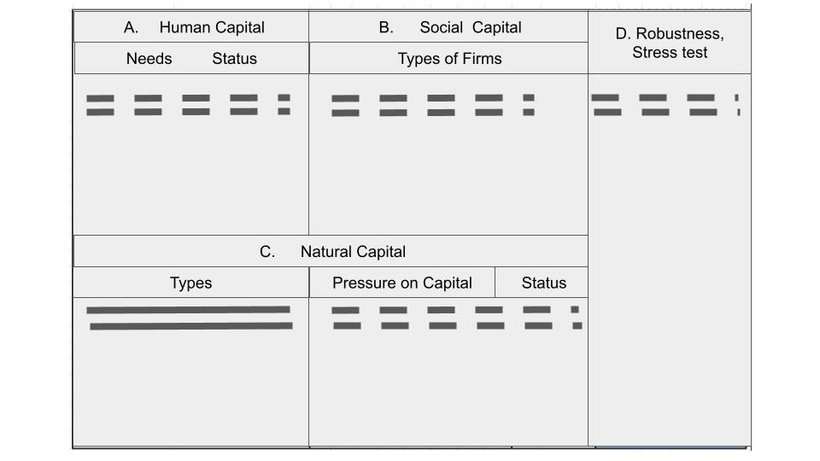
The next evolution was the creation of a diagnostic tool called the Four-Pane Regional Robustness Matrix. It allows regional planners to perform scenario analyses and stress tests by mapping four connected domains:
Pane A (Needs & Benefits): Essential human needs (food, water, housing) and their societal benefits.
Pane B (Industries): The economic sectors responsible for provisioning those needs, evaluating their capacity versus actual distribution performance.
Pane C (Sustainability): The qualitative or quantitative pressures these industries exert on biological and mineral capital stocks, mapped against planetary boundaries.
Pane D (Robustness & Stress Testing): Testing the provisioning pathways against disturbances (e.g., transport cuts, droughts) using four key criteria: multiple backups, diverse pathways, local living systems, and local resources.
Phase 6: The Present-Day Basis for a Regional Resilience Center
Today, RCF serves as the implementation architecture for Regional Resilience Centers, such as the Centro de Resiliencia Austral (CRA) in Chile.
Rather than functioning as static academic institutes, modern resilience centers use the fully matured RCF to act as the custodians of regional capacity. They offer concrete, asset-based resilience services: establishing Regional Real Capital Registers, tracing cross-capital dependencies, and conducting stress tests to direct public and private investments toward interventions that maximize systemic adaptive capacity rather than just short-term GDP
The EU Nature Restoration Regulation changes the conversation in a fundamental way. It is no longer enough to say that nature should be protected in principle; the new question is how restoration will actually be financed, implemented, and distributed across the economy. That is a political question, but it is also an accounting question, because restoration spending does not happen in a vacuum. It moves through firms, households, labour markets, tax systems, and public budgets.
What follows is a simple attempt to make that visible. The point is not that nature can be reduced to a spreadsheet. The point is that if we want to restore ecosystems at scale, we need to understand the financial flows clearly and we need to understand the ecological ones. If we do not, we risk letting a crucial policy debate get trapped in slogans about “cost” while the real economy keeps absorbing the losses from degraded nature.
We risk letting a crucial policy debate get trapped in slogans about “cost” while the real economy keeps absorbing the losses from degraded nature.
From protection to restoration
For many years, environmental policy in Europe was mainly about limiting further damage. That remains important, but it is no longer enough. The Nature Restoration Regulation introduces a more demanding idea: that damaged ecosystems must actively be restored, not merely left in a slow decline.
That is a major shift. It means governments can no longer treat ecological degradation as an externality that sits quietly outside the budget. Restoration now becomes a concrete obligation, with long time horizons, practical trade- offs, and real financial consequences. The debate therefore moves from “should we act?” to “how do we pay for it, and who carries the burden?”
Nature is productive capital
One reason this debate matters is that nature is not just a background condition for the economy. It is part of the economy’s productive base. Healthy soils, pollinators, clean water, stable climate conditions, forests, and biodiversity all support production in ways that are often invisible until they start to fail.
When natural systems deteriorate, the costs do not remain confined to the environment ministry. They show up in agriculture, infrastructure, insurance, public health, and regional development. A weakened ecosystem means weaker economic capacity. In that sense, restoration is not a luxury add- on to growth policy; it is maintenance of the productive foundations that growth depends on.
This is why it helps to think in terms of real capital.
Real capital is that which is used in provision of goods and services but not used up.
Real capital has functions and capacity. If a road is not maintained, it deteriorates. If a forest is not managed sustainably, its capacity changes. The same logic applies to ecosystems. They are not endlessly renewable in practice, and once their functions are damaged, the cost of recovery rises. A simple example would be straightening a river. The function of dealing with flood water is low compared to a meandering river.
The four capitals are presented in the table below:
Capital Maturity
The concept of maturity is that capital is mature when it has the functions and capacity to fulfill human needs and values. In the case of nature restoration and pollinators, nature is mature when it can support the pollinators and the pollinators are sufficient to pollinate crops.
Capital, or an asset, can be considered mature when it has functions and capacity able to be employed to serve values and needs at a sufficient level to all citizens.
This is where maturity helps us connect nature and economics.
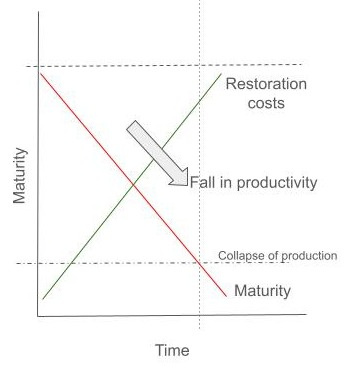
The diagram below explains these concepts. As the maturity of the natural resource declines, so does productivity, resulting eventually in a collapse of production. This has a cost. At the same time, a restoration budget is accumulated, rather like accumulated maintenance costs.
A note on “valuation”: This approach deliberately avoids trying to assign a market price to nature’s services. The critical concept here is “gap value.” The question isn’t “What is a pollinator worth?” but rather “What does it cost to restore the pollination function to a sufficient, mature state?” This is a practical, non-ideological way to frame the problem.
Why the finance question is often framed badly
The standard way to discuss restoration is to ask: where will the money come from? That sounds reasonable, but it can hide more than it reveals. In public finance, the question is not whether a government can “find” euros in some household sense. The real questions are whether resources exist, whether labour and materials can be mobilised, and whether spending is directed toward productive outcomes.
That is why the financing debate should not start with accounting panic. A restoration programme does not magically create forests, wetlands, or biodiversity. But it can mobilise workers, landowners, firms, planners, and public authorities around a deliberate investment in ecological repair. The central issue is therefore coordination, not money in the abstract.
The Godley-table logic
This is where a sectoral balance perspective becomes useful. A Godley table is simply a way of showing how flows move between sectors of the economy. Government spending becomes income for firms and households. Wages generate tax payments and consumption. Consumption generates VAT. Bonds may be issued to manage reserves or financial flows. The key point is that one sector’s spending is another sector’s income.
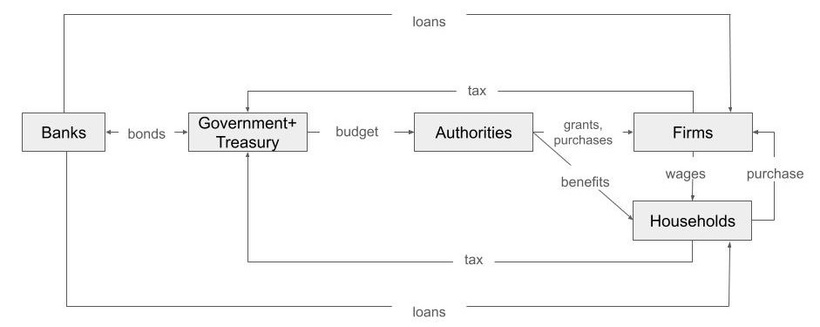
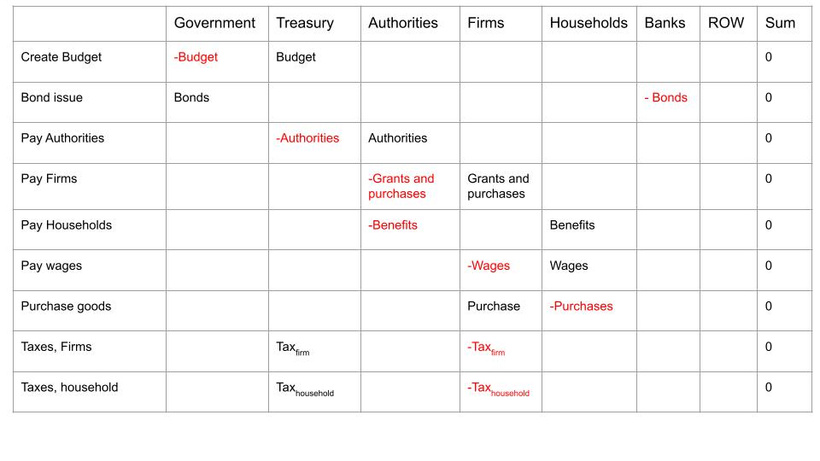
The diagram below illustrates main flows.
The government approves the budget, and puts money in the accounts of the aouthortites, who pay firms and private individuals. These individuals purchase goods, and firms and households pay money in tax. Banks lend to the government via bond schemes and loans to firms and households.
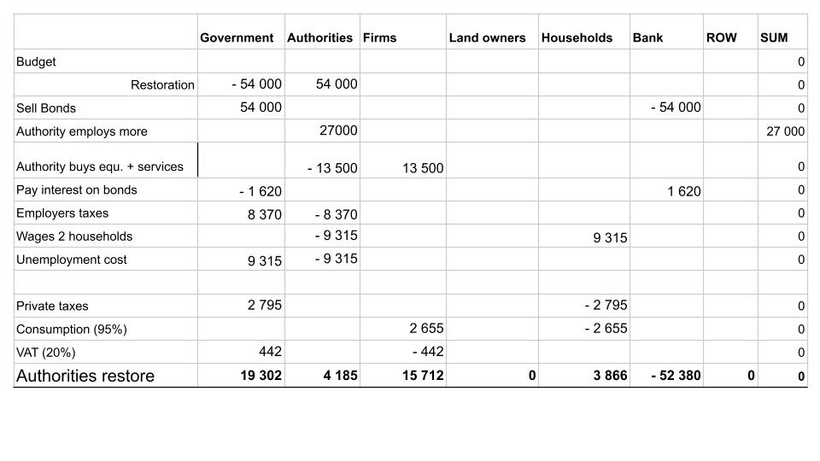
These kinds of diagrams may mislead, as economist Wynne Godley pointed out. Financial flows are ALWAYS one account gets debited, the other credited. Let us draw the above out in a Godley table to illustrate. The horizontal row should always add up to zero. ROW means rest of the world, which we have left out for simplicity.
It is important to see this table as a “snapshot” of a complex system. As a static table, it captures the initial and immediate financial circulations. However, it misses the important feedback loops—like how improved natural capital later increases agricultural productivity, which then boosts firm revenues and tax income. To capture those dynamic effects, we would need a more advanced system dynamics model.
How to model material flows and the effects of mature capital
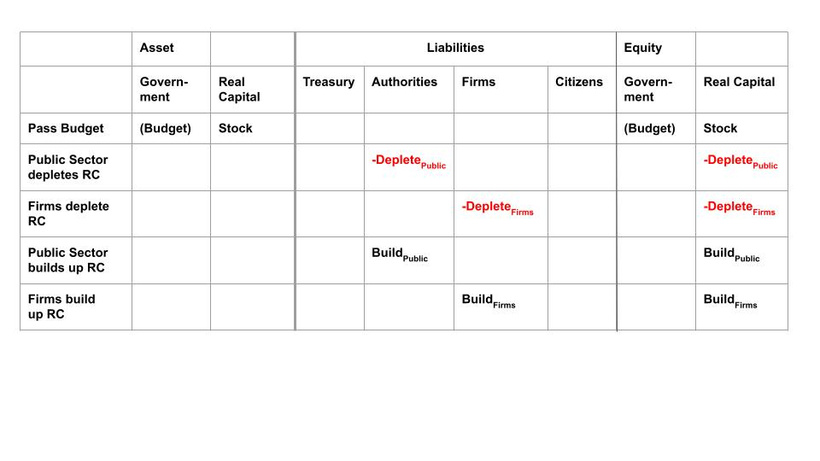
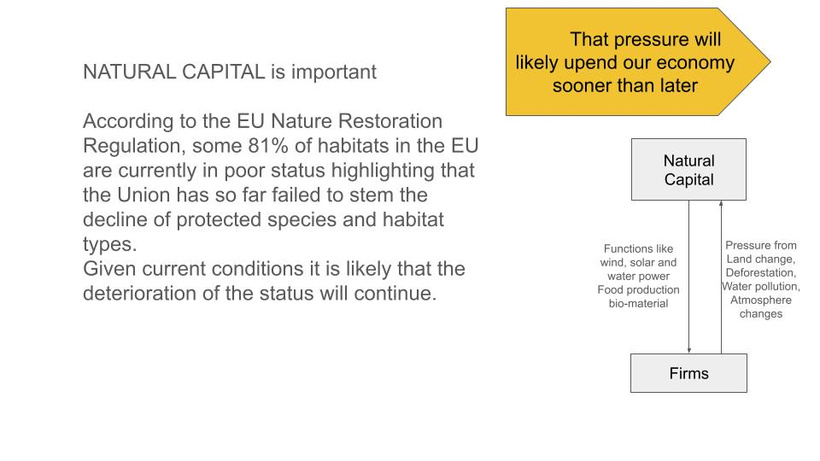
Financial flows always miss out material flows – that would be comparing chalk and cheese. It would work if for every harvest, nature sent an invoice! However, there ARE two important dependencies. The activities of firms use materials and services from nature, and many deplete natural capital. The diagram, adapted from the previous one adds this dimension.
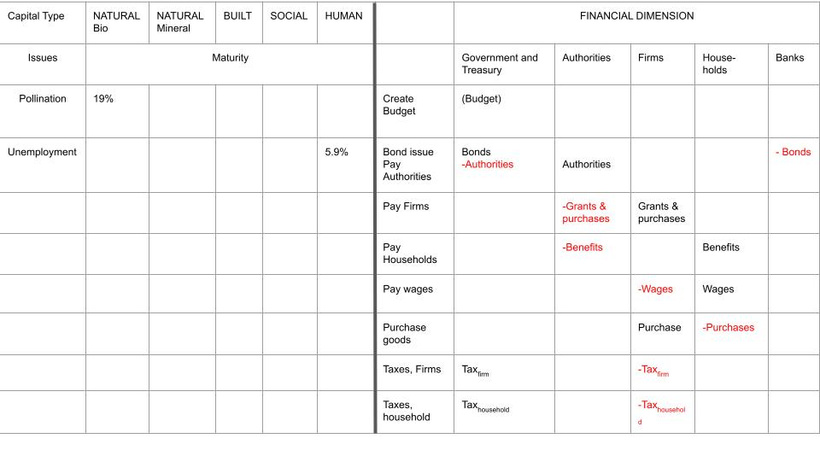
It is possible to put real capital columns next to Godley Tables to gain a better understanding of the impact of resources on the economy. The concept of capital (or you could say asset ) maturity is useful here.
In the diagram above, we have added real capital columns. We use percentages to illustrate the concept. Say for example, a certain real asset X is immature. That will affect production, which may reduce both spending and tax returns. This is especially if the firm lets workers go because it lacks resources or ecosystem services.
In the pollinator example, a 19% maturity will affect production ( that which is purchased from firms). At the same time, there are costs for unemployment which increases the budget.
Considering real capital status should, then, inform budget preparation. Before national budgets are compiled, a full analysis of resources should be undertaken.
That leads to questions like: “Should the budget include unemployment benefits, or should it be spent on job creation? Should nature be restored, or not?”
Failure to restore nature will, in the long run, destroy the productivity of the firms relying on its materials and/or functions and increase losses to the firm.
Unemployment must be budgeted for. If we are talking food production, the whole system would become unable to fulfill basic needs if pressure from firms continues. As time goes on, without restoration or removal of pressures from firms, the cost of restoration will increase.
Applied to restoration, this means public spending on ecological repair is not just a line in a budget. It supports capability to provide the basics. It is a flow that supports employment, contracts for firms, income for households, and tax receipts for the state. Some of the spending leaks back through taxes. Some circulates as wages and purchases. Some creates productive capacity that remains after the initial outlay.
That does not mean restoration is “free.” It means the real economic question is not whether expenditure occurs, but what it produces. If public funds are used to restore ecosystems that support food production, flood protection, and long-term resilience, then the spending should be judged against the losses avoided and the capacity created.
A Swedish example
Let us make this concrete. Suppose Sweden needs to finance a restoration programme linked to pollinator decline, habitat repair, and wider ecosystem recovery. The starting point is not a fantasy of unlimited money. It is the reality that there are unemployed people, underused labour, and ecological damage that already imposes costs on the economy.
A program like this could work through familiar channels. The state commissions restoration work. Firms carry out the work. Workers are employed. Wages are paid. Those wages feed into household consumption. Consumption generates tax revenue and VAT. Landowners and local actors may also be involved, depending on the design. The result is a circular flow where restoration is not simply “spending against nature,” but a way of rebuilding the material base that supports production.
Let us explore the case of pollinator restoration. The budget is 5.4 billion kronor, about a quarter of the total budget. The loss of pollinators would devastate real natural capital depriving it of pollination services for maybe half of the types of crops grown, decimate biodiversity by depriving birds of the insects they eat. Furthermore, without removing the pressures on pollinating insects from chemical use and land use, the situation would only become even worse.
Modelling the extra money in the budget
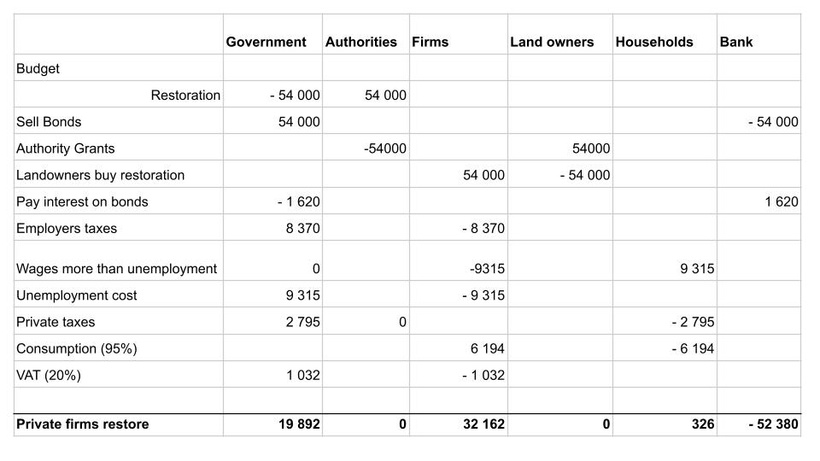
The table below shows how an increase in public spending cascades through the economy. We constructed this scenario using standard percentages, with the budgeted 5.4 billion SEK for pollinator restoration.
The example below assumes that the extra budget means unemployed workers are employed, and the cost of employment is reduced by this. From the top, the budget is decided for the restoration, and the money paid to authorities who create grants for landowners. These landowners employ firms to do the work, and the firms create new jobs, we assume, increasing the income of households which in turn increases their spending (we assume they save 5%). This results in taxes coming back to the Treasury, in this case the government column.
In this example, the government issues bonds which banks acquire from reserves. We calculate a nominal 3% interest on the bonds.
Already from the example above you can see what happens when the budget is applied: money comes back as tax and the government account is positive. Firms have a net gain and so do households. The government has sold bonds which are time-limited and will have to be bought back. However, the money came from the banking sector’s reserves and will not affect firms or households.
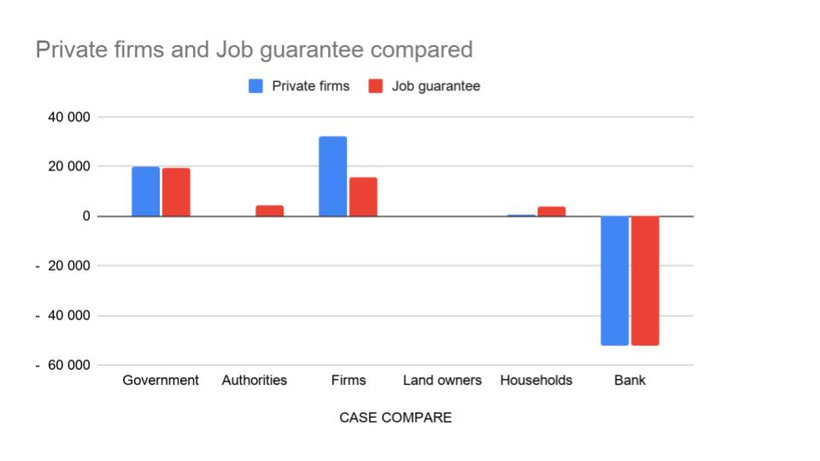
One crucial decision is who carries out the restoration. The model above uses private firms. An alternative, which many favor for efficiency, is a direct public employment model—a Job Guarantee. In this approach, the government authority itself becomes the employer, mobilising unemployed workers directly. This can be more cost-effective by cutting out profit margins and administrative overhead. It also directly addresses the social goal of reducing unemployment.
The graph below illustrates the differences in the approaches.
As might be expected, authorities gain in the job guarantee case, and firms in the firm case. There is more for households in the job guarantee version, as less money flows to private capital.
Inflation will not happen.
In either case, the spending is safe from an inflationary perspective. Sweden currently has hundreds of thousands of unemployed and underutilized labour. By using these idle resources, the government can boost economic activity and ecological health without creating the classic “too much money chasing too few goods” scenario that triggers inflation.
In the Swedish case, the important point is that ecological restoration can be aligned with domestic employment and regional development. That is politically important. A program framed only as environmental compensation risks resistance. A program framed as productive investment in resilience, food security, and employment is much harder to dismiss.
What can we learn from this example?
Although this is a stylised example, using rough percentages, it illustrates the workings of an economy prioritizing nature through paying market actors and using idle resources.
Unemployment decreases, in this case there are some 500 000 unemployed, and this could create 25 000 jobs, a decrease of 5%5% .
Production is secured, averting a possible food crisis.
Companies have developed the capacity to continue to restore nature.
Banks get interest for lending from reserves
Nature and biodiversity are restored, giving production as well as resilience.
The government ends with a net positive position (14,404 million SEK in this simplified scenario), showing that a significant portion of the initial outlay recirculates back to the treasury. The net cost to the state is far lower than the headline figure.
Why should the state carry the cost?
This is where the political argument begins. Restoration should not be financed in a way that hides responsibility or shifts all burden onto ordinary households. At the same time, it is unrealistic to pretend that all costs can be pushed onto a single group of actors, whether that is taxpayers, landowners, or specific industries.
The fair approach is usually a mix. Public budgets can fund core restoration work. Sector- specific rules can require those who generate pressure on ecosystems to contribute more. Agricultural policy, land- use regulation, environmental liability, and targeted subsidies can all play a role. The important thing is to avoid pretending that one clean mechanism will solve a problem that is inherently mixed, historical, and structural.
We see from the example above that the state can take the lead and make things happen. They can then introduce new or increase old taxes to cement the changes and avoid inflation from putting too much money into the economy. However, the most powerful argument for state-led action is not about “finding money,” but about coordination. The state is the only institution with the mandate and scale to identify the “gap value” (the cost of restoring ecosystem functions to a mature state), plan a national response, and mobilise the unemployed resources to achieve it.
Timing matters. The longer restoration is delayed, the more expensive it becomes. Once habitats collapse further, the cost of repair rises and some damage becomes harder to reverse. In other words, delay is not neutral. It is a policy choice that creates a larger bill later.
The bigger economic point
The most important thing to understand is that the Nature Restoration Regulation is not just an environmental directive. It is a test of whether governments are willing to treat ecological systems as essential infrastructure. If nature is part of the productive base, then restoration is not a side issue. It is economic policy.
It is critical to distinguish between the financial logic and the ecological outcome. The purpose of this exercise is not to show that restoration is “profitable” in a narrow accounting sense. The financial flow is the tool. The real goal is ecological resilience. A restored wetland, for example, provides flood protection and biodiversity. This resilience is a public good that doesn’t show up in a standard financial statement. The financial argument is a necessary but not sufficient condition. It helps us understand how to pay for restoration without breaking the economy, so that we can achieve the non-negotiable goal of a healthy, functioning planet.
That does not mean every project will be easy, or that every budget constraint disappears. It means the debate should be honest about what is being financed and why. The real choice is not between “saving nature” and “protecting the economy.”
The real choice is between investing in the systems that sustain the economy, or allowing those systems to deteriorate until the costs are larger, more unevenly distributed, and harder to repair.
If we want a functioning economy in the long run, then we need functioning ecosystems. That is the financial logic, the ecological logic, and the political logic all at once.
This is just the beginning of a crucial conversation. Integrating real capital into our economic models is a significant step forward. The next step is to explore these dynamic feedbacks using tools like system dynamics models (e.g., Minsky) to better understand how investment in natural capital creates long-term resilience.
Not in the markets—you won’t see it on a stock ticker. Not in central banks—you won’t hear it in a rate decision. But in the intellectual foundations of the economy itself, a quiet revolt is underway.
For decades, we’ve been told a simple story:
Manage the money supply, and you manage the economy.
Let markets self-organise, and society will benefit.
Pursue growth, and prosperity will trickle down.
That story is now being challenged—not by fringe activists, but by the UN, leading economists, and global research institutions. And in the summer of 2026, three major initiatives landed almost simultaneously, all pointing in the same direction: the economy needs rewriting.
1. The UN’s “Beyond Growth” Roadmap: Growth is Not the Solution
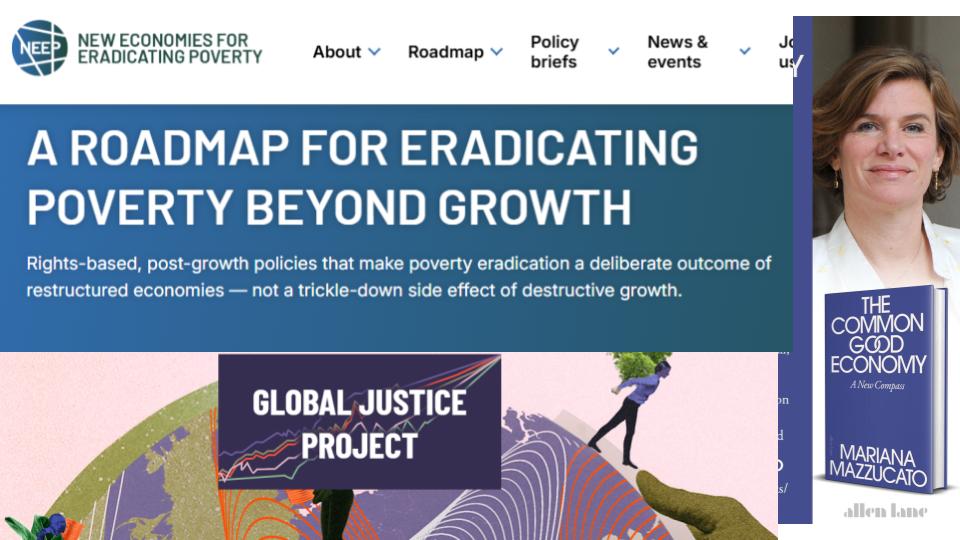
In June 2026, the UN Special Rapporteur on extreme poverty released a striking document: The Roadmap for Eradicating Poverty Beyond Growth.
Its core provocation? Economic growth is no longer a reliable path out of poverty.
The report explicitly rejects the long-held assumption that “growth = progress,” arguing that this belief is now “neither realistic nor sustainable.” [ohchr.org]
Instead, it lays out around 80 policy measures designed to:
reduce inequality,
strengthen public services,
and decouple poverty reduction from GDP growth. [ohchr.org]
The roadmap calls for a“human rights economy”—one that puts well-being and planetary limits at the center, rather than production and consumption. [srpoverty.org]
Even more radical: it argues that our current growth-driven model is actively fueling inequality, weakening democracy, and damaging the planet. [ohchr.org]
This is not tinkering. It is a direct challenge to the idea that markets, left alone, will deliver broad prosperity.
2. The Global Justice Project: Equality First, Not Markets First
Just days earlier, economists associated with the World Inequality Lab launched the Global Justice Report.
If the UN report is a policy roadmap, this is a full-blown alternative economic vision.
Its starting point: We cannot solve climate change, inequality, or instability within the current economic framework.
The report proposes a radical reordering of priorities:
drastic reductions in global inequality,
shorter working hours,
massive redistribution through global wealth taxes,
A fair and sustainable world is possible—but only if inequality is reduced dramatically and systematically. [globaljust….wid.world]
The report also dismisses GDP as the primary measure of success, arguing that prosperity must be measured in terms of well-being within planetary limits. [newsline.com]
This is a frontal assault on the idea that markets, driven by individual self-interest, will naturally converge on the best outcomes.
Instead, it suggests the opposite: unchecked markets produce outcomes incompatible with both democracy and planetary survival.
3. Mariana Mazzucato’s “Common Good Economy”: Markets Must Be Shaped
At the same time, one of the world’s most influential economists, Mariana Mazzucato, is publishing The Common Good Economy (rolling out globally through 2026).
Her argument is as sharp as it is simple: Markets are not natural systems to be managed—they are tools to be designed.
For decades, governments have treated “the good” (public services, environmental protection) as a correction to markets. Mazzucato calls this a trap.
Instead, she proposes:
designing markets around collective goals from the outset,
aligning business, finance, and public policy around shared missions,
She rejects the passive role of government in traditional economics:
The state should not just fix market failures—it should actively shape markets. [hachettebo…kgroup.com]
Her “common good compass” reframes the economy as a purpose-driven system, not a spontaneous outcome of private incentives.
What’s Really Being Challenged
Taken together, these three initiatives form a pattern.
They all reject the same three pillars of old economic thinking:
1. The “invisible hand” is enough
The idea that markets self-organise into efficient and beneficial outcomes—dating back to Adam Smith—is now under heavy criticism. Even modern research suggests markets can be fragile, unstable, and prone to cascading crises. [arxiv.org]
2. Growth fixes everything
The “growth-first” model is being reframed as part of the problem:
it can increase inequality,
degrade ecosystems,
and fail to improve real living conditions for many. [ohchr.org]
3. Managing money equals managing society
Macroeconomic policy—interest rates, inflation, fiscal deficits—has long been seen as the main lever of control. But these new frameworks argue that structure matters more than flows:
Who owns what
Who decides what gets produced
And who benefits from it
A New Economic Imagination Is Emerging
What makes this moment remarkable is not just the ideas themselves, but their convergence.
A UN roadmap
A global inequality research coalition
And a mainstream bestselling economist
…are all saying versions of the same thing:
The economy is not a neutral system. It is a political and social construction—and it must be rebuilt.
The Provocation
Here’s the uncomfortable thought:
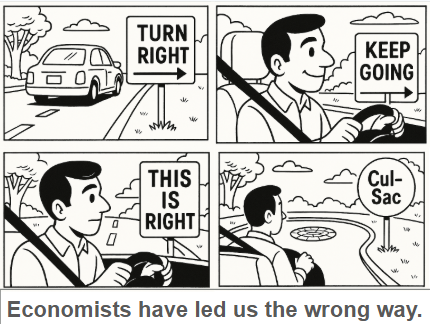
What if the traditional economic “common sense” we’ve relied on for 40 years was never neutral science—but a set of assumptions that fit a particular era?
And what if that era—of globalisation, cheap resources, and faith in markets—is ending?
Because if these summer 2026 interventions are right, then the real question is no longer:
Human Provisioning Systems (HPS) is a proposed scientific and professional discipline dedicated to understanding, designing, and governing how human societies meet fundamental human needs within biophysical and social limits.
For decades, our economic discourse has been trapped in a false choice between two unsatisfying futures. On one side stands the familiar model of endless economic growth. This path that relentlessly consumes natural resources and risks environmental devastation. On the other is the alternative of degrowth, a concept often perceived as a narrative of reduction, scarcity, and diminished quality of life. This document introduces a third, more inspiring path forward: the pursuit of Real Capital Maturity. This vision reframes our ultimate economic goal not as perpetual expansion, but as the achievement of a stable, high-quality, and regenerative state where the fundamental needs of everyone are met with sufficiency and efficiency.
This is a letting my heart out moment and I can’t promise it is going to be coherent. But I see some very important things that have happened recently as stakes in the new ground of economic thinking and in politics. There is a challenge laid down to find something new, built out of the old
Most national budgets tell us how much money governments plan to spend and collect. But they rarely say anything about whether the nation’s forests are thriving, its infrastructure is decaying, or whether citizens are healthy and capable of sustaining the next generation’s wellbeing.
In other words, the budget tracks the money — but not the real foundations of value that the money is meant to mobilize.
That missing link is what the Real Capital Framework was created to address.
Communicating science to policy makers in a way they will understand and action science-based insights requires more than just presenting figures. The process is multi-layered, multi-dimensional and multi-discipline.
Our methodology briefing brings together all the tools needed to develop your abilities in this area.
In the face of ecological degradation, infrastructure stress, and social fragility, national budgets remain mired in outdated accounting frameworks. They report in money terms only, largely ignoring the real capacities that sustain economic life. But what if we treated the productive and regenerative capacities of Real Capital—ecosystems, infrastructure, human health, and institutional systems—as central to budgeting itself?