
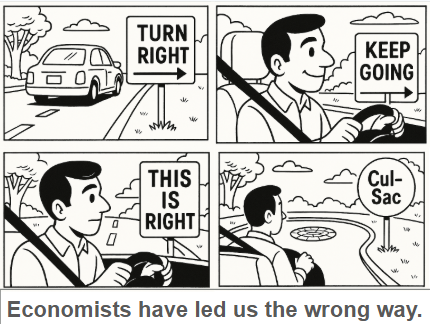
Something strange is happening in economics.
Not in the markets—you won’t see it on a stock ticker. Not in central banks—you won’t hear it in a rate decision. But in the intellectual foundations of the economy itself, a quiet revolt is underway.
For decades, we’ve been told a simple story:
- Manage the money supply, and you manage the economy.
- Let markets self-organise, and society will benefit.
- Pursue growth, and prosperity will trickle down.
That story is now being challenged—not by fringe activists, but by the UN, leading economists, and global research institutions. And in the summer of 2026, three major initiatives landed almost simultaneously, all pointing in the same direction: the economy needs rewriting.
1. The UN’s “Beyond Growth” Roadmap: Growth is Not the Solution
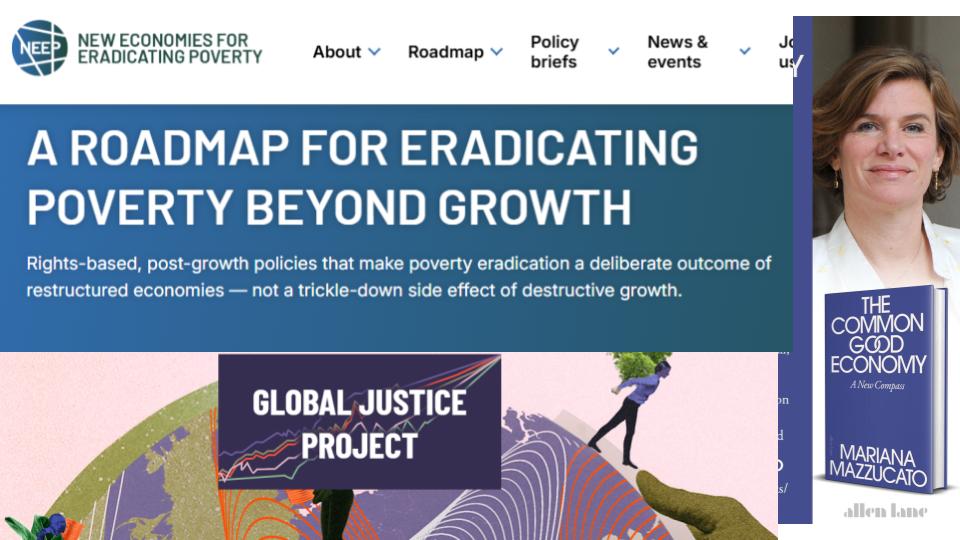
In June 2026, the UN Special Rapporteur on extreme poverty released a striking document: The Roadmap for Eradicating Poverty Beyond Growth.
Its core provocation?
Economic growth is no longer a reliable path out of poverty.
The report explicitly rejects the long-held assumption that “growth = progress,” arguing that this belief is now “neither realistic nor sustainable.” [ohchr.org]
Instead, it lays out around 80 policy measures designed to:
- reduce inequality,
- strengthen public services,
- and decouple poverty reduction from GDP growth. [ohchr.org]
The roadmap calls for a“human rights economy”—one that puts well-being and planetary limits at the center, rather than production and consumption. [srpoverty.org]
Even more radical: it argues that our current growth-driven model is actively fueling inequality, weakening democracy, and damaging the planet. [ohchr.org]
This is not tinkering. It is a direct challenge to the idea that markets, left alone, will deliver broad prosperity.
2. The Global Justice Project: Equality First, Not Markets First
Just days earlier, economists associated with the World Inequality Lab launched the Global Justice Report.
If the UN report is a policy roadmap, this is a full-blown alternative economic vision.
Its starting point: We cannot solve climate change, inequality, or instability within the current economic framework.
The report proposes a radical reordering of priorities:
- drastic reductions in global inequality,
- shorter working hours,
- massive redistribution through global wealth taxes,
- and a shift towards what it calls“sufficiency”—less consumption, but higher well-being. [globaljust….wid.world]
Perhaps the most explosive claim:
A fair and sustainable world is possible—but only if inequality is reduced dramatically and systematically. [globaljust….wid.world]
The report also dismisses GDP as the primary measure of success, arguing that prosperity must be measured in terms of well-being within planetary limits. [newsline.com]
This is a frontal assault on the idea that markets, driven by individual self-interest, will naturally converge on the best outcomes.
Instead, it suggests the opposite:
unchecked markets produce outcomes incompatible with both democracy and planetary survival.
3. Mariana Mazzucato’s “Common Good Economy”: Markets Must Be Shaped
At the same time, one of the world’s most influential economists, Mariana Mazzucato, is publishing The Common Good Economy (rolling out globally through 2026).
Her argument is as sharp as it is simple: Markets are not natural systems to be managed—they are tools to be designed.
For decades, governments have treated “the good” (public services, environmental protection) as a correction to markets.
Mazzucato calls this a trap.
Instead, she proposes:
- designing markets around collective goals from the outset,
- aligning business, finance, and public policy around shared missions,
- and ensuring value is created and shared collectively. [marianamazzucato.com]
She rejects the passive role of government in traditional economics:
The state should not just fix market failures—it should actively shape markets. [hachettebo…kgroup.com]
Her “common good compass” reframes the economy as a purpose-driven system, not a spontaneous outcome of private incentives.
What’s Really Being Challenged
Taken together, these three initiatives form a pattern.
They all reject the same three pillars of old economic thinking:
1. The “invisible hand” is enough
The idea that markets self-organise into efficient and beneficial outcomes—dating back to Adam Smith—is now under heavy criticism.
Even modern research suggests markets can be fragile, unstable, and prone to cascading crises. [arxiv.org]
2. Growth fixes everything
The “growth-first” model is being reframed as part of the problem:
- it can increase inequality,
- degrade ecosystems,
- and fail to improve real living conditions for many. [ohchr.org]
3. Managing money equals managing society
Macroeconomic policy—interest rates, inflation, fiscal deficits—has long been seen as the main lever of control.
But these new frameworks argue that structure matters more than flows:
- Who owns what
- Who decides what gets produced
- And who benefits from it
A New Economic Imagination Is Emerging
What makes this moment remarkable is not just the ideas themselves, but their convergence.
- A UN roadmap
- A global inequality research coalition
- And a mainstream bestselling economist
…are all saying versions of the same thing:
The economy is not a neutral system. It is a political and social construction—and it must be rebuilt.
The Provocation
Here’s the uncomfortable thought:
What if the traditional economic “common sense” we’ve relied on for 40 years was never neutral science—but a set of assumptions that fit a particular era?
And what if that era—of globalisation, cheap resources, and faith in markets—is ending?
Because if these summer 2026 interventions are right, then the real question is no longer:
“How do we grow the economy?”
But:
“What is the economy actually for?”
And that is a far more dangerous question.

