At first glance, Modern Monetary Theory and Doughnut Economics might appear to come from different worlds. MMT is a macroeconomic framework focused on understanding the monetary operations of currency-issuing governments, while Doughnut Economics is a visual framework for sustainable development that balances social foundations against ecological ceilings. Yet beneath these differences lies a profound inter-relatedness that, properly understood, offers a complete framework for addressing the defining challenges of our time.
These books are not simply “books about sustainability.” Together they describe the intellectual territory from which the Real Capital Framework emerges:
ecological limits → systems → stocks and development → design → management → economics → law and governance → regional application.
The Real Capital Framework begins with a simple proposition: human wellbeing and economic activity ultimately depend upon real stocks and capacities. These include the condition of natural systems, the built environment, human capabilities and the social institutions that enable people to cooperate. The works in this reading list provide complementary perspectives on how these systems function, how they interact, the limits within which they operate, how they can be designed, and how they can be managed for the long term.
For a region, this perspective shifts attention from economic activity alone to the underlying condition and maturity of the real capital upon which that activity—and the wellbeing and resilience of the population—ultimately depend.
Not in the markets—you won’t see it on a stock ticker. Not in central banks—you won’t hear it in a rate decision. But in the intellectual foundations of the economy itself, a quiet revolt is underway.
For decades, we’ve been told a simple story:
Manage the money supply, and you manage the economy.
Let markets self-organise, and society will benefit.
Pursue growth, and prosperity will trickle down.
That story is now being challenged—not by fringe activists, but by the UN, leading economists, and global research institutions. And in the summer of 2026, three major initiatives landed almost simultaneously, all pointing in the same direction: the economy needs rewriting.
1. The UN’s “Beyond Growth” Roadmap: Growth is Not the Solution
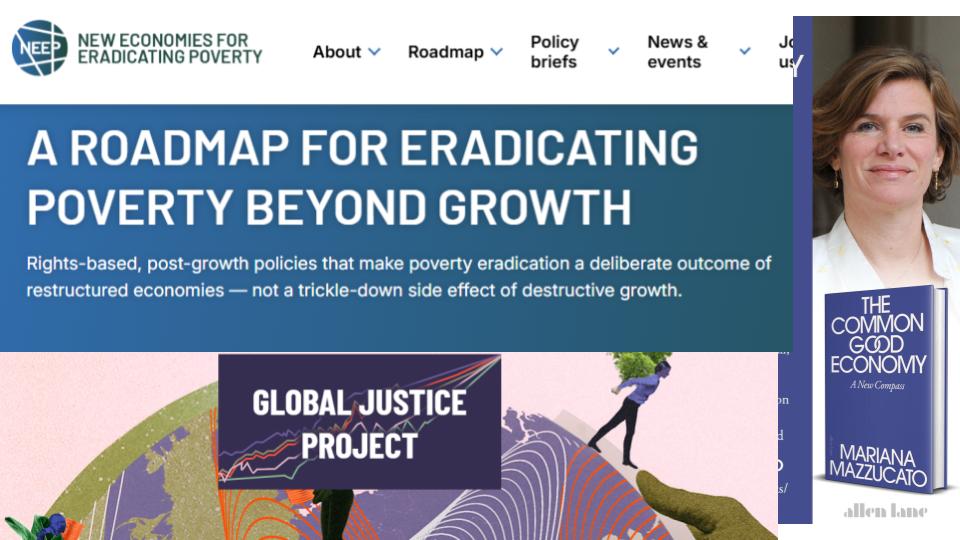
In June 2026, the UN Special Rapporteur on extreme poverty released a striking document: The Roadmap for Eradicating Poverty Beyond Growth.
Its core provocation? Economic growth is no longer a reliable path out of poverty.
The report explicitly rejects the long-held assumption that “growth = progress,” arguing that this belief is now “neither realistic nor sustainable.” [ohchr.org]
Instead, it lays out around 80 policy measures designed to:
reduce inequality,
strengthen public services,
and decouple poverty reduction from GDP growth. [ohchr.org]
The roadmap calls for a“human rights economy”—one that puts well-being and planetary limits at the center, rather than production and consumption. [srpoverty.org]
Even more radical: it argues that our current growth-driven model is actively fueling inequality, weakening democracy, and damaging the planet. [ohchr.org]
This is not tinkering. It is a direct challenge to the idea that markets, left alone, will deliver broad prosperity.
2. The Global Justice Project: Equality First, Not Markets First
Just days earlier, economists associated with the World Inequality Lab launched the Global Justice Report.
If the UN report is a policy roadmap, this is a full-blown alternative economic vision.
Its starting point: We cannot solve climate change, inequality, or instability within the current economic framework.
The report proposes a radical reordering of priorities:
drastic reductions in global inequality,
shorter working hours,
massive redistribution through global wealth taxes,
A fair and sustainable world is possible—but only if inequality is reduced dramatically and systematically. [globaljust….wid.world]
The report also dismisses GDP as the primary measure of success, arguing that prosperity must be measured in terms of well-being within planetary limits. [newsline.com]
This is a frontal assault on the idea that markets, driven by individual self-interest, will naturally converge on the best outcomes.
Instead, it suggests the opposite: unchecked markets produce outcomes incompatible with both democracy and planetary survival.
3. Mariana Mazzucato’s “Common Good Economy”: Markets Must Be Shaped
At the same time, one of the world’s most influential economists, Mariana Mazzucato, is publishing The Common Good Economy (rolling out globally through 2026).
Her argument is as sharp as it is simple: Markets are not natural systems to be managed—they are tools to be designed.
For decades, governments have treated “the good” (public services, environmental protection) as a correction to markets. Mazzucato calls this a trap.
Instead, she proposes:
designing markets around collective goals from the outset,
aligning business, finance, and public policy around shared missions,
She rejects the passive role of government in traditional economics:
The state should not just fix market failures—it should actively shape markets. [hachettebo…kgroup.com]
Her “common good compass” reframes the economy as a purpose-driven system, not a spontaneous outcome of private incentives.
What’s Really Being Challenged
Taken together, these three initiatives form a pattern.
They all reject the same three pillars of old economic thinking:
1. The “invisible hand” is enough
The idea that markets self-organise into efficient and beneficial outcomes—dating back to Adam Smith—is now under heavy criticism. Even modern research suggests markets can be fragile, unstable, and prone to cascading crises. [arxiv.org]
2. Growth fixes everything
The “growth-first” model is being reframed as part of the problem:
it can increase inequality,
degrade ecosystems,
and fail to improve real living conditions for many. [ohchr.org]
3. Managing money equals managing society
Macroeconomic policy—interest rates, inflation, fiscal deficits—has long been seen as the main lever of control. But these new frameworks argue that structure matters more than flows:
Who owns what
Who decides what gets produced
And who benefits from it
A New Economic Imagination Is Emerging
What makes this moment remarkable is not just the ideas themselves, but their convergence.
A UN roadmap
A global inequality research coalition
And a mainstream bestselling economist
…are all saying versions of the same thing:
The economy is not a neutral system. It is a political and social construction—and it must be rebuilt.
The Provocation
Here’s the uncomfortable thought:
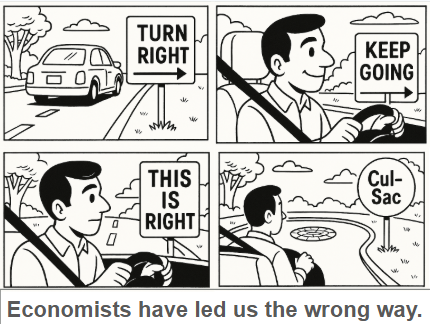
What if the traditional economic “common sense” we’ve relied on for 40 years was never neutral science—but a set of assumptions that fit a particular era?
And what if that era—of globalisation, cheap resources, and faith in markets—is ending?
Because if these summer 2026 interventions are right, then the real question is no longer:
Human Provisioning Systems (HPS) is a proposed scientific and professional discipline dedicated to understanding, designing, and governing how human societies meet fundamental human needs within biophysical and social limits.
For decades, our economic discourse has been trapped in a false choice between two unsatisfying futures. On one side stands the familiar model of endless economic growth. This path that relentlessly consumes natural resources and risks environmental devastation. On the other is the alternative of degrowth, a concept often perceived as a narrative of reduction, scarcity, and diminished quality of life. This document introduces a third, more inspiring path forward: the pursuit of Real Capital Maturity. This vision reframes our ultimate economic goal not as perpetual expansion, but as the achievement of a stable, high-quality, and regenerative state where the fundamental needs of everyone are met with sufficiency and efficiency.
Most national budgets tell us how much money governments plan to spend and collect. But they rarely say anything about whether the nation’s forests are thriving, its infrastructure is decaying, or whether citizens are healthy and capable of sustaining the next generation’s wellbeing.
In other words, the budget tracks the money — but not the real foundations of value that the money is meant to mobilize.
That missing link is what the Real Capital Framework was created to address.
I really recommend listening to this Youtube with Richard Murphy, Emeritus Professor of Accounting Practice and John Christensen, co-founder of the Tax Justice Network.
The subject was the idea of homo economicus – the supposed rational economic actor at the heart of mainstream economics – and its critics.
John traces the origins of the concept back to the late nineteenth century, when economics shifted from being a branch of moral philosophy into the mathematically-driven neoclassical framework most of us were taught at university.
One of the key figures was Francis Ysidro Edgeworth, a mathematician and economist at Oxford. Edgeworth drew on Jeremy Bentham’s utilitarian philosophy – the idea that human beings are rational calculators of pleasure and pain – Edgeworth sought to create a perfectly tidy model of human behaviour. We were, he argued, calculating machines engaged in constant cost-benefit analysis, each of us pursuing our own utility.
Modern models of the economy, like – the DSGE models used by the Bank of England and the UK Office for Budget Responsibility – still rest on the fiction of a single rational agent – or homo economicus – who knows everything and always restores balance.
And these models continue to shape policy. They produce neat forecasts that always return to equilibrium, because the assumptions guarantee that outcome. They are sadly blind to the lived reality of power, inequality, exploitation and environmental breakdown.
Investors in peace, one of my projects, something else. We don’t see homo economicus, we see homo pax. Our true nature is peace and as long as we don’t realise and get to enjoy and appreciate that, we will continue to be homo errorum leading to homo insatisfactus (man of error, unsatisfied man).
This is where Investing in peace and political economy overlap: as long as economics and business continue to model their art on misguided views of what it is to be human, they will continue to guide policy in the wrong direction.
If you are working with economic policy we urge you to look closer at yourself: what is it you really want, what is driving you? Can it be that is something you share with the rest of the people on the planet?
The Real Capital framework bridges the gap between scientific insights and policy-making. It critiques traditional economic models for undervaluing non-monetary assets (e.g., ecosystems, social systems) and proposes a methodology to quantify and manage Natural, Built, Human, and Social Capital for sustainable decision-making.
Communicating science to policy makers in a way they will understand and action science-based insights requires more than just presenting figures. The process is multi-layered, multi-dimensional and multi-discipline.
Our methodology briefing brings together all the tools needed to develop your abilities in this area.