
Introduction
At first glance, Modern Monetary Theory and Doughnut Economics might appear to come from different worlds. MMT is a macroeconomic framework focused on understanding the monetary operations of currency-issuing governments, while Doughnut Economics is a visual framework for sustainable development that balances social foundations against ecological ceilings. Yet beneath these differences lies a profound inter-relatedness that, properly understood, offers a complete framework for addressing the defining challenges of our time.
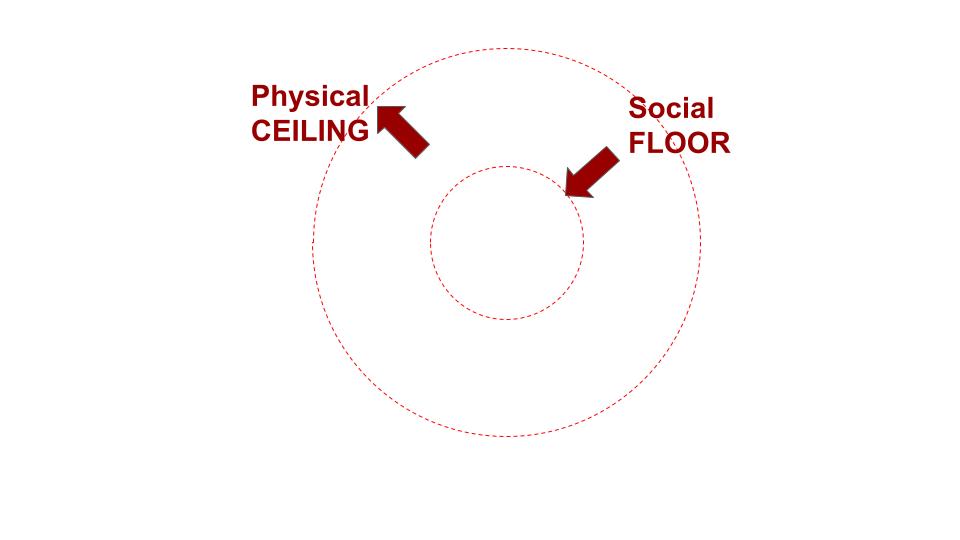
The Doughnut’s boundary and social floor
This essay is written for followers of both traditions—not to argue that either is complete on its own, but to demonstrate how each strengthens the other where it is weakest. The goal is to provide a starting point for genuine dialogue between communities that share more common ground than they might realise.
The Core Insight: Money is Not the Constraint
The most fundamental contribution MMT makes to Doughnut Economics is dissolving the false funding question. Doughnut Economics insists there is a social foundation below which no human being should fall—housing, food, healthcare, meaningful work. But when policy proposals to achieve this foundation are made, the inevitable question arises: “How do you pay for it?”
MMT provides a definitive answer: a currency-issuing government faces no financial barrier to funding the social foundation. As MMT scholars have consistently argued, the real constraint on government spending is never money, but real resources—labour, materials, technology, and ecological systems . This is not a minor clarification; it is transformative for how Doughnut policy proposals are received politically.
The implications are stark and unambiguous. MMT insists that a sovereign government that issues its own currency can always create the money needed to provision itself and run the economy . Therefore, leaving people below Raworth’s social foundation is never an economic necessity—it is always a political choice.
Where the Frameworks Overlap
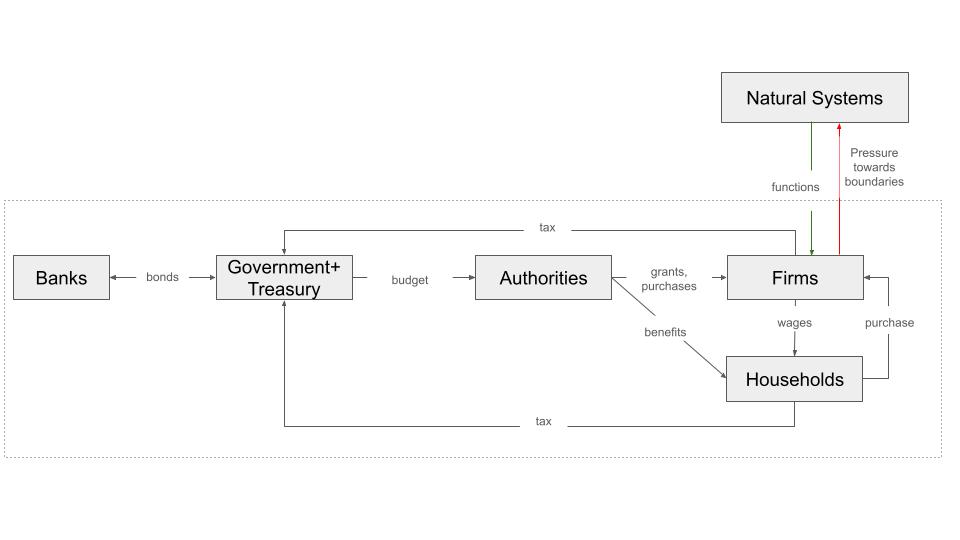
The diagram above shows the flow of money from left to right starting with the government budget at the beginning of the year, through the services provided by firms, the pressure of the firms on natural systems as a result of their activities.
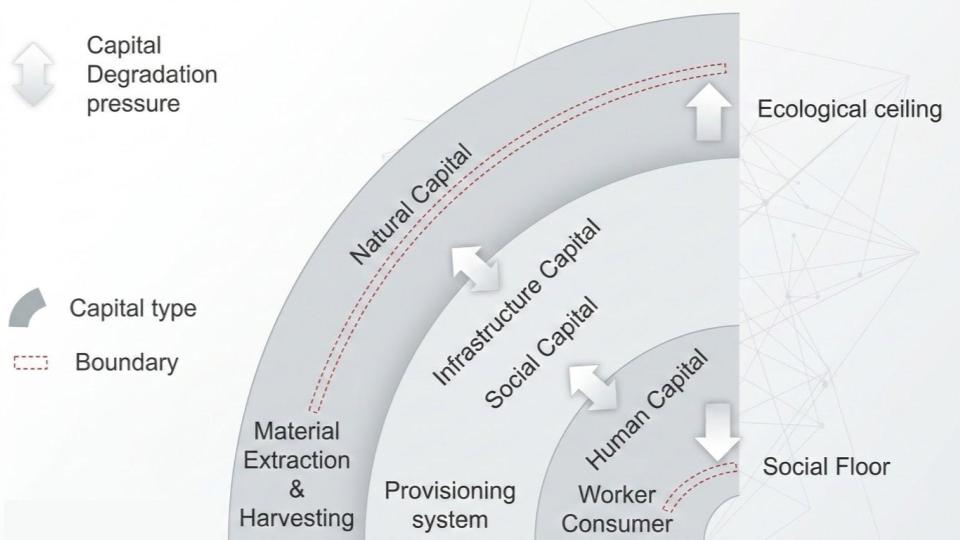
The diagram above shows a more detailed interpretation of the doughnut, using the four main capitals:
Human capital represents citizens’ many roles as workers, customers, dependants, etc. The social floor requires a firm (private or otherwise) to ensure the floor is stable.
A firm is social capital and uses built capital – tools, machines, buildings, etc in its operations.
This built capital in turn puts the pressure on natural capital, which includes the natural processes that make up the nine planetary boundaries.
The point is that a nation’s annual budget can either be planned to restore or deplete the natural capital represented in the boundaries.
The monetary operations involved in this are explained in the section below on Godley tables.
Rejecting GDP as the Goal
Both frameworks are deeply sceptical of GDP growth as the measure of success. Doughnut Economics argues that GDP is blind to both social damage and ecological destruction; it counts activities like pollution cleanup as positive economic activity while ignoring the destruction of natural capital. MMT scholars, for their part, have been scathing about mainstream economics treating financial metrics as if they were real outcomes .
The Job Guarantee as a Transition Tool
MMT’s Job Guarantee—a permanent, federally funded programme that supplies voluntary employment opportunities on demand at a living wage—is arguably the most powerful policy tool ever proposed for guaranteeing the social foundation Doughnut Economics describes . It would ensure that nobody falls below the social floor while simultaneously providing a buffer stock of employed labour that helps maintain price stability.
Crucially, a Job Guarantee could be the mechanism that makes the transition to a Doughnut economy politically feasible . Workers displaced from ecologically destructive industries could be offered meaningful employment in socially useful activities, ensuring that nobody loses their livelihood during the shift toward sustainability . This addresses one of the most politically sensitive aspects of environmental transition—the fear that ordinary people will bear the costs while others continue to benefit from the status quo.
Where Doughnut Economics Strengthens MMT
MMT’s core insight that real resources are the true constraint is profound, but the framework has not always been explicit about naming ecosystem limits as one binding constraint. Doughnut Economics has done considerably more work on:
- Defining specific planetary boundaries—climate, biodiversity loss, fresh water, soil integrity
- Measuring ecological overshoot concretely—quantifying how far human activity has pushed beyond safe operating limits
- Communicating the ecological ceiling visually and accessibly—the doughnut diagram itself is a powerful tool for making complex systems thinking comprehensible
This is not a minor gap. If real resources are the true constraint, then a framework that does not rigorously account for what those resources are and how they are being depleted is incomplete. MMT needs the ecological specificity Doughnut Economics provides to complete its own logic.
The Godley Table Extended: Accounting for Physical Resources
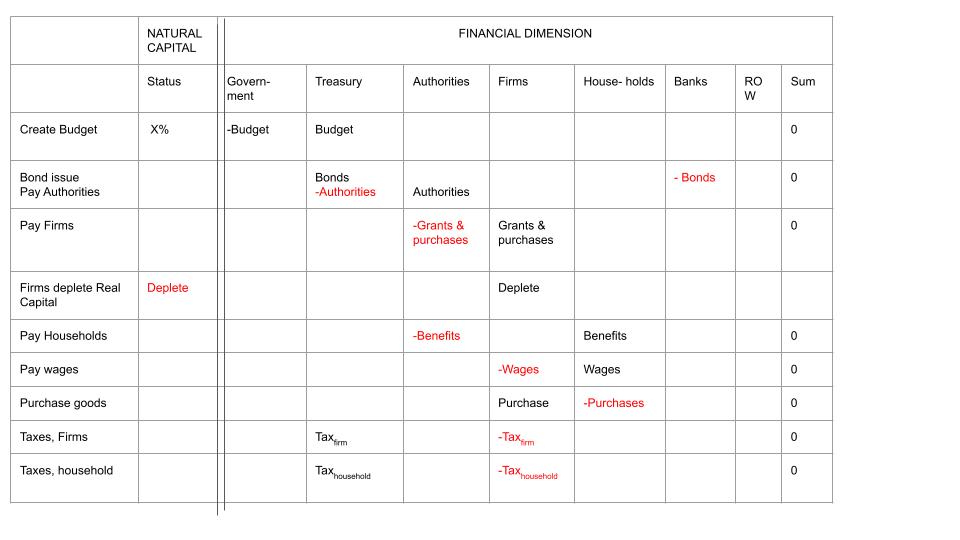
One of the most powerful analytical tools in MMT is the sectoral balances framework—the Godley table—which tracks net financial flows between sectors of the economy: the domestic private sector, the government sector, and the external sector . This framework reveals that the sectors must sum to zero: one sector’s deficit is another’s surplus.
Here is where a genuinely novel synthesis becomes possible. The Godley table can be extended to include a physical sector—tracking real ecological stocks and flows of natural capital alongside financial ones. This is line four. At the end of each accounting period, one would measure whether the physical sector’s stock has gone up or down, just as one measures whether a financial sector is in surplus or deficit.
The power of this dual-register approach is profound. Consider a government that:
- Creates money that flows to firms
- Allows those firms to deplete ecosystems for profit
- Taxes those profits
- Knows the ecosystem—the ultimate real resource base—is being permanently destroyed
A traditional Godley table would show the financial sector looking fine—government deficits creating private sector surpluses. The physical sector table would show the real balance sheet deteriorating, with ecosystem stocks declining year on year. The gap between those two pictures reveals the hidden subsidy that polluting industries currently enjoy: they book the financial gains in one register while the losses appear in a register nobody is officially watching .
This extended accounting framework would give Raworth’s ecological ceiling the same analytical rigour that Godley tables give to financial balances. It would make the slow buildup of ecological overshoot visible in standard economic accounting terms before tipping points arrive.
The Betrayal of Authority: A Political Choice, Not Economic Necessity
Perhaps the most significant implication of this synthesis is its political conclusion. A government that understands both frameworks and still permits ecosystem depletion is making a conscious political choice, not facing an economic necessity.
MMT’s own logic demands this conclusion :
- Money is not the constraint ✓
- Real resources are the constraint ✓
- Ecosystems are the foundation of all real resources ✓
- Therefore, knowingly depleting them whilst having the monetary power to prevent it is a betrayal of sovereign responsibility ✓
The government’s authority to tax—which MMT describes as the foundational act of monetary sovereignty, creating the unemployment that drives demand for the currency—derives from its role as steward of the nation’s resources and wellbeing. If that same government knowingly permits ecosystem depletion as a budgetary strategy—expecting firms to profit from resource extraction in order to generate taxable activity—then it is using its sovereign monetary power in a way that undermines the very resource base that makes that power meaningful.
This is not just a policy error. It is a fundamental contradiction at the heart of fiscal policy. A government that genuinely understood MMT and acted consistently with it would recognise that no depletion needs to happen—and that allowing it to happen anyway is a choice, not a necessity .
Conclusion: A Complete Framework
Doughnut Economics tells you what the boundaries are—both the social foundation and the ecological ceiling. MMT tells you that a currency-issuing government has no monetary excuse for failing to stay within them. Together, they form something neither achieves alone: a complete framework where the social floor is guaranteed, the ecological ceiling is respected, and the funding question is permanently answered.
Scholarly work is already moving in this direction . Researchers are exploring how MMT’s insights can inform a degrowth transition, shifting from a “pay for” frame to a “resource” frame while centring abundance before limits . The job guarantee, universal public services, taxation, and credit regulation are being discussed as complementary policies that can address both social and ecological crises simultaneously .
The synthesis is not merely theoretical. It has practical implications for how we understand government responsibility. A government that permits ecosystem depletion while having the monetary power to prevent it is not responding to economic necessity—it is making a deliberate political choice. Naming that choice is the first step toward demanding a different one.
For followers of both traditions, this is where dialogue can begin—not from a place of defending territory, but from recognising that each framework supplies what the other lacks. The social foundation Doughnut Economics insists on can be funded because MMT shows the money is always available. The ecological ceiling Doughnut Economics defines can be respected because MMT’s resource logic demands that it be measured and accounted for.
The tools exist. The choice is political.

