

The development of the Real Capital Framework (RCF) has evolved from a conceptual tool designed to bridge the gap between scientific research and public policy into a rigorous, operational system for managing regional resilience.
Phase 1: Bridging the Science-to-Policy Gap
The initial spark for the Real Capital Framework came from a fundamental frustration with how society translates scientific insights into action. Historically, scientists operated descriptively rather than normatively; they would identify environmental crises but refrain from dictating the exact levels of public investment or policy changes required to solve them. They expected politicians and civil servants to instinctively translate their findings into action.
In reality, these insights rarely reached decision-makers in a format they could understand. RCF was originally developed to bridge this gap, providing a systematic way for local groups to relate their ground-level realities directly to scientific data, allowing information to flow seamlessly “from science to policy and back again”.
Phase 2: Incorporating Modern Monetary Theory (MMT) and Resource Ontology
As the framework developed, we integrated insights from Modern Monetary Theory (MMT), heavily inspired by the realization that the primary constraint in any economy is not monetary wealth, but physical, real-world resources.
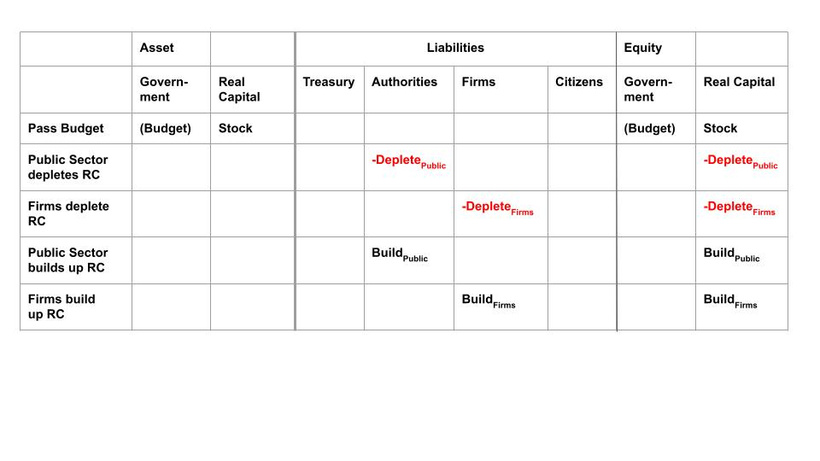
To bring precision to this space, RCF established a strict distinction between “capital” and “resources”:
- Capital Stocks are assets that are used but not used up in production (such as a power station and its transmission grid).
- Resources are the flows that emanate from those capital stocks (such as the electricity transmitting through the lines).
By tying RCF to MMT, the framework expanded beyond a mere scientific communication tool and became a practical methodology for national budgeting and resource-constrained planning.
Phase 3: Partnering with Permaculture and Establishing “Two Ledgers”
As RCF matured, it became clear that while it excelled at measurement, it needed a design counterpart. This led to a conceptual partnership with Permaculture. In this synthesis:
- Permaculture serves as the design language, offering heuristics to create permanent, productive social-ecological systems.
- RCF serves as the accounting language, defining stocks, maturity, and systemic performance.
During this phase, the framework also solidified its stance on economic accounting. It argued that financial accounting and real capital accounting are complementary, non-competing systems. While financial accounting tracks transactions, monetary claims, and obligations (“What changed in money?”), RCF tracks the actual physical state, condition, and capacity of the region’s stocks—such as soil health, forest maturity, and social trust (“What changed in reality?”).
Phase 4: Merging with ISO 55001 to Create a “Canonical Asset Model”
To move the framework from a high-level policy philosophy to a credible, operational asset management discipline, RCF integrated the structures of ISO 55001. While ISO standardizes the management of physical infrastructure (like roads and bridges), RCF adapted these rules to biological, human, and social assets.
This integration yielded the Canonical Asset Model, ensuring every natural or social asset is treated as a distinct, manageable unit with an explicit register record:
- Asset Identity: Unique ID, location, and custodian.
- Asset Function: The ecosystem services or human services it provides.
- Condition/Maturity: Its current health status relative to its target resilience standard.
- Pressures: Tracking both internal degradation (e.g., invasive species) and external degradation (e.g., upstream runoff).
- Pressuring Assets: The specific physical infrastructure or entities causing the pressure, creating clear traceability.
- Material Actors: The legal owners or operators responsible for those pressuring assets, showing policymakers exactly who needs to be engaged.
- Restoration Requirements: A calculated “maintenance backlog” detailing the necessary intervention steps and costs.
- Asset Relationships: A map of the ecological interdependences of the asset network.
Phase 5: Designing the Diagnostic Architecture (The Four-Pane Matrix)
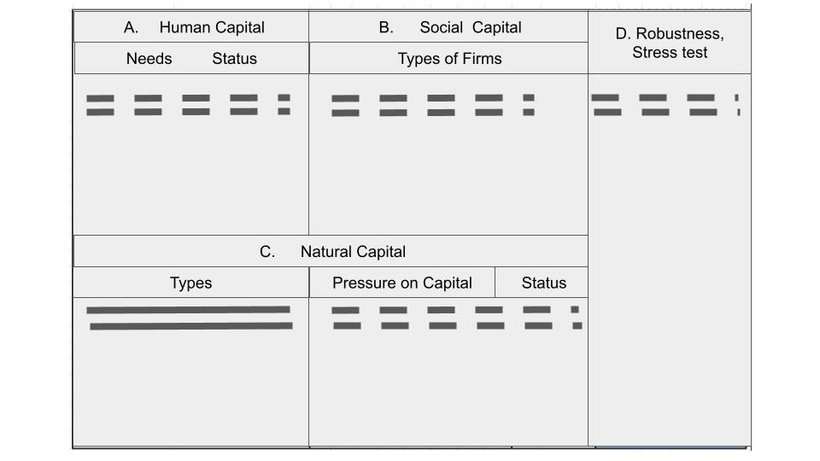
The next evolution was the creation of a diagnostic tool called the Four-Pane Regional Robustness Matrix. It allows regional planners to perform scenario analyses and stress tests by mapping four connected domains:
- Pane A (Needs & Benefits): Essential human needs (food, water, housing) and their societal benefits.
- Pane B (Industries): The economic sectors responsible for provisioning those needs, evaluating their capacity versus actual distribution performance.
- Pane C (Sustainability): The qualitative or quantitative pressures these industries exert on biological and mineral capital stocks, mapped against planetary boundaries.
- Pane D (Robustness & Stress Testing): Testing the provisioning pathways against disturbances (e.g., transport cuts, droughts) using four key criteria: multiple backups, diverse pathways, local living systems, and local resources.
Phase 6: The Present-Day Basis for a Regional Resilience Center
Today, RCF serves as the implementation architecture for Regional Resilience Centers, such as the Centro de Resiliencia Austral (CRA) in Chile.
Rather than functioning as static academic institutes, modern resilience centers use the fully matured RCF to act as the custodians of regional capacity. They offer concrete, asset-based resilience services: establishing Regional Real Capital Registers, tracing cross-capital dependencies, and conducting stress tests to direct public and private investments toward interventions that maximize systemic adaptive capacity rather than just short-term GDP

