A more holistic way of thinking about value. A truly thriving society is built on four key pillars.
- Natural Capital
- Built Capital
- Social Capital
- Human Capital

A more holistic way of thinking about value. A truly thriving society is built on four key pillars.
To be part of developing our culture towards peace, it is vital we all gain an awareness of what our culture is. And why we need to be actively involved with its evolution. This article presents culture as a group’s way of living that emerges and adapts over time. We will seek to explore, in coming articles, how we as individuals can influence our culture towards peace. For now, let us explore this concept of culture. It has many dimensions that interact with each other. We may find places we as individuals, or as the groups we are involved in, where we can intervene to orient our way of life more towards peace.
Continue reading “We need to first understand our culture before we can change it”I’ve been at it a long time. Working on the circular economy. From advising the Swedish Circular Economy Delegation, to working on the circular region at the university in Gävle, Sweden, to creating an online education for county administrators. Thinking to put it all in a book, I started collecting fragments into Google’s experimental NotelbookLM. Of course, it offered to do a podcast summary of it all.
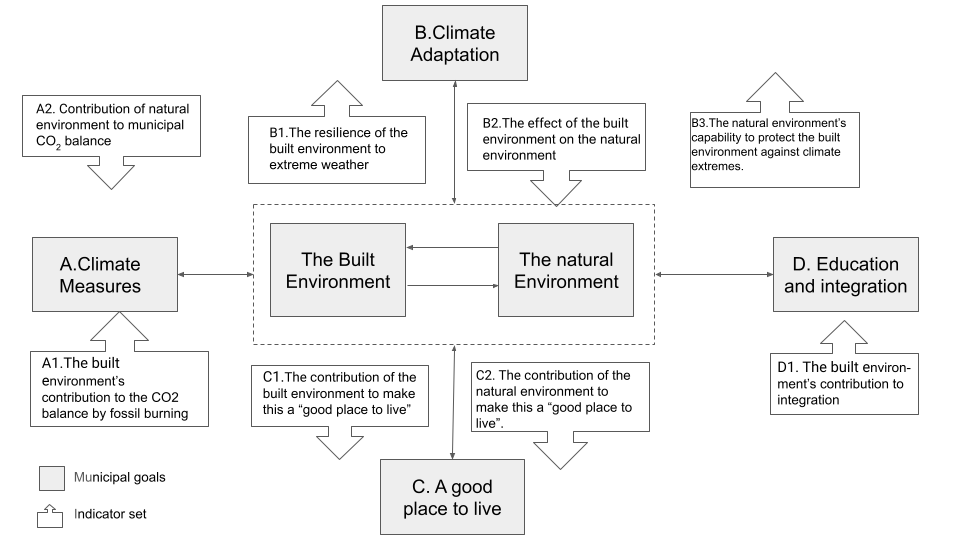
Continue reading “AI summarizes my circular economy work in 13 minutes”Readers will recall we produced a proposal for indicators for municipalities. A dashboard would help local politicians understand how the built infrastructure was affecting the living environment and how the environment was affecting society. The first proposal is illustrated below.
Development of AI tools is progressing at breakneck speed. One tool we have tried is Google’s NotebookLM. The tool works as the name suggests, you create a “page” of a notebook about a specific subject, and load up “sources” of information about the subject. Sources are pdfs, web pages, etc.
Continue reading “Does AI “get” peace? Listen to the AI generated podcast before you make up your mind.”Pattern language is a concept that describes a structured method of solving recurring problems in a specific context by using standardized solutions, or “patterns.” Each pattern is a tried-and-tested solution to a common issue that can be reused across different situations, forming a “language” of solutions.
All over the world, alternatives to the fossil-addicted way of living are up and running. However, these alternatives are rarely featured or communicated as they are drowned out by predominant paradigm of industrial capitalism.
Continue reading “Pattern language is useful in communicating alternatives that work.”For those readers who have followed the articles in the category Multi Capital and its focus on Real Capital, you’ll have probably seen me attempting to get to a framework with which to create decision basis for policy. A decision basis that does not rely on economic information alone.
Continue reading “Real Capital Framework: a deep dive podcast”When we think about buying a home, what’s the first thing that comes to mind? For most of us, it’s the price. How much does the house cost? How much can I afford? Will it be a good investment in the long run?
But what if we shifted our focus slightly? What if, instead of getting caught up in bidding wars and paying far above the asking price, we thought about how we could actually invest in the house itself? And we’re not talking about expensive countertops or high-end appliances. We’re talking about investing in the home’s environmental performance.
Continue reading “Time for banks to join the sustainability transformation”Does a good life entail pursuing progress? As a local politician my focus is turning to adapting society to extreme weather. And a supportive, inclusive culture. Kindness is good for a feeling of well-being.
As a local politician I’ve been involved in dialogue around strategy for 2025. The process will result in a plan to be agreed in September this year (2024) for next year. My group is responsible for the built environment – in Sweden the municipality has a monopoly on built environment planning as well as domestic waste, which brings great responsibility with it. Faced with the fact that warnings from the IPCC have gone unheeded, (use of fossil fuels has increased year on year) we concluded that our #1 priority is to prepare for the consequences of 1.5 degrees. Ideas on pursuing “progress” seem so last century. But how do you put a management system in place to achieve preparedness? How do you ensure a place is good one to live in? Can we have prosperity as our aim?
Continue reading “What is a municipality to do? Abandon “progress” would be a reasonable strategy.”A look at the passenger miles produced in the Swedish transport system reveals some interesting statistics. When you add the CO2 emissions per transport type you get even more interesting insights.
The graph below comes from the transport statistics authority for transport within Sweden. And the nature protection agency.

In terms of CO2 emissions, the one transport type that dominates is the one that produces a greater proportion of emissions than the proportion of passenger miles. The reverse is true of rail transport. It produces the second largest number of passenger miles and a miniscule proportion of emissions.
What does this mean for policy? Just looking at the diagram, if you want to reduce CO2 fast, then policy must be aimed at the private combustion engine car. And using the advantage of rail. Where rail cannot be used, the bus is much better than the private car.
The sea results are interesting. Boat transport is very effective, but we are looking at the ferry system included in the figures. It may well be that we need to investigate further as ferries take cars as well.
The graph would have looked different for the 1950s. The chart below shows what has happened to transport in Sweden since then: it’s been automobiled! Swedes are using the same amount of rail and bus travel as they did in the 50s – and the population has grown from 7 million to 10.5 million!

Sweden went rapidly from a rail, bus and other transport method society (MC, moped, walking, cycling) to a nation whose transport method was predominantly by car.
Maybe there is clue to how Sweden can defossilize in this, and it will have to do with building a society where people don’t actually need to take the car. How did it work in the 1950’s? I can’t believe life was that harsh. This is definitely a line to investigate more.
Some things spring to mind: towns had a lot more local shops. And people did not work all hours, so they could use public transport with routes that coincided with work hours. Or, if they worked shift, they lived close to their work.
Of course, people will feel badly hurt if their car is taken away, this needs careful planning! What could you offer instead? How about a green transition basic income with a free electric taxi card topped up to say 10,000 kms a year?
Do put your ideas in the comments section.



 Stephen Hinton Consulting