Brace yourself

Gail Tverberg, an insurance industry actuary, turned her skills towards understanding the world energy situation some twenty years ago. And she has been following and analysing the impact of oil, gas, etc on the world since then. In a recent blog post she summarizes the situation with the world economy as “Brace Yourself”.

In many ways, the situation of the industrial age is the situation of man finding oil. With oil, which is transportable, concentrated energy, we could create, build, organise society to offer a level of material comfort only previously enjoyed by kings.

But like life itself, all developments have endings. Maybe 21st century man dreams of the comfort offered by a spaceship, or of a world of technical toys. In her article, Gail suggest that the industrial age has peaked already. In 2008. You can forget the dreams. And we are on the way down. Hence the Brace Yourself warning.

Life, which for the majority got more and more comfortable, is now getting less and less comfortable for many. And this is only the beginning.

Our very way of life – the paradigm if you like – is based on having vast quantities of easy to get, use, transport and develop energy. The sky is the limit. We can dream. Except it isn’t. It’s not as if the amounts of resources we can use are unlimited, sooner or later, with expanding world population, there is less and less per capita to go round.

Gail points out that everything evolves to increase complexity. From single celled organisms to a biodiverse array of ecosystems, from simple tribes to complex societies. She sees the hand of the creator behind it all, and yes, the predicament with dwindling resources she sees as a step in the evolution of man.

From a peace perspective I can only agree, that there is a hand of the creator in there. Indeed the hand of the creator is within us all. It’s the longing for peace, the essence of life itself. We need peace, we need to feel it, and connecting with that longing is the compass for getting the best out of the situation we are in.

To have a wonderful life is built in. We need peace with ourselves, and if there is basic security of food, housing, inclusion, that is easier to focus on. So we need to have another dream, one based on the deepest longing we can find.

With any luck, humanity might survive.

Ecological Insolvency: When the Forestry Industry is unable to restore its damage

The term insolvency is normally used in finance. A company is insolvent when it can no longer pay its debts. What if we applied this concept ecologically?

Sweden’s forestry industry is in a state of ecological insolvency. It cannot meet the environmental obligations that come with responsible land stewardship. The industry is profitable and not financially insolvent. However, it fails to maintain biodiversity, soil fertility, water quality, and climate stability—its ecological “debts” continue to grow. This is a perfect example of where Real Capital – the forest ecosystem – is extracted and degraded and converted into money. It is becoming so degraded that it may even lose its material-producing capability.

Continue reading “Ecological Insolvency: When the Forestry Industry is unable to restore its damage”

Put Real Capital into national accounts, not just the money

In the face of ecological degradation, infrastructure stress, and social fragility, national budgets remain mired in outdated accounting frameworks. They report in money terms only, largely ignoring the real capacities that sustain economic life. But what if we treated the productive and regenerative capacities of Real Capital—ecosystems, infrastructure, human health, and institutional systems—as central to budgeting itself?

Continue reading “Put Real Capital into national accounts, not just the money”

To talk science to policy you need to speak normative.

Are you a scientist who wants to influence policy? Or are you a consultant charged with writing reports as a basis for policy decisions? If so, we need to talk about normatives. If we, as scientists, want our work to actually influence policy or help guide practical decisions, then normatives are essential. This article breaks down what they are, why they matter, and how we can put them to good use in our work.

Continue reading “To talk science to policy you need to speak normative.”

Explain it to like I’m five, in a fairy tale: How does the economy work?

Explain it to like I’m five, in a fairy tale: How does the economy work?

People seem to be asking about this a lot, so here goes: An explanation of how the economy actually works dressed as a tale at five-year olds level with adult language. For those of you who think I’m not explaining this accurately, I’ll be back with a list of references to back everything up. But for now:

The story of the Weighty Bunt: how one nation invented its money.

Continue reading “Explain it to like I’m five, in a fairy tale: How does the economy work?”

Real Capital supports Modern Monetary Theory

Modern Monetary Theory (MMT)  and Real Capital Frameworks both stress the importance of understanding the capacity of the economy to deliver, using real resources.

MMT demonstrates how the economic system works: a government budgets for a year at time, planning its expenditures and expected levels of tax returns. The expenditures are calculated on resources being available to purchase. Real Capital frameworks offer ways to measure production capability and capacity, and the status of the real capital that will be employed through the budget year. This article explores how MMT and real capital align.

Continue reading “Real Capital supports Modern Monetary Theory”

You’ll find more on Real Capital Framework on Patreon

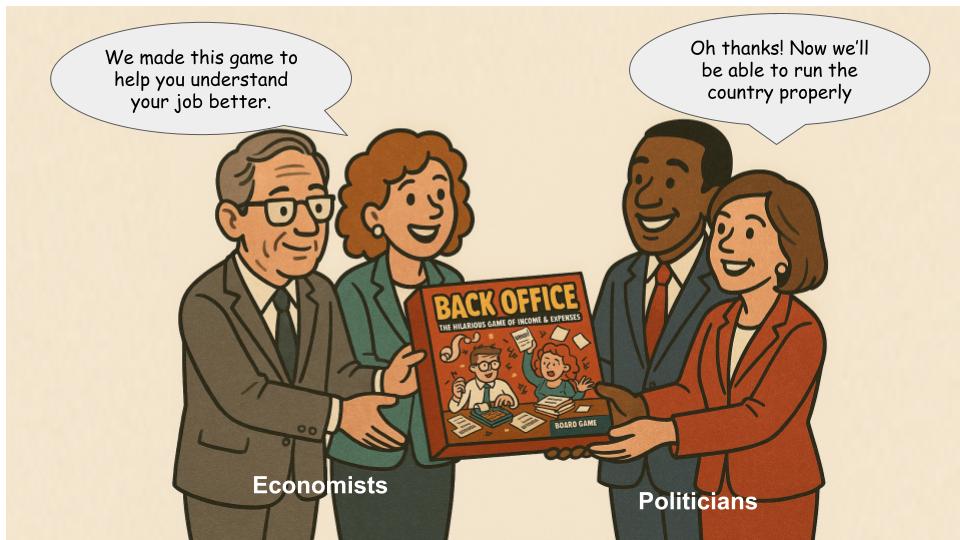
Not understanding that economics offers a rather limited view of the workings of the nation, economists sought to train politicians in their worldview, reducing governance to a game of back room book-keeping.

I have decided to focus my efforts on spreading the word about the Real Capital Framework. I believe in the potential of the Real Capital Framework to evolve into a discipline that provides better decision bases to policy. To this end I will be co-posting articles here on my blog and on my new Patreon channel. Deeper and broader treatment of the subject will appear for Patreon subscribers.

Do please, if real capital interests you, subscribe to get into the full depth of the subject.

Workers! Don’t worry about the tariffs.We have nothing to lose but the miserable lives capitalism imposes

I am of a mind that this tariffs business is a kind of homeopathic medicine: where the medicine aggravates the symptom which is arising as a result of the body healing itself. Aggravating the symptoms forces the body to heal faster.

Continue reading “Workers! Don’t worry about the tariffs.We have nothing to lose but the miserable lives capitalism imposes”