Charts showing the long-term GDP-energy tie (Part 2 – A New Theory of Energy and the Economy)

One phrase from this blog struck me; Now we have practically nowhere to go. To all the people working with disaster mitigation I implore you to scenario-study what a sudden fall in oil and gas supply would mean for the society you are charged with protecting. There are ways of handling this apart from the sort of mass-death that a several million city in minus 20 degrees C might find itself.

Gail Tverberg's avatarOur Finite World

In Part 1 of this series, I talked about why cheap fuels act to create economic growth. In this post, we will look at some supporting data showing how this connection works. The data is over a very long time period–some of it going back to the Year 1 C. E.

We know that there is a close connection between energy use (and in fact oil use) and economic growth in recent years.

In this post, we will see how close the connection has been, going back to the Year 1 CE. We will also see that economies that can leverage their human energy with inexpensive supplemental energy gain an advantage over other economies. If this energy becomes high cost, we will see that countries lose their advantage over other countries, and their economic growth rate slows.

A brief summary of my view discussed in Part 1 regarding how inexpensive…

View original post 2,815 more words

(IN SWEDISH) Supplemental environmental fees simulation Stockholm 27 March

simulation_results
Exempel resultat efter 7 ronder

Kunskapsnivå: medel – hög
Huvudämne: miljöavgifter med återbäring som styrmedel för hållbar utveckling
Målgrupp: representanter för organisationer engagerade i miljö, klimat mm. som vill vet mer om hur styrmedel kan hjälpa till i utvecklingen. Tjänstemän som arbetar inom ekonomi och miljöpolicy.
Fördelarna med att delta: simulering är ett effektivt sätt att få inblick i olika faktorer och hyr de samverkar/motverkar. Bl.a. illustreras hur viktigt det är med – vad som kommuniceras, storleken på avgiften, tillgång till teknik, prisbilder totalt m.fler.


TID: 9:30 – 12:30
DATUM: 27 mars 2015
PLATS: Citykonditoriet konferens Adolf Fredriks Kyrkogata 10 111 37 Stockholm Continue reading “(IN SWEDISH) Supplemental environmental fees simulation Stockholm 27 March”

Oil, the economy’s central power source, is now insufficient for 3% economic growth

Great analysis by Swedish Professor on economy and oil – the long view. We ARE in changes times and that means there are opportunities to form our society how we want.

Aleklett's avatarAleklett's Energy Mix

Last Monday in January on the “Report” news programme of Sweden’s most widely watched TV channel, SVT1, they discussed future economic outlooks and they stated that the economic growth prognoses from the Sweden’s National Institute of Economic Research over the past five years had been excessively optimistic. The Institute has been projecting future economic growth of approximately 3% per year. Every prognosis has proven incorrect and the Report programmer asked, “what will happen if there can no longer be rapid economic growth?” One answer is that it is the unemployed who will pay the price. Klas Eklund, senior economist at the Swedish bank SEB, stated his opinion that the forecasters at the National Institute of Economic Research had been far too optimistic and that most people now understand this.

Historically, economic downturns have always been followed by growth but Klas Eklund now believes that this coupling is no longer valid…

View original post 523 more words

The next step in complementary currency

Cover_biomassComplementary currencies like the Bristol Pound act as vouchers for national currency. You swap one Bristol Pound for a Bank of England pound at a  1:1 or 1:0,9 rate. The benefit of a currency like that is that it encourages money to stay in the local economy (jobs with it). The Bristol Pound is valid only locally.

The question is, can complementary currencies take a next step, towards keeping money locally AND stimulating the green economy – an economy where nutrients recycle instead of being brought from outside (entailing a large expenditure of fossil fuel) and an economy where wind, biomass and sun provide the energy.

A recent updated version of a report from Stephen Hinton Consulting demonstrates one way that might be achieved.

The vouchers are not swapped for national currency but for sorted biomass, and for promises to sequester carbon in the soil.

Learn more about this proposal in the white paper.

A complementary currency to drive a cityR5 (.pdf)

VIDEO: Fiscal reform brings emissions into line while keeping economy stable

This video explains the monetary system in simple terms. It demonstrates how to use points in the system to control its overall functioning. It shows how it is possible, applying the principles of control and feedback the way control engineering steers physical machines, to ensure that the economy runs clean and provides for citizens at the same time.

Learn more
Environmental Fiscal Reform

Global warming not stopped

According to NOAA, 2014 broke temperature records:

  • 2014 was the warmest year across global land and ocean surfaces since records began in 1880.
  • The global average ocean temperature was also record high, at 0.57°C (1.03°F) above the 20th century average of 16.1°C (60.9°F), breaking all previous records.
  • Average land surface temperature was 1.00°C (1.80°F) above the 20th century average of 8.5°C (47.3°F), the fourth highest annual value on record.

The data show that global warming has not slowed, as some have proposed. Says Bob Ward of the Grantham Research Institute on Climate Change: “The record temperatures last year should focus the minds of governments across the world on the scale of the risks that climate change is creating, and the urgency of the action that is required, including an international agreement to strongly reduce greenhouse gas emissions, to be reached at the United Nations climate change summit in Paris in December 2015,”

READ MORE article on BBC News

OPINION: The overwhelming case for tax on carbon and climate dividend


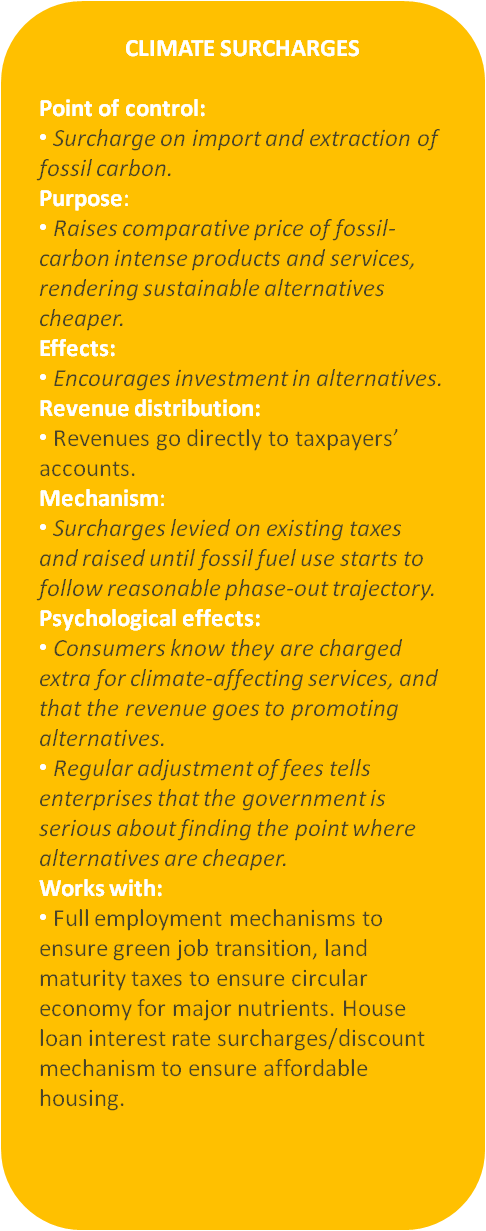
surcharge rutaLet us start by agreeing that the fossil carbon economy presents some tricky issues: much of what we see around us, and the standard of living we enjoy, comes to us thanks to an economy driven by energy and chemicals extracted from fossil fuels. The best jobs are thanks to them and our pensions are invested in them; these largest companies in the world rely on fossil energy or are suppliers to those industries. That is hard to just give up, especially when no alternatives as agreeable are in sight. Continue reading “OPINION: The overwhelming case for tax on carbon and climate dividend”

Oil and the Economy: Where are We Headed in 2015-16?

Sharpest thinker and analyst of our time, Gail joins the dots between energy and economy. We should take her warnings seriously

Gail Tverberg's avatarOur Finite World

The price of oil is down. How should we expect the economy to perform in 2015 and 2016?

Newspapers in the United States seem to emphasize the positive aspects of the drop in prices. I have written Ten Reasons Why High Oil Prices are a Problem. If our only problem were high oil prices, then low oil prices would seem to be a solution. Unfortunately, the problem we are encountering now is extremely low prices. If prices continue at this low level, or go even lower, we are in deep trouble with respect to future oil extraction.

It seems to me that the situation is much more worrisome than most people would expect. Even if there are some temporary good effects, they will be more than offset by bad effects, some of which could be very bad indeed. We may be reaching limits of a finite world.

The Nature…

View original post 3,090 more words