Modern Monetary Theory (MMT) and Real Capital Frameworks both stress the importance of understanding the capacity of the economy to deliver, using real resources.
MMT demonstrates how the economic system works: a government budgets for a year at time, planning its expenditures and expected levels of tax returns. The expenditures are calculated on resources being available to purchase. Real Capital frameworks offer ways to measure production capability and capacity, and the status of the real capital that will be employed through the budget year. This article explores how MMT and real capital align.
Swedish forests are being clear-cut at such a rate that alarms bells are ringing about dramatic loss of biodiversity and old-growth forest. Once clear cut, it is unlikely that biodiversity and old-growth forest will return. Activists are calling for the preservation of the last remaining patches of bio-diverse forest. This must happen. However, we need to look at the demand side. What is driving this demand and are there demand-strategies available?
Stephen Hinton, Fellow, International Association of Advanced Materials
ABSTRACT
Supply chains are international. To be effective, it follows that actors should use a common language with the same vocabulary, metrics etc. in each country to be able to run, monitor and regulate them. They have a common grammar that embodies key generally accepted concepts. This grammar, however, still reflects the make-take-dispose mental models of the linear economy. This report presents a proposal for a description of supply chain grammar using the Swedish SNI categorisation of industries. The proposal models supply chains with sufficient granularity to allow identification of intervention points for the crafting of policy to stimulate the transition to circularity.
Each installed production device in the various types of the chain can be classified according to their capability for circularity, allowing for quantitative measures to help companies and countries craft policy and strategy.
Applying ALE tables to the material world: an introduction.
You’ll need to be familiar with the concepts of real capital and systems dynamics from previous posts, if you are not already.
The Assets – Liabilities – Equity (ALE) accounting method is a fundamental approach used in financial accounting to record and report the financial position of an organization. It involves the classification and measurement of an organization’s resources (assets), obligations (liabilities), and owners’ interests (equity). This method is widely appreciated by businesses, non-profit organizations, and governmental entities as it provides a comprehensive and transparent overview of an organization’s financial health.
The approach therefore, is favoured by economists advising policy makers. However, not just money, but physical resources – their function, availability, capacity, etc. are vital to the workings of society. This dimension can be lost when looking through an economics-heavy lens. What is needed is the robustness of the ALE method applied to the material world. Let us present it here:
I’ve been at it a long time. Working on the circular economy. From advising the Swedish Circular Economy Delegation, to working on the circular region at the university in Gävle, Sweden, to creating an online education for county administrators. Thinking to put it all in a book, I started collecting fragments into Google’s experimental NotelbookLM. Of course, it offered to do a podcast summary of it all.
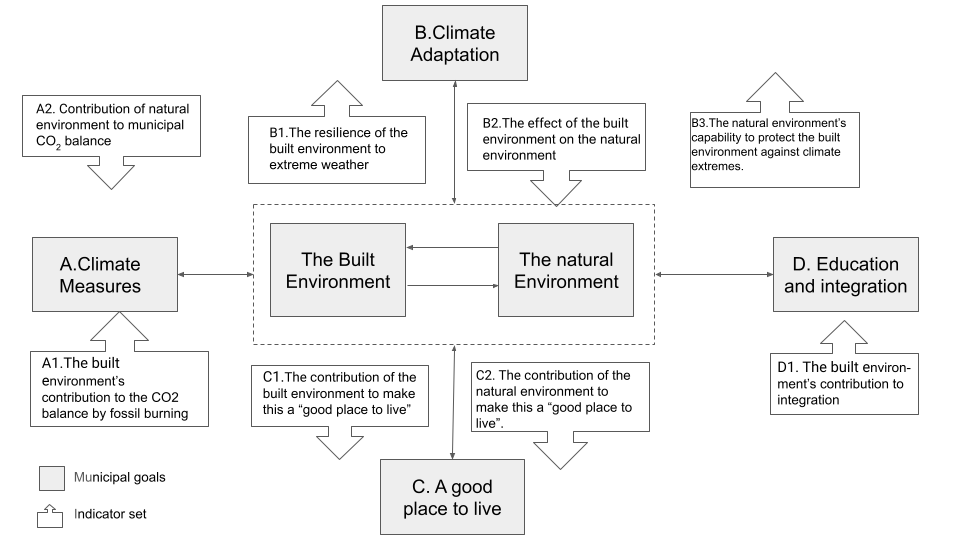
Readers will recall we produced a proposal for indicators for municipalities. A dashboard would help local politicians understand how the built infrastructure was affecting the living environment and how the environment was affecting society. The first proposal is illustrated below.
When we think about buying a home, what’s the first thing that comes to mind? For most of us, it’s the price. How much does the house cost? How much can I afford? Will it be a good investment in the long run?
But what if we shifted our focus slightly? What if, instead of getting caught up in bidding wars and paying far above the asking price, we thought about how we could actually invest in the house itself? And we’re not talking about expensive countertops or high-end appliances. We’re talking about investing in the home’s environmental performance.
A look at the passenger miles produced in the Swedish transport system reveals some interesting statistics. When you add the CO2 emissions per transport type you get even more interesting insights.
The graph below comes from the transport statistics authority for transport within Sweden. And the nature protection agency.
In terms of CO2 emissions, the one transport type that dominates is the one that produces a greater proportion of emissions than the proportion of passenger miles. The reverse is true of rail transport. It produces the second largest number of passenger miles and a miniscule proportion of emissions.
What does this mean for policy? Just looking at the diagram, if you want to reduce CO2 fast, then policy must be aimed at the private combustion engine car. And using the advantage of rail. Where rail cannot be used, the bus is much better than the private car.
The sea results are interesting. Boat transport is very effective, but we are looking at the ferry system included in the figures. It may well be that we need to investigate further as ferries take cars as well.
The graph would have looked different for the 1950s. The chart below shows what has happened to transport in Sweden since then: it’s been automobiled! Swedes are using the same amount of rail and bus travel as they did in the 50s – and the population has grown from 7 million to 10.5 million!
Sweden went rapidly from a rail, bus and other transport method society (MC, moped, walking, cycling) to a nation whose transport method was predominantly by car.
Maybe there is clue to how Sweden can defossilize in this, and it will have to do with building a society where people don’t actually need to take the car. How did it work in the 1950’s? I can’t believe life was that harsh. This is definitely a line to investigate more.
Some things spring to mind: towns had a lot more local shops. And people did not work all hours, so they could use public transport with routes that coincided with work hours. Or, if they worked shift, they lived close to their work.
Of course, people will feel badly hurt if their car is taken away, this needs careful planning! What could you offer instead? How about a green transition basic income with a free electric taxi card topped up to say 10,000 kms a year?
Several thinkers (including, for example, Boyd 2020 and Hazel Henderson) have suggested that the concept of real capital – or multi-capital – be introduced into the political economy to aid decision-making at policy level as well at corporate level. This may overcome one of the failings of standard economics: Policy makers often rely on economists to provide their decision bases. However, one of the failings of standard economics when preparing decision bases for policy makers, is that anything that cannot be valued in money is seen to have no value or little value. The Earth does not send a bill for the use of its atoms so the stewardship of the material world is left out. Without a comprehensive valuation framework, policy makers and strategists are likely to miss the full picture by just relying on monetary values and make decisions that could be detrimental to society, counter to the intentions of the policy.
This article gives a general explanation of the category of real capital that is built capital, and how to use its valuation in preparing decision bases. The Real Capital approach gives a more robust decision basis, helping identify long term investment needs and policy that steers investment and activities to avoid capital degeneration and promote capital regeneration.
Economic growth sounds great! But as with all growth you have to ask yourself what it will look like when it’s fully grown. So too with the “economy”. I’m not talking about the monetary system that produces tokens and circulates these tokens around between citizens, companies, governments and back. I’m talking about the arrangement for keeping a roof over your head, food on your table and a load of other essential services.




 Stephen Hinton Consulting