
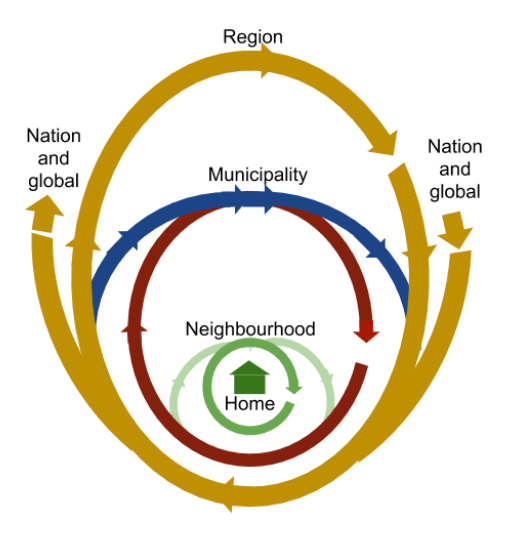
For me, 2020 was the year I threw myself into the circular economy. Along the way I came up against a lot of really challenging things. Let’s look back on a year’s blogging together, with some sidetracks into things that I only just started to accept during the year.
Continue reading “2020: A year of tough realisations”Author: stephenhinton
The time to pivot is now
My interpretation of what a pivot is: a cap on resource withdrawal followed by a rapid reduction. A pivot can happen before or after the breach of capacity. When the pivot happens greatly affects how much resources will be needed to rectify the situation, as well as the costs of the negative impacts of overshoot. This article lays out the basic concepts of pivot.

Anyone growing up when times just get worse will expect that they will continue to get worse. Growing up in a time when things just get better you will expect them to continue to get better. The worst are when things have been getting better but you know they are going to get a lot worse. That is where we are. It’s uncomfortable to say the least.
We are waking up the realisation that progress since the 1950s has actually been at the expense of earth systems and natural resources. The carrying capacity of earth systems has been eroded to such an extent, and populations and their material uses have grown to such a magnitude, we now find ourselves in overshoot.
Continue reading “The time to pivot is now”Indigenous leaders’ message about regenerative agriculture. We should listen
Regenerative Agriculture and Permaculture Offer Narrow Solutions to the Climate Crisis
Regenerative agriculture (Regen Ag) and permaculture claim to be the solutions to our ecological crises. While they both borrow practices from Indigenous cultures, critically, they leave out our worldviews and continue the pattern of erasing our history and contributions to the modern world.
While the practices ‘sustainable farming’ promote are important, they do not encompass the deep cultural and relational changes needed to realize our collective healing.
Continue reading “Indigenous leaders’ message about regenerative agriculture. We should listen”Multi capital scoring: how to measure what matters in the circular economy
As circular economy thinking takes hold among policy makers, civil servants and scientists, policy is tending towards circular as a strategy to reach environmental objectives. Hopes are that production systems will continue to deliver and indeed grow economically, but with far less material and fossil energy intensity. This article explains why that might not be so easy and offers a way forward.

Circular economy thinking is taking hold among policy makers, civil servants and scientists alike. For example, the Swedish Government formed its own Circular Economy Delegation last year and recently announced its national strategy for the Circular Economy. Facing reduced material availability and rapidly reducing use of fossil fuels to align with the Paris accord, Sweden hopes that its production system will continue to deliver and indeed grow economically, but with far less material and fossil energy intensity. This article explores some of the theoretical and practical challenges of measuring what matters in order to help frame policy and effectively pursue strategy.
Continue reading “Multi capital scoring: how to measure what matters in the circular economy”Circular economy comes free
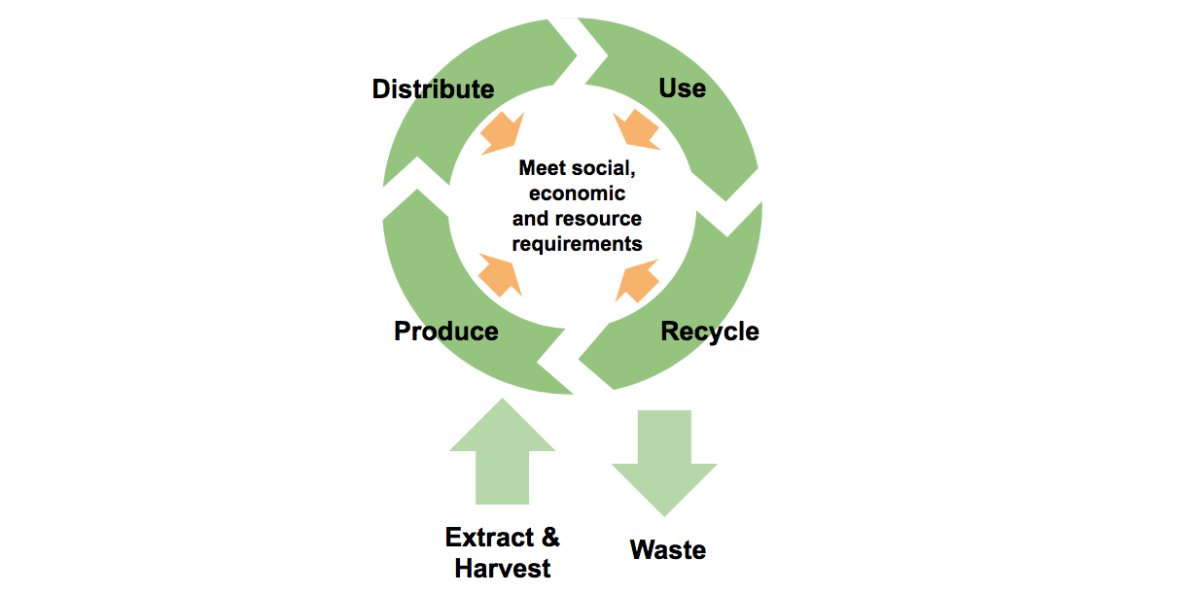
This article attempts to answer the question of “what would it cost for a nation to transition to the circular economy?” with “actually not a lot”. To explain this rather startling position you’ll need to bear with me while I explain the importance of a firm’s infrastructure for investment, what a circular business model is, where circular infrastructure fits and then where the money will come from to make new infrastructure and finally – what it will cost in terms of investment.
Continue reading “Circular economy comes free”Circular city logistics

This article comes from the book “Inventing for the Sustainable Planet” a novel which asks the question “if you were to visit a city that was sustainable- what would it look like?” The novel about the city of Porena contains several far-reaching ideas including the idea of global design with local assembly. In this section the book’s hero, Max Wahlter, describes how circular manufacturing needs circular local city logistics to be sustainable.
Continue reading “Circular city logistics”Three hacks that could put capitalism back into its box
My recent article on how come capitalism is an extractive practice, and the later explainer of how it degrades real capital got, for me at least, a lot of interest. Very few, however, asked what could be done about it. Let’s do just that. We have described the problem, now we can get on and solve it. There are three ways to limit the destructive power of the capitalist form of production and its toxic side kick, free markets .They are surprisingly simple. Read on!
Continue reading “Three hacks that could put capitalism back into its box”System description – where are the disconnects? #2
Three overwhelming global disasters are facing us – climate change, the Coronavirus pandemic, and unknown, transformative socio- economic changes in the Coronavirus aftermath. Some of these socio-economic changes, like the reduction in air travel, if sustained, will have positive effects in support of climate change mitigation and adaptation. Time to take a step back and look at what is not working before making any changes.
Continue reading “System description – where are the disconnects? #2”System description – where are the disconnects? #1
The COVID crisis is exposing many ways in which society isn’t working. We need to get to the root cause. What better way than to start by mapping the system as-is? My recent post system description gave a high-level description of the system we live in. We identified six entities and twenty-one flows. All but two of the entities are man-made, so if we can make something and it doesn’t work work well we can surely improve it? Once we have mapped the system we need to look for disconnects. Disconnects are where things don’t work as they should.
Continue reading “System description – where are the disconnects? #1”System description
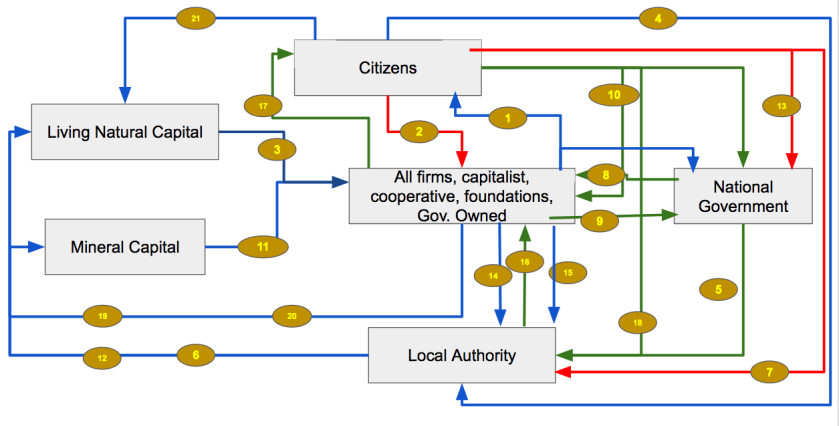
In order to change something you need to see how it is from the start. We identify 21 vital flows in the system representing economic transactions and relationships to natural capital. The three main types of flow are:
- Material flows, for example minerals, products, waste (in BLUE)
- Flows of money representing economic transactions (in GREEN)
- Work – selling of citizens’ time to firms and authorities (in RED)
 Stephen Hinton Consulting