Kate Raworth’s Doughnut model of the way an economy should perform is excellent. But it needs an idea of how to control that economy so it performs to requirements. Enter the bath tub.
Kate Raworth has a wonderfully clear and simple concept – that we should arrange the way we run society on the principle that we do not exceed planetary boundaries – in our relation to nature – on one hand, and that we set things up to avoid people suffering and that everyone’s basic needs get fulfilled – the human dimension – on the other. She draws it like a doughnut.
In her excellent book, Doughnut Economics, Kate shows how this task is essentially one for the economy and a question for economics. Doughnut economics gives us a very clear set of requirements for how an economy should work. That immediately brings one to think of money, investments, taxes, banks businesses etc. And that is where the model needs a little help .
Appearing in the Online magazine Resilience, (link here) former Greenpeace director Rex Weyler summarizes the brutal shortcomings of our present day economics.
In this article we are going to demonstrate how the UBI works “under the hood” by looking at the underlying game logic.
The game makes some vast simplifications of how a national economy works – it is after all designed to be a learning experience rather than a mirror of how the world actually works.
Some results from alpha testing of the Universal Basic Income simulation game
Together with the Swedish Sustainable Economy Foundation I am developing a Universal basic Income “Business Game“. The idea is to take a simplified, fictive country and play around with various aspects of UBI to learn by doing.
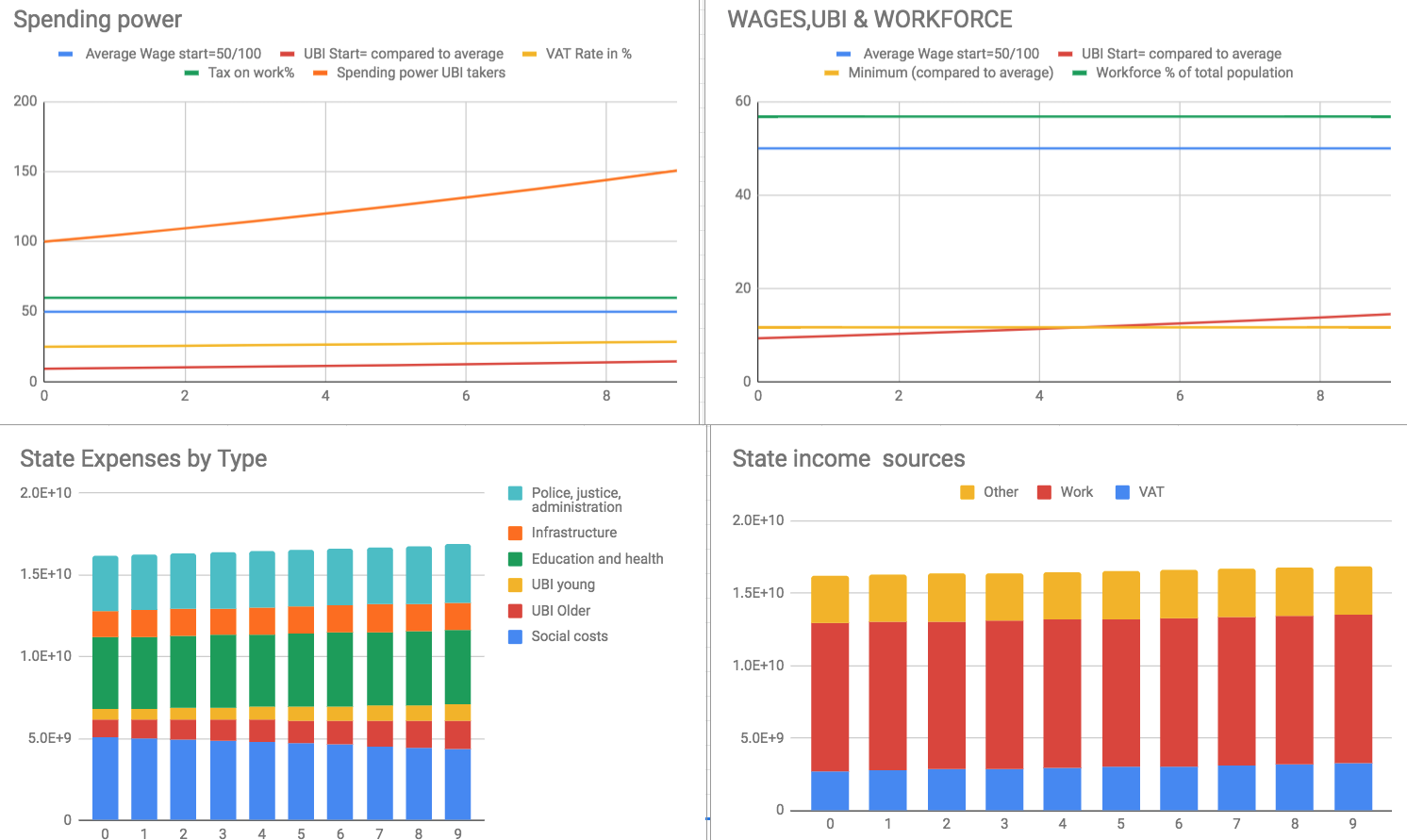
We are into the first alpha testing phase and have produced an overview dashboard to look into what sort of figure we are interested in following as the game progresses
Conditions: raise VAT, lower taxes on wages, start raising UBI, reduction in workforce.
The above run was a force run to see how raising taxes and lowering numbers in work looks in the system. As you see the state gets less to spend on services as income declines. Maybe not so interesting. The next run looks at raising UBI from under minimum standard and just raising VAT.
Conditions: raise UBI from under minimum, raise VAT.
The second run added spending power of UBI takers to the dashboard. If you raise VAT you lower spending power. Interestingly – in the simplified model at least – you get MORE state income and the UBI takers do not get lowered VAT. This gives us a hint that it might be possible to raise UBI and Universal Basic Services, although the UBI eats away at the money available for social costs.
Modelling like this raises many detailed questions and it is a difficult task to make the game engine simple enough to handle in a game situation ( so that you learn basic principles) and complex enough to give a feeling of “real life” (so it feels authentic enough).
Let me know in the comments if there is any logic I am missing or any metric you want to see on the dashboard.
Circle Economy Training issed their first self-assessment quiz today on circularity readiness. The quiz covers most aspects of the circular economy from an organizational point of view.
Our analysis of signals of change in the world tell us that there are major changes being called for.
Eliminate poverty – we already decided
The Sustainable Development goals set a new precedent for human development and it is still sinking in that the majority of countries in the world have signed up to eliminating poverty (SDG1) and hunger (SDG2) and eliminating threats to the environment.
A new Green Deal proposes massive investment in a new USA
From the Democratic party, the New Green Deal is the boldest proposal to come from the US for a long time – it will aim to eliminate poverty, create green jobs and transform the technical infrastructure of the US to a circular economy
The Circular Economy is central to achieving the SDGs and the New Green Deal
The idea has been with us for a while, and it is slowly becoming more and more apparent that nature works in a circular way and society needs to fit in. The possibilities are huge, from green, dignified jobs for all to eradication of pollution to a better life for future generations.
Supporting links: Learn more about the Circular economy at this online school.
Heavy fees on things that pollute like fossil fuel can be a blessing
We are noticing how more and more economists are realizing that a heavy, increasing fee on fossil carbon could stimulate the economy rather than slow it if the fees are paid back to taxpayers. Some estimates point to 70% of citizens being better off under the scheme as those who use fossil fuels are ofter the wealthiest.
Have you ever pondered over the role played by the neighbourhood- cobbler, electrician and tailor in recovering resources and reducing waste? Most of us have never even noticed them. If I say that they like wastepickers and recyclers are going to be the pillars of ‘Circular Economy’ envisioned by economically advanced countries, will you believe me?
I am assured that your first question will be ‘What is circular economy?’
According to the authors- Peter Lacy & Jakob Rutqvist of the book ‘Waste to Wealth- The Circular Economy Advantage’, ‘
Shifting to a circular model means changing our linear economy’s supply logic. We will need more renewable energy, more biomaterials and biochemical that can degrade safely, and more technical materials like metals that are designed to use recovered secondary material and for low cost end of life recycling, effectively closing the manufacturing loop. We need components designed for reuse and products…
Sixteen-year old Greta Thunberg is asking good questions like “why are we doing nothing about climate change?” She tells it like it is as we stand unmoving – no group wanting to give anything away. Unions rightly take the stance that workers should not pay with lowered standards. Some want to play with small tax adjustments to see the poor OK.
The New Green Deal says “never mind the economics of it – we’ll just invest in the planet we want.” That is good, but you need to make sure people have the money to pay for those new high speed rail services and electric buses.
Renting out your car, selling second stuff etc. is part of the circular economy but there is more. Firstly, things from nature need to circulate – food waste goes to compost goes to soil goes to food- for example. And trees go to wood to waste wood to fibre board to fuel maybe. And things come from the earth, like metals and they are made into, say, raw iron, then steel, then a product, then scrap, then more steel, and so on.
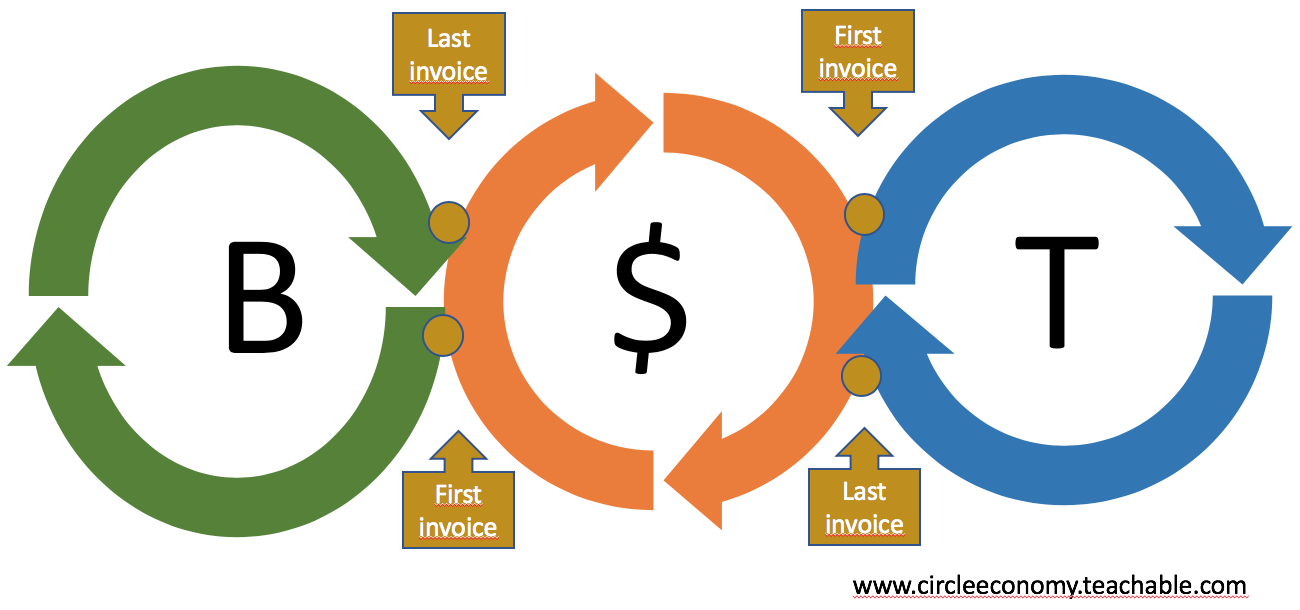
The biological, monetary and technical cycles of the circular economy
Most people take a narrow view of the circular economy, seeing it as renting out your car, selling second stuff etc. All true, but there is more to it. Firstly, things from nature need to circulate – food waste goes to compost goes to soil goes to food- for example. And trees go to wood to waste wood to fibre board to fuel maybe. And things come from the earth, like metals and they are made into, say, raw iron, then steel, then a product, then scrap, then more steel, and so on.
But money needs to go round too. Forget government hoarding surplus – that only removes money from the economy. We need the workers to get good wages so they buy stuff from factories that make good profits that pay good taxes and wages and so it goes round.
Many people react to the idea of people spending more because they think business will extract some stuff and dump others and leave the earth exhausted and polluted. They will. Unless there are either strict laws or stiff fees to stop them. So the circular economy will make it very expensive to extract or dump. And that is where the first and last invoice come in. In the life of a material, be it iron or sand, for example, the first invoice (paying for extraction) is the start of a long chain of invoices that the circular economy continues as long as possible. It puts dumping or burning off – the last invoice – and delays it in time. And the economy is rigged to reward them.
So, there are the basics. If you want to learn more about the three cycles, do look up the relevant course in our online school: https://circleeconomy.teachable.com





 Stephen Hinton Consulting