I believe we need to start to envision what a circular, low-impact, bio-based society will look like in order to usher in the fossil free era.
Indeed the Swedish Government have already declared in January 2019 that they aim for Sweden to be circular and bio-based and resource effective.
I guess we need the circular vision at four levels:
The circular house
The circular neighborhood
The circular municipality
The circular country
The circular nation
Below is a first sketch of what a circular house might look like:
Close to the necessary services (Cycling – ebike – distance?)
Part of a circular neighbourhood
Captures energy, water
Is energy effective
Recycles nutrients
Is part of food provision, too
Lots of reparable items
Or compostable items
If we have the circular house then we need local businesses that serve houses and apartments a n d supply all that is needed for the transition. This could be huge business.
Think of all the new businesses the circular house needs!
Starting this week the Initiative Investors in Peace, founded by the Swedish Sustainable Economy Foundation and several other institutions, is launching its online Academy of Peace. The first courses centre on circular economy as a way to approach peace with the Earth.
For the opening period, all courses are offered free of charge.
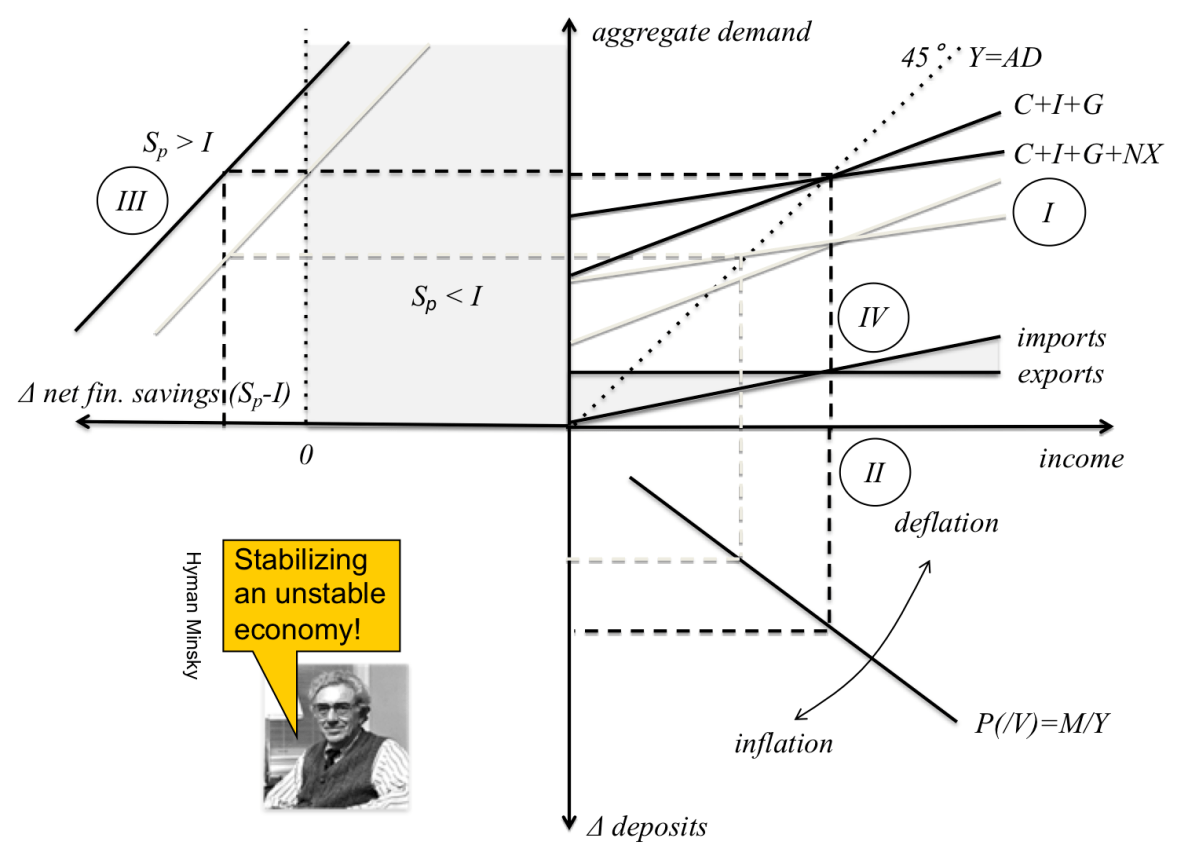
There is a lot of talk about how MMT would lack a “model”. Some commentators on Twitter even claim that MMT would have “no model” and that they just created one themselves. Others believe that stock-flow consistent (SFC) models are basically SFC models. All of that is not quite right!
I think that the only model that can really claim to be a “MMT model” is the one I published in a peer-reviewed journal in 2014. The article in the International Journal of Pluralism and Economics Education (IJPEE) was named “A simple macroeconomic model of a currency union with endogenous money and saving-investment imbalances” (link). With hindsight, it was not a good title, since there is nothing specific about “currency union” or (private!) “saving-investment imbalances” in the model. It is really a replacement of the IS/LM-model and nothing else. The working paper version is accessible freely and was…
Some investment visionaries are rubbing their hands in gleeful anticipation of what AI (artificial intelligence) can do and what they can earn from it. AI has already shown that it can, cheaper and better, do the jobs of warehouse workers, doctors, lawyers and so many other professions. We ask the question what if it could do the job of investing better than capitalists themselves? How would that work? Would capitalism as a way of providing what we need become outdated?
For a long time now, the liberal attitude is that private enterprise, driven by greedy but well-meaning people with money they want to see grow is the best in class problem-solver. Transport? Enter the Henry Fords. Internet services? Enter Googles. Shopping online? Enter Amazons. A sustainable, equitable society? Enter … well we are waiting.
It only takes a short flight of the imagination to see the potential. Already, city developers and other experts are painstakingly developing the workings of something that could change the very logic of investment forever: cities that work for people, owned by people, supported by AI.
City infrastructure – power, transport, waste handling, commerce, water etc., key to creating sustainable cities, cannot be left to individual contractors and private investment to get the city quickly on the path to sustainability. Consultants like Resilience.io are offering infrastructure design applications that optimise infrastructure, use the latest and most sustainable solutions available, and end up often reducing investment needs by as much as 40%.
It is only a short step away to applications like those from Resilience.io can begin writing requests for tenders and indeed legal agreements. In fact, AI could start to propose whole company structures with business plans accompanied by full financial analysis.
So how about planning a city? One not just with an infrastructure that is eco-friendly, circular economy, but one that affords all citizens a decent life? And that includes the city’s vast hinterland. If AI can write songs, stories, design products, prepare legal cases it could well design not only spaces but ownership patterns, investment instruments, jobs, organisations, indeed whole cities.
Now, the wealth created from investment seldom trickles down to the poorer inhabitants. Current capitalist or even social democratic approaches are simply not cutting it.
Suppose, then, that this AI system gets tasked to design optimal sustainable infrastructure along with the optimal ownership pattern of the companies building and running the infrastructure and benefit for residents.
This is new. Under capitalism and social democracy firms produce primarily for profit rather than need. In this proposal, the firms should produce primarily for need. Obviously, one driving force, the possibility to earn money, should be there for private enterprises.
I imagine the AI system might come up with some form of Public Private Partnership. The firms building and operating the infrastructure are 50% owned by private interests, and 50% owned by an investment firm where every city resident is an investor and has equal voting rights.
In this way, not only does the city get great infrastructure, but the better the firm runs, the more dividend goes to residents (and private investors). And citizens get to have a say. One share gives one vote. They might even want to buy more shares if they believe in the company.
As they own part of the infrastructure residents might even be interested in looking after it, reporting faults, handling it with care, etc.
Maybe AI can be the force to help us get past the current impasse of capitalist/socialist – left/right outdated thinking?
Starting in August, 2019, we are offering a one-day deep immersion experience of Universal Basic Income (UBI). The day revolves around a business-game like simulation featuring an imaginary country, Lilliput, that has decided by referendum to introduce UBI.
New! Now available to run online. Contact us for more details.
Reposting sharp analysis by Economist Micheal Roberts of the role of government in capitalism and talk of a scarey economist who thinks government investment can make capitalism.work better.
Mariana Mazzucato is one of the world’s most influential economists, according to Quartz magazine. She has won many awards for her work. She is an adviser to the UK Labour Party on economic policy; she “has the ear” of radical Congress representative Alexandria Ocasio-Cortez, she advises Democratic presidential hopeful, Senator Elizabeth Warren and also Scottish Nationalist leader Nicola Sturgeon. And she has written two key books: The Entrepreneurial State (2013) and the The Value of Everything (2018).
Mazzucato is considered radical, even ‘scary,’ by many mainstream economists and conservative politicians. This is because she has highlighted the important role that the state and governments have played in delivering innovation in technology and in advancing productive investment. The idea that the state can be a leading force in innovation and investment in useful activity is anathema to the right-wing neo-liberal ‘free market’ views of the majority of mainstream economists and…
Having just started as Chair of the Sustainability Committee of Re-Equity partners I have had the opportunity to get involved in the question of how to invest to drive the good things we want like sustainability, resilience and fulfil the aims of doughnut economics. This article shares my learning so far and explains the thinking (as I understand it) behind what Re Equity Partners are aiming to do. I hope you find it as exciting as I do.
This article follows on from the previous one in the series on explainers about capitalism “What exactly about capitalism means it extracts and exploits?“. We are gravitating towards offering a solution but we need to take a deeper look at what we mean by capital.
Stephen Hinton Consulting recently completed the compilation of a database of Market Based Instruments that have been thought of, proposed or applied to stimulating the economy to circularity. The list is far from comprehensive but was put together as a first step for the Circular Economy Delegation to gain an initial insight into the opportunities for politicians and authorities to use these instruments to introduce full circularity into the Swedish Economy.
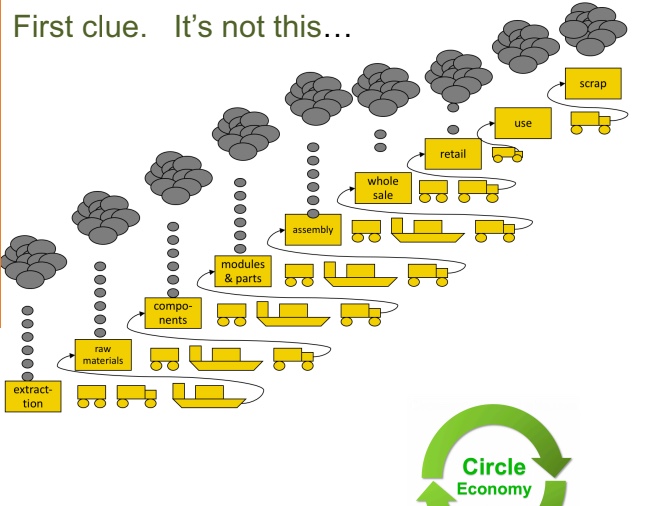
If renewable solutions were cheaper for firms to use, they would. This is how price signals function to steer the behaviour of firms. For the circular economy to function, price signals should favour circular products and production methods. In other words, it needs to make better business sense to install circular and renewable energy infrastructure, and to install and use infrastructure that uses recycled materials. Without that, the linear economy – one that inputs extracted materials and outputs materials as waste – will continue to be the modus operandi of the profitable firm.
This article explores how to use price signals to steer firms’ buying behaviour in a way that keeps the economy stable. Market-based instruments are financial mechanisms that steer price signals to guide the behaviour of firms and markets in general.
What not to do
The linear supply chain
The product cost price equation reveals the opportunity
From the equation above it follows that the relative prices of renewable energy compared to fossil will affect the choice of energy source and the end-price of the product. So will too the price of circular materials over extracted materials affect sourcing decisions. If renewable energy is more expensive to utilize then fossil energy will be substituted. The same goes for recycled materials being substituted for extracted ones.
Add a progressive charge on virgin material and distribute it to all taxpayers alike. (Fee and dividend model.)
As proposed by the Swedish Sustainable Economy Foundation, a progressive extraction surcharge (or import surcharge) on for example fossil fuels could be levied when the material enters the economy. This surcharge is raised at regular intervals. This is a process of discovery; the levy is raised until sustainable products reach price parity with unsustainable alternatives.
A surcharge on waste leaving the firm could have the same effect, assuming the surcharges are carried over to the final consumer price. This makes sustainable products competitive. We can represent this in the equations below.
However, introducing the fee would make the overall range of product offering more expensive to the end-user.
ProductCost_Linear+ Surcharge> Normal Market Price
ProductCost_Circular>Normal Market Price
To redress the imbalance, all or most of the fees levied should be returned to tax payers as a dividend. Guaranteeing the repayment of a sufficient fraction of the dividend in equal amounts to every tax payer by law will be an important step in an Environmental Fiscal Reform and an essential component for majority support in a functioning Circular Economy.
The repayment is needed to secure that the majority of the tax payers will always receive more dividend (repayment) each month than their increased cost of living due to the fees levied to correct the price signals and to create a sustainable economic incentive structure.
To find out more about financial instruments for the circular economy see my website. To learn more about the circular economy visit our online academy for free training. Circleeconomy.teachable.com