
This is a letting my heart out moment and I can’t promise it is going to be coherent. But I see some very important things that have happened recently as stakes in the new ground of economic thinking and in politics. There is a challenge laid down to find something new, built out of the old
Continue reading “The Challenge”Category: Call for leadership
We need to first understand our culture before we can change it
To be part of developing our culture towards peace, it is vital we all gain an awareness of what our culture is. And why we need to be actively involved with its evolution. This article presents culture as a group’s way of living that emerges and adapts over time. We will seek to explore, in coming articles, how we as individuals can influence our culture towards peace. For now, let us explore this concept of culture. It has many dimensions that interact with each other. We may find places we as individuals, or as the groups we are involved in, where we can intervene to orient our way of life more towards peace.
Continue reading “We need to first understand our culture before we can change it”Experiments with prototyping a municipal dashboard.
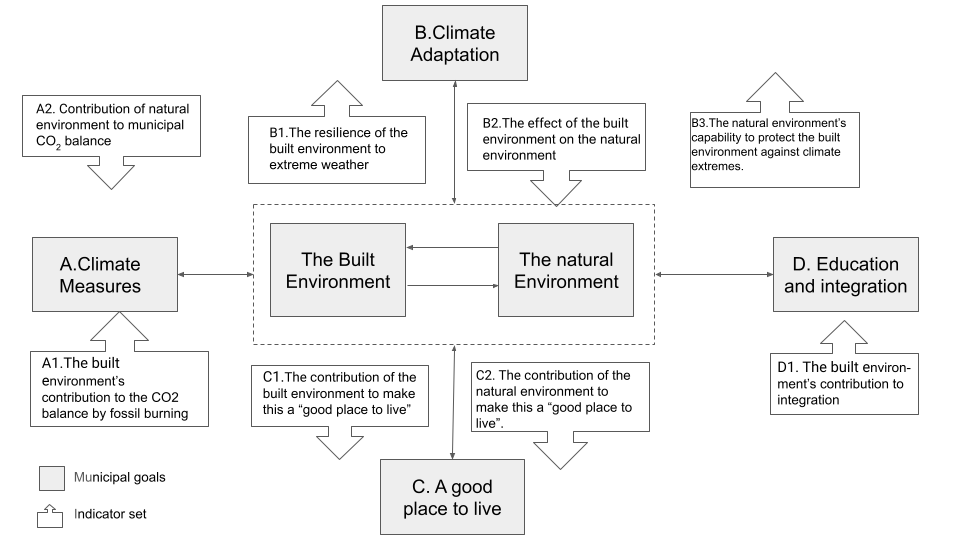
Readers will recall we produced a proposal for indicators for municipalities. A dashboard would help local politicians understand how the built infrastructure was affecting the living environment and how the environment was affecting society. The first proposal is illustrated below.
What is a municipality to do? Abandon “progress” would be a reasonable strategy.
Does a good life entail pursuing progress? As a local politician my focus is turning to adapting society to extreme weather. And a supportive, inclusive culture. Kindness is good for a feeling of well-being.
As a local politician I’ve been involved in dialogue around strategy for 2025. The process will result in a plan to be agreed in September this year (2024) for next year. My group is responsible for the built environment – in Sweden the municipality has a monopoly on built environment planning as well as domestic waste, which brings great responsibility with it. Faced with the fact that warnings from the IPCC have gone unheeded, (use of fossil fuels has increased year on year) we concluded that our #1 priority is to prepare for the consequences of 1.5 degrees. Ideas on pursuing “progress” seem so last century. But how do you put a management system in place to achieve preparedness? How do you ensure a place is good one to live in? Can we have prosperity as our aim?
Continue reading “What is a municipality to do? Abandon “progress” would be a reasonable strategy.”The sorry state of Swedish Forests
Factual, concise and hard-hitting. This new website from Sweden shows the ACTUAL state of Swedish forests and the almost impossible challenge of preventing total biodiversity loss.
The fact that a large percentage of forests have already been clear-felled means that there is little chance these areas can recover their biodiversity. That just a few percentage of biologically and ecologically valuable forest has protected status has locked endangered species into such a small area reduces the chances of these species spreading.
The site also takes up the carbon sequestration function of Swedish forests and the challenge to have old growth continue to absorb carbon.

Start
Fossil fuel policy decision tree
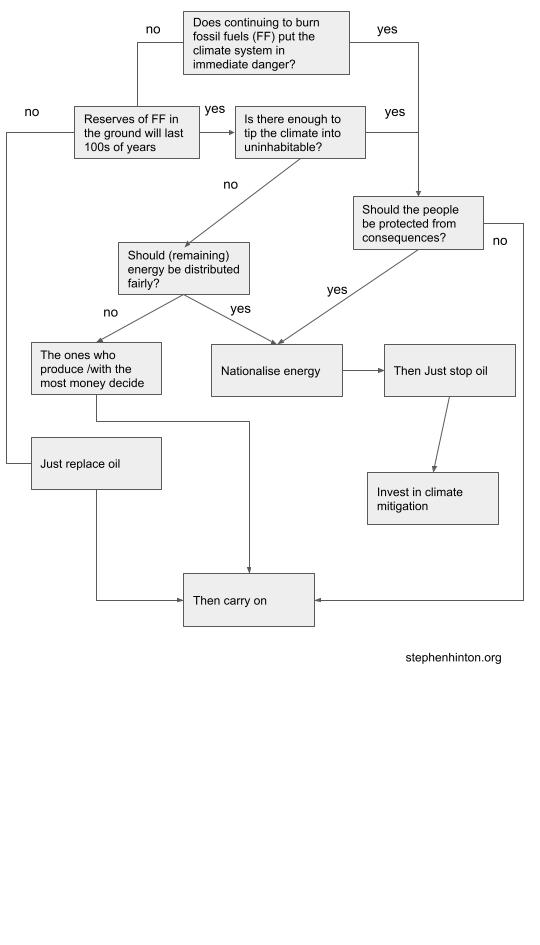
I thought I’d help #cop27 out by providing a decision tree for policy makers. Rather simplified, I think it needs to match the level of public dialogue going on. Feel free to suggest additions/corrections.
The Water, Air and Food Awards hold some of the answers.

The Water, Air and Food Awards, WAFA, is a Copenhagen-based NGO dedicated to identifying initiatives that show practically what can be done to ensure water and food security and clean air.
By offering an annual award, WAFA identifies and showcases initiatives already working to remediate the earth’s environmental and social challenges.
The prestigious Award Events communicate positive messages of hope and invite sponsoring and partners to further support, spread and build on these grass-roots innovations.
Since 2010 WAFA over 400 applicants have gained approval and 14 have been awarded from countries as far apart as Canada, Jordan and India.
This year, the general public will be invited to vote for four winner among 14 finalists. To get informed about when voting opens, sign up for WAFA’s newsletter.
I am currently acting Program Office manager, and we are looking for several volunteers to take us from where we are today to the Award Ceremony on the 7th December.
Not targets but U-turns: reflections on the IPCC report

Released today, the report, which summarises scientists’ understanding of what is happening with climate change, warns that Earth will unavoidably hit the critical threshold of 1.5°C warming due to climate change within the next 20 years. This is a combination of natural processes and human emissions. This is regardless of how radically global governments cut greenhouse gas emissions. This article urgently proposes a new framing approach: a pivot.
Continue reading “Not targets but U-turns: reflections on the IPCC report”The time to pivot is now
My interpretation of what a pivot is: a cap on resource withdrawal followed by a rapid reduction. A pivot can happen before or after the breach of capacity. When the pivot happens greatly affects how much resources will be needed to rectify the situation, as well as the costs of the negative impacts of overshoot. This article lays out the basic concepts of pivot.
Anyone growing up when times just get worse will expect that they will continue to get worse. Growing up in a time when things just get better you will expect them to continue to get better. The worst are when things have been getting better but you know they are going to get a lot worse. That is where we are. It’s uncomfortable to say the least.
We are waking up the realisation that progress since the 1950s has actually been at the expense of earth systems and natural resources. The carrying capacity of earth systems has been eroded to such an extent, and populations and their material uses have grown to such a magnitude, we now find ourselves in overshoot.
Continue reading “The time to pivot is now”Pivot Projects seeks to inform post-covid strategy for net zero carbon

Understanding that as a species humans cannot go on as we were, 140 experts, academics and volunteers across the world are coming together to engage with policy agenda of the G20, COP26, EU and UK Government. The group will provide post-COVID19 stimulus policies that are socially fair; stimulate economic growth; and accelerate our transformation to a sustainable planet.
Worryingly, the outlook as we emerge from the restrictions is bleak. If we are to reach Net Zero carbon emissions by 2050 and have any hope of limiting the rise in global average temperatures to a level that will not cause a societal catastrophe, we have to achieve 15% of reduction in carbon emissions *every year*.
Stephen Hinton volunteered to work in the area of sustainable infrastructure. If you would like to join the project, please visit the Pivot Projects Website.
 Stephen Hinton Consulting