Video of Professor Krumdieck answering the question “the largest challenge”
The Professor create the Global Association for Transition Engineering, an academic group to effectively manage the risks of un-sustainable resource use and environmental impacts by implementing changes and adaptations in existing engineered systems
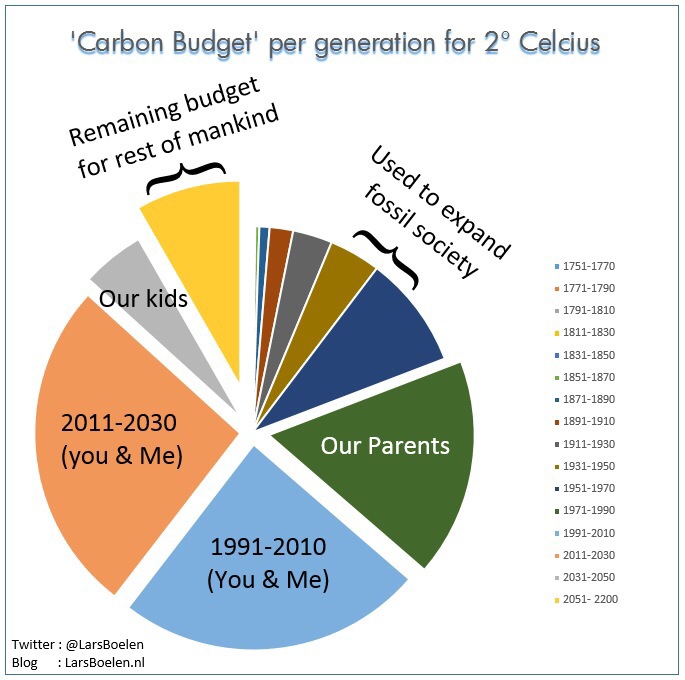
In order to ensure that the climate does not flip to a situation where human life would be drastically reduced, we need to keep warming under 2 degrees. To do that we need to restrict release of climate gasses into the air. Stopping the burgeoning of fossil fuels is one major part of that. But there is some wiggle room, we could maybe burn a little more……. The question is, what are we going to burn it doing?
If you ask me, ( a few do), I would say we need to use it to create sustainable communities that are far less dependent on transportation of goods to and from them. These communities need to have their own renewable sources of energy, and be designed so food and fiber production is carried out close by without the need to burn fossil fuel.
The diagram below explains how much is left. Anyone got a detailed idea of what we could do with it?
Are you working with strategy and planning, especially with value chains? We map latest understanding of fossil fuel industry and how phasing out fossil fuels will affect the economy and consider scenarios and strategies to manage them.
Fast Facts:
Main Theme: managing fossil-fuel intensity reductions value chain
Main audience: managers involved in creating scenarios and strategies for a future of uncertain energy supply
Main benefits: get fast insights and strategies to manage risk and opportunity
The energy transition challenge is so huge that it requires every sector of society – civil society, corporations and authorities to be involved, separately and together.
And because every place is different, with its own demographics, geography, climate and installed base of infrastructure – not to say culture – we believe there is a good case to convene a municipality- wide cross sector collaboration.The scale of change presents opportunities too, to create the culture we want.
One of the instruments we are developing to assist this development is called the sustainable municipality matrix.
The matrix is a set of 25 dimensions, values on the horizontal axis and capital on the vertical. Addressing these dimensions will give stakeholders a view of the capability of a municipal area or similar to embrace change to sustainability. The horizontal axis represents human values and the vertical axis represents key capital categories including human, biological and social capital. Continue reading “Municipal Matrix”
ECO ISLANDS is a network of Islands that have stated that they are aiming toward sustainability by signing something called the Charter, a statement of intent that over 50 islands have already signed.Continue reading “Learning sustainability from Eco-Islands”
The latest version of the white paper connects the need to exert control of the economy’s handling of carbon, phosphorus and nitrogen as well as ecological maturity with price. Updated from previous versions, this version now connects emissions fees with the transition to the circular economy and offers more in-depth coverage of ecological maturity and the process of introducing the fee mechanism.
This presentation was prepared for Swedish municipal school accommodation planners, and presented at the launch of a new, sustainable range of school buildings by the company CRAMO.
På svenska
En powerpoint from mötet med kommun folk som ansvarar för byggnader för förskolor och andra skolor. Presentationen pratar om fur vi måste planera för framtiden med mindre tillgång på energi och vad det kan innebär.
This white paper is written to give decision-makers and policy-makers an overview of the 16 most import things to know about the significance of the modern economy’s reliance on non-renewable energy.
Written in 2009, we republish it
Especially in focus are the likely effects of the impact of liquid fuels on communities as oil prices hike and availability wanes. For officers in the public and private sector alike, this paper describes 16 main aspects of the coming energy situation. Organisations need to consider these 16 in order to begin to craft energy depletion management strategies. Download the pdf here.
This e-book will explain the five major reasons I see why you need to start re-thinking your business and your way of life.
You might be thinking: “ Why haven’t I heard of this before?” Well, you have. It’s just that it has been a long time coming and you are probably like most people, bound up in daily life, with your own causes and issues and distractions. And the situation is complicated. That’s why I have tried to boil it all down to five aspects you can monitor and work out for yourself.
You might be thinking: “Why now?” Well, it’s been coming a long time. In 2005 the peak of oil production, or production of easy oil, was reached. Three years for the effects to work their way through supply chains and the World sees the first shocks – rapid rise of prices followed by economic instability. Comparatively small supplies of oil from, for example, shale oil, may postpone the inevitable – but for how long?
Understanding these five simple things will get you started on rearranging and rethinking the way you do things in your work, in your business and in your daily life. Specifically you will need to think about where you are investing your time and money as an employee, investor, business owner and consumer.
Whatever you do, don’t just believe me, think about it and find out for yourself. Download here 5_guide

 Are you working with strategy and planning, especially with value chains? We map latest understanding of fossil fuel industry and how phasing out fossil fuels will affect the economy and consider scenarios and strategies to manage them.



 Stephen Hinton Consulting