Economists dominate policy making for now, but there might be a way around them

Economists dominate policy making for now, but there might be a way around them

Creator profile picture

One thing that gets my goat is the way economic thinking – with its stupid ideas about the way people work (maximizers) and the way companies work (increasing marginal costs) and the way nations work (banks lend other people’s money) – pervades policy making. Most politicians seem to have swallowed economics 101. I made it my personal crusade to find ways to get around this disingenuous bunch. I might have found something. Read on.

I understand the appeal. It all comes down to money anyway, why not just manage a nation based on money – as long as it looks like all is under control why worry? But as I point out in my Real Capital Blog, things you want to keep functioning – health, forests, railways, water cycles, metal access – get downgraded to a point where they might collapse.

The alternative is complicated. Say you are a scientist that sees that a city has got 3 years left of groundwater. Your report will probably end up nowhere. The machinery, to get from warning through the engineering, through the companies pumping, through the city administration, through the planning, through the political leadership is so complicated and you would need specialist knowledge in every layer to be taken seriously. Just finding out who is actually responsible for what is months of work. And as a scientist you won’t have a workable alternative.

Or, it USED to be that way. You can now get AI to do all the heavy lifting. I tried it with the Real Capital Framework. Get this: there is nothing new with Real Capital, in all its components, the ideas have been around a while (read accessible to AI). The only trick to getting AI to do the work is to point it in the right direction.

This is where AI prompts come in. If you just get the prompts right, in the right order AI will sail through the spaghetti of causes, responsibilities, effects, etc to produce clear, policy decision basis reporting synthesising dozens of professional domains.

This is what economics should be, and AI can prise the role from the sweaty grasp of economists.

Soon, AI will do system dynamics Ravel simulations for you so you can show your work.

I am testing AI prompts just now, and the results are encouraging. 

Subscribe to my Patreon to keep up to date.

Continue reading “Economists dominate policy making for now, but there might be a way around them”
Workers! Don’t worry about the tariffs.We have nothing to lose but the miserable lives capitalism imposes

I am of a mind that this tariffs business is a kind of homeopathic medicine: where the medicine aggravates the symptom which is arising as a result of the body healing itself. Aggravating the symptoms forces the body to heal faster.

Continue reading “Workers! Don’t worry about the tariffs.We have nothing to lose but the miserable lives capitalism imposes”

UK water industry is environmentally insolvent

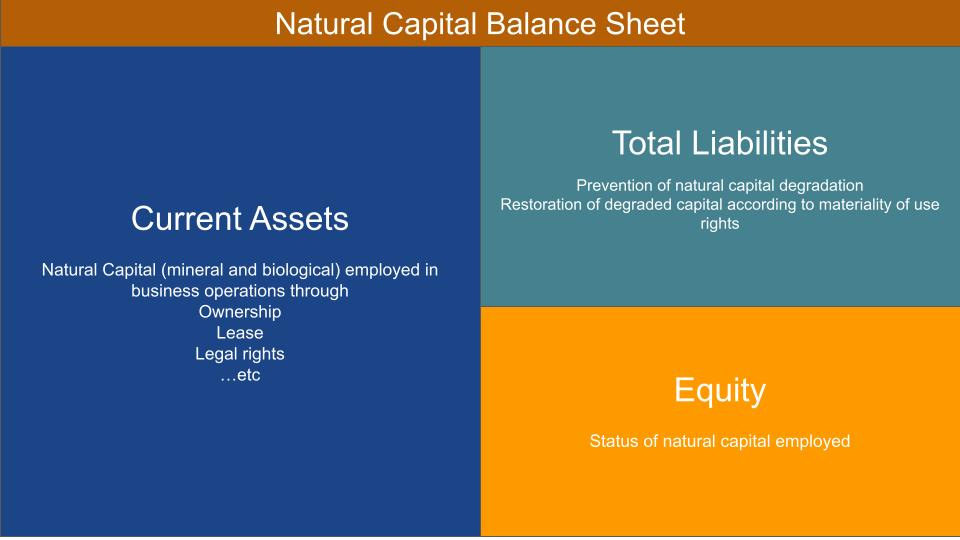
This is something for investors in peace with the Earth: the concept of environmental insolvency. It happens when a business creates an environmental liability (in this case, when water cleaning activities pour sewage into rivers and coasts requiring massive reparations). This liability comes when the operational contract requires restitution and the firms do not have enough assets to fund the restoration and upgrade.

Continue reading “UK water industry is environmentally insolvent”

Opinion: reporting hides what is going on with finite resources

One thing you need to understand: the production apparatus (capitalism) has been battling for ultimate control over resources since the industrial revolution has begun. It has used its money to influence politics, rule making and everything else. It has won and it is a total disaster.

Stephen Hinton 2016, photo Maj-Lis Koivisto

One thing you need to understand: the production apparatus (capitalism) has been battling for ultimate control over resources since the industrial revolution has begun. It has used its money to influence politics, rule making and everything else. It has won. This is disastrous for them and for us as workers and citizens. of the Earth. To understand why, you need to look into their materiality .

Continue reading “Opinion: reporting hides what is going on with finite resources”

Please Nippon Steel, don’t cut these woods! Update.

My letter pleading with Nippon Steel to reverse the decision to log Ovakos forest, close to Hofors town was premature. Ovako have reversed their decision

Lissjön woods with the lake in the background

Update! They didn’t cut the woods down.

We just heard that Ovako, subsidiary of Nippon steel, just announced that they will not cut the forest.

Continue reading “Please Nippon Steel, don’t cut these woods! Update.”

Not targets but U-turns: reflections on the IPCC report

Released today, the report, which summarises scientists’ understanding of what is happening with climate change, warns that Earth will unavoidably hit the critical threshold of 1.5°C warming due to climate change within the next 20 years. This is a combination of natural processes and human emissions. This is regardless of how radically global governments cut greenhouse gas emissions. This article urgently proposes a new framing approach: a pivot.

Continue reading “Not targets but U-turns: reflections on the IPCC report”

Opinion: AI will do away with capitalism as we know it

Stephen Hinton 2016, photo Maj-Lis Koivisto

Some investment visionaries are rubbing their hands in gleeful anticipation of what AI (artificial intelligence) can do and what they can earn from it. AI has already shown that it can, cheaper and better, do the jobs of warehouse workers, doctors, lawyers and so many other professions. We ask the question what if it could do the job of investing better than capitalists themselves? How would that work? Would capitalism as a way of providing what we need become outdated?

For a long time now, the liberal attitude is that private enterprise, driven by greedy but well-meaning people with money they want to see grow is the best in class problem-solver. Transport? Enter the Henry Fords. Internet services? Enter Googles. Shopping online? Enter Amazons. A sustainable, equitable society? Enter … well we are waiting.

It only takes a short flight of the imagination to see the potential. Already, city developers and other experts are painstakingly developing the workings of something that could change the very logic of investment forever: cities that work for people, owned by people, supported by AI.

City infrastructure – power, transport, waste handling, commerce, water etc., key to creating sustainable cities, cannot be left to individual contractors and private investment to get the city quickly on the path to sustainability. Consultants like Resilience.io are offering infrastructure design applications that optimise infrastructure, use the latest and most sustainable solutions available, and end up often reducing investment needs by as much as 40%.

It is only a short step away to applications like those from Resilience.io can begin writing requests for tenders and indeed legal agreements. In fact, AI could start to propose whole company structures with business plans accompanied by full financial analysis.

So how about planning a city? One not just with an infrastructure that is eco-friendly, circular economy, but one that affords all citizens a decent life? And that includes the city’s vast hinterland. If AI can write songs, stories, design products, prepare legal cases it could well design not only spaces but ownership patterns, investment instruments, jobs, organisations, indeed whole cities.

Now, the wealth created from investment seldom trickles down to the poorer inhabitants. Current capitalist or even social democratic approaches are simply not cutting it.

Suppose, then, that this AI system gets tasked to design optimal sustainable infrastructure along with the optimal ownership pattern of the companies building and running the infrastructure and benefit for residents.

This is new. Under capitalism and social democracy firms produce primarily for profit rather than need. In this proposal, the firms should produce primarily for need. Obviously, one driving force, the possibility to earn money, should be there for private enterprises.

I imagine the AI system might come up with some form of Public Private Partnership. The firms building and operating the infrastructure are 50% owned by private interests, and 50% owned by an investment firm where every city resident is an investor and has equal voting rights.

In this way, not only does the city get great infrastructure, but the better the firm runs, the more dividend goes to residents (and private investors). And citizens get to have a say. One share gives one vote. They might even want to buy more shares if they believe in the company.

As they own part of the infrastructure residents might even be interested in looking after it, reporting faults, handling it with care, etc.

Maybe AI can be the force to help us get past the current impasse of capitalist/socialist – left/right outdated thinking?

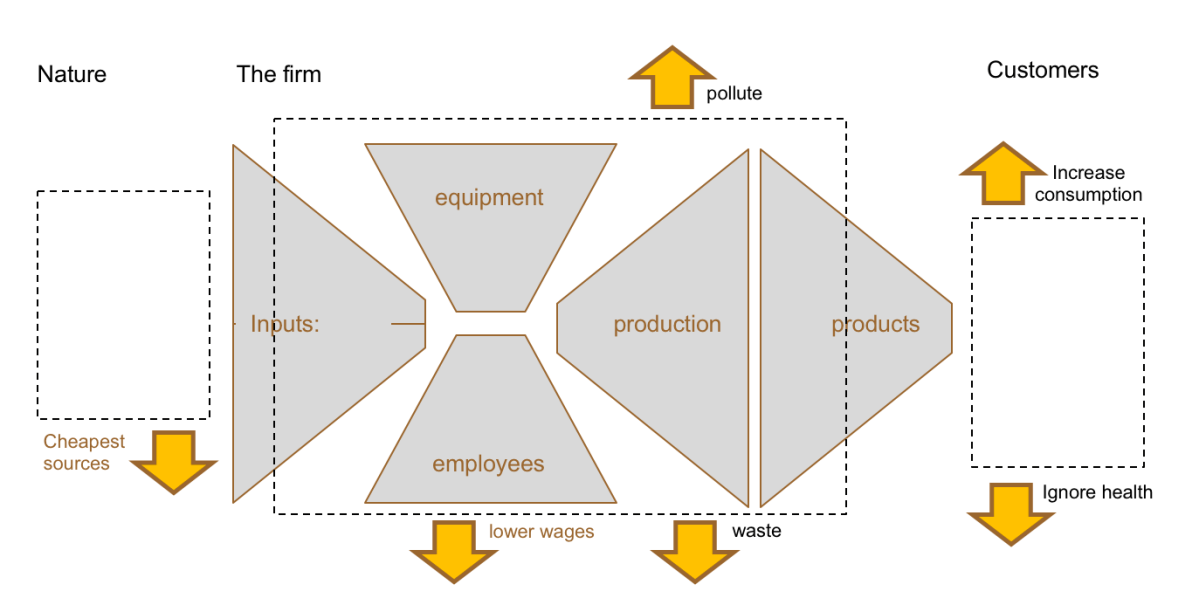
What exactly about capitalism means it extracts and exploits?


Not crony capitalism, not raw capitalism, not capitalism in the hands of wrong people but capitalism itself is the cause of the environmental degradation and social misery we see around us. Capitalism offers the rules if you like, the players play by those rules, and the results are what we see. If I am going to say something this bold, I need to be really specific and present good arguments. Let me attempt that, but you will have to bear with me through some details. This is not rocket science, but the whole subject area has many branching ideas so you will need to look hard to see the path through the subject matter.

Continue reading “What exactly about capitalism means it extracts and exploits?”

Shop your way to fossil freedom

Sixteen-year old Greta Thunberg is asking good questions like “why are we doing nothing about climate change?” She tells it like it is as we stand unmoving – no group wanting to give anything away. Unions rightly take the stance that workers should not pay with lowered standards. Some want to play with small tax adjustments to see the poor OK.

The New Green Deal says “never mind the economics of it – we’ll just invest in the planet we want.” That is good, but you need to make sure people have the money to pay for those new high speed rail services and electric buses.

So. No easy solution? Perhaps there is.

Continue reading “Shop your way to fossil freedom”