Swedish Sustainable Economy Foundation Board member Stephen Hinton will be presenting at the annual Future Day held by waste handling company Ragn-Sells.
See the video above (in Swedish!)

Swedish Sustainable Economy Foundation Board member Stephen Hinton will be presenting at the annual Future Day held by waste handling company Ragn-Sells.
See the video above (in Swedish!)
Most of us would like to think that people taking important decisions – ones that affect our lives deeply – would be basing their judgement on deep criteria. We hope that they are being reasonable and rational, balancing long-term and short term, what is fair and what is equitable etc. What many might suspect, however, is that decision-maker’s logic is more ruled by the economics of the situation and the budget covering just the domain of their decision. Indeed, many social experiments like the Stanford Prison Experiment show how authority and social pressure alter decision making. Of course economics are important but should they be the trump card that overrules compassion, equity, decency and plain common sense? The initiative Invest in Peace proposes a safe house for humanity. Continue reading “Envisioning a Safe House for Humanity”
 Invitation to Webinar!
Date: 18 April 2018
Time: 18:00 -19:00 CET
Host: Invest in Peace http://investinpeace.tssef.se
Theme: Where climate-friendly farmers need investment
Objectives: To hear progress from India involving some 20,000 farmers with achieving climate and friendly food production – bringing functioning soils, carbon mitigation and food security
Register: Follow this link Continue reading “Webinar: live or replay Investing in Farmers, experiences from India”

I will be talking about how we need to love phosphorus and nitrogen in new ways.
See the latest video film offering here!
As world population expands, and the demand for a better standard of living drives the world economy, it is becoming clearer to many that using up the world’s resources will actually put us at risk of ending up with a lower standard of living. It could even drive conflicts. Insecurity and lack of the capability to produce the basics are likely to fan the flames of conflict and undermine peace in the world. We urgently need a new mindset – one that focusses on bringing security of the basics to everyone whilst preserving and indeed increasing the capability of society to provide.
Part of this new mindset requires us to rethink capital. This article breaks down the importance of capital to society, and how the economy should manage capital if we are to transition to a sustainable and peaceful future. Continue reading “EXPLAINER: capital, sustainable development and peace”
Maybe it is just a sinking feeling you get in your stomach when you think of the global economy, or maybe you have delved into the depths of economic thinking. Either way we are not alone if you are concerned that the great human invention – money – is dysfunctional. Many are commenting on how our economic system – often called capitalism although that is hard to define exactly what it is – is coming apart. The comments are coming from the direction of Marxists, conventional economists, free thinkers and even the World Economic Forum.
In other words, the way we use money is not fulfilling the purpose of distributing wealth, ensuring the basic for survival, or driving stewardship of land and minerals.
People have started taken action. Although in their infancy, alternatives abound, including the REconomy movement – a branch of the Transition Towns movement that seeks to help create social, resilient enterprises based on local conditions. REconomy is very much a grass-roots movement. Those involved in REconomy locally have very little time for coordinating with others, sharing knowledge or engaging in EU-funded large projects. Making something happen on a local basis takes a lot of effort. Despite the initial enthusiasm you can whip up initially, it is a long, hard slog to get your high-street, if you are lucky enough even to have one (most are gone in Sweden), free of the domination of global brand chains. Indeed its hard enough just to get a local bakery started.
But it IS working. In several places the REconomy movement has increased the number of jobs in local firms, seen businesses be more sustainable and helped foster a sense of community,
The REconomy movement doesn’t have to start its own brand chain. Like many other movements it sees itself as a community of practice (COP). A community of practice is a network of practitioners helping each other get on with their practice, or business. A community of practice does not have to have its own organisation, rules, by-laws, membership fees, shareholders, stakeholders or the like. Just people sharing experiences. It COULD have some or all of that – if it helped – of course. You can commercialize a community of practice. Do that in a fair way and you get a platform co-operative.
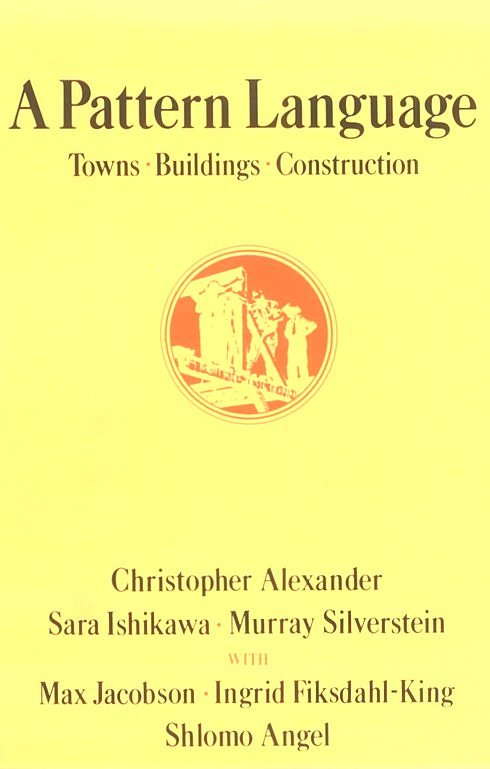 A shared language of patterns
One thing that helps communities of practice is to develop a shared language. Terms appear that only practitioners understand the real meaning of – like names of tools used by people pursuing the same craft. But how do you share experience? The answer came from Christopher Alexander who put forward a ‘pattern language’ approach. He believed – and proved it – that you can describe something in a way that others pursuing your craft can follow. They can at least get started, copy what you describe and learn from experience from there.
As Alexander says: “no pattern is an isolated entity. Each pattern can exist in the world, only to the extent that it is supported by other patterns: the larger patterns within which it is embedded, the patterns of the same size that surround it, and the smaller patterns which are embedded in it. This is a fundamental view of the world. It says that when you build a thing you cannot merely build that thing in isolation, but must also repair the world around it, and within it, so that the larger world at that one place becomes more coherent, and more whole; and the thing which you make takes its place in the web of nature, as you make it”.
This is huge. As Peter Senge pointed out in his book the Fifth Discipline, we all go around with patterns in our heads of “good ways to get stuff done” without even knowing. For practitioners of a craft, as their surrounding context changes, for them to change with it they need to be aware of the pattern (or paradigm) they are applying and question whether it will take them into the new context.
This is REconomy : Bringing to the surface the patterns that are hidden but operating, putting them together with the new context, questioning their fitness for purpose and developing new ones.
Very useful in this context is to understand the two loops theory of system change. We are in a dying system and a new one is emerging.
Footnote: you might be asking for an example of the way this pattern language could work in practice. If you revisit the article you will see it is written using my proposed structure. Still needs work but a start at least!
The funnel concept, introduced by Karl-Henrik Robert Founder of the Swedish Natural Step, explains how increasing pressure on resources reduces the options of future generations to maintain a standard of living. Stress like that on populations radically increases conflict and undermines peaceful societies. In the diagram below, the width of the funnel represents the opportunities to continue society’s per capita resource usage. The depth of the funnel represents time. Continue reading “EXPLAINER: The funnel concept of reduced available resources”
What we call “technology” is actually a narrow description of a practice including mechanics, electronics and computer science. This confusion is hampering human development, especially when the expectation is on not developing financial and social technology but demanding mechanical solutions when simple agreements could suffice. Modern technology is failing, we are not addressing the challenges in front of us. Our very use of language in this case is holding us back and preventing us from thinking clearly.
Continue reading “Opinion: rethink “technology” to save the planet”
 A recent article published in Medium talks about the importance of the source of ideas and initiatives.
Having tried Inventing for the Sustainable Planet, co-founding an eco-village and working with leading edge economic and sustainability thinkers I feel I qualifies me to say a few things about how it is to be the source.
It’s a lot of things, amazing, stimulating, but rarely fun for long. It is lonely.
I am not saying this out of bitterness or anything, I hope that my experiences will help people understand that originators and sources are often unusual personalities and will be highly productive under the right conditions.
I printed a number of copies of the book about inventing for sustainability and gave them to friends for feedback. Lukewarm reception. As with the website, although from far afield, I got some interest so I carried on.
Look. I used my own judgement. Would I as a late teenager or university student, or when I was a science teacher have picked up and bought the book and found it useful? Yes I think I would. That’s where the feeling lonely comes in.
Anyway. The point is I was interested to see if it was helpful. What I wanted to do was to contribute thinking and designs that people who were longing to do something sustainable would be able to use. That was all, that was my motivation. It didn’t seem to be helpful so I didn’t update it. I always had the ambition to update the book with new chapters, already prepared etc. Anyway, I did a short video explaining the main aspects of the inventions from the book. I thought the invention might be of interest and helpful even if the novel was hard to follow.
A TV producer rang me up and wanted to do a program with me in it, featuring the inventions. I cancelled my meetings for that day and waited for the car to pick me up. Cancelled. Heard no more.
I still find that the insights from the work on the book are relevant. And the consulting company I started did manifest some of the ideas into walking maps.
I was invited to Stockholm City management to talk about the maps, and suggested that the most sustainable thing the city could do was to declare itself the walking capital of Scandinavia and set up walking routes using our methodology. I got the reply that they had had the idea to make Stockholm the Capital of Scandinavia and that they were experts at walking cities anyway.
The move to make itself the capital of Scandinavia created a lot of bad will with Copenhagen and Oslo. And the only innovation in terms of walking is that maps on streets show walking distances…. sort of.
As to the eco-village, the basic concept of Eco-Unit, developed by Folke Gunther is genius, and one that lay at the centre of the eco-village project I helped found. However, today, the group do not want to be associated with eco-unit. They have many very good reasons why not and will argue the point many times over. What they did not do was to consult the originator (me) to hear why I thought the way I did. From my perspective they missed some stuff.
What can we learn from this?
We need insights, we need ideas, we need the crazies. If we let them be lonely they will just invent less and less or find a way to exploit you and make a lot of money for themselves. Or they become bitter and cynical. Handled right, they have many gifts to give, and will keep on giving!
|
At the Transition Town Hubs gathering in Santorso, Italy we were given a task to do on our own: How can we recharge together? I lay down in the green grass in the park, put my tape recorder on and did an imagestream. Imagestreaming; You just describe and dictate what you see. |
|---|
| The idea of imagestreaming is you give yourself an assignment to visit a place that has already solved the problem. You just describe and dictate what you see. The first thing you do is frame the assignment. I normally start the tape recorder to do that so I capture everything. Here is the tapescript. Edited for clarity.
The assignment is to take me to a place which has a culture of personal recharging and a culture of recharging together. The place I want to visit is an industrial capitalist and consumer society.The first thing I see is a lift in front of me with RECHARGÉ written on it. I get into the lift, notice it is covered with kids’ pictures. I press the button, I ascend and the doors open onto a bridge over to an old town, like a French town. The sun is shining, a market is going on selling all kinds of stuff. Rechargé is a planned event that takes place on market days.I ask around about how people recharge. It has to do with the market. Rechargé is a planned event that takes place on market days. Beyond the market it looks like a fete or party is going on. I see a sign “RECHARGÉ ” and times for various activities. People are sitting in a circle on the grass in the park- I sit next to them. Inside the circle people are moving together, unscripted, like some kind of movement choir, like a game. Anyone can join at any point – anyone can give up at any point. I watch the choir move. It’s very funny. You have to forget yourself to get into it. It requires people stepping aside, falling over, doing silly stuff. Like an amoeba, people stick out here and there. People seem to know the rules. I go and “borrow the eyes” of one of the participants’ so I can, in my imagestream, see what they are seeing and feel what they are feeling.They move fast; you have to concentrate and be really aware… you cannot think, you need to be right there. All in a fun spirit. All in silence. People are sitting watching. You need to be in the front row if you want to join in, I realise. So it seems there there are quite strict rules. On market day, there are “new games” offered throughout the day, including this movement choir. These are subsidized by local businesses. It is good for business. These new games are non-competitive and run by paid facilitators belonging to the RECHARGÉ commons. (More on that later) You recharge by taking yourself out of a situation and put yourself where you have to relax and get out of your head.This one, the movement choir, is for adults, kids can watch but there is other stuff for kids. The day is a designated PLAY DAY that means the kids lead the play, telling their parents what should happen. It seems to be a great way to hang out with your kids, being in the play space with them and other adults, parents, with all kinds of activities going on. I sense there is a facilitator here, “Explain it to me,”I ask him. “You recharge by taking yourself out of a situation and put yourself where you have to relax and get out of your head. Doing games that you have to relax to do. With the kids outside in the fresh air, lots to do, lots of other kids and the pressure is off you can relax in a safe space with the children knowing they are happy and you are together with them.” Then there is the healing garden. That is another kind of space available during Rechargé and even at other times. I get it. There is a part of the town given over to Rechargé on market days although some things are permanent. It’s a place you know you can always go to. The healing garden offers smoothies, made from what is grown there, you can shoot yourself full of vitamins: I take one, sipping at it as I go looking around more. This part of the town has created a name for itself as the the Rechargé quarter. With the green and the garden it offers space, a culture of revitalization, new games without stress – a place to be with your children and friends. And always a place you can go back to for more. Rechargé is a brand run as a commonsIt is highly lucrative too… they have built up their reputation and attract many people at the same time so it can be done effectively. All the facilitators, massage therapists, personal trainers etc earn good money. From a business perspective, Rechargé is treated as a commons. All the local actors own the concept. Like a brand. Combinations are important; the more diverse the things that they offer the stickier the place is that keeps people coming back. That the place is easy to get to is important. It is like a day trip place for outings, especially weekends. It serves the county. And the more people who come, the more people come back. The place has a brand which for each commons member means it si much more effective to share resources like marketing, PR, offices, etc. A cooperative owns the brand and works with marketing, you as a Rechargé supplier buy their services. The facilitator team are good at what they do and they have practices in the town. There are special theme days as well, a bit like a fairground! In the winter they have less. Maybe they will develop it, like with winter break services. There are plenty of long walking footpath routes already so rechargé even acts as a starting point and can sell bed and breakfast nights on the top of it. My Analysis: I am surprised in a good way about the business model. Often, play and games are not good jobs. Combine it with market day and you get a win-win. Parents can shop and kids can play and facilitators can earn. The shared brand is kind of new to me but I am sure it could work. FIND OUT MORE About imagestreaming About how to learn imagestreaming You might like the idea of a Center of Wellbeing…. from an earlier imagestream. |
 Stephen Hinton Consulting