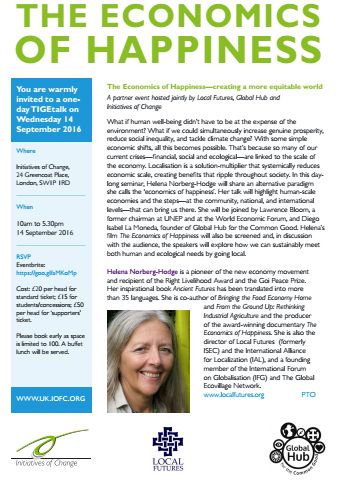
The Economics of Happiness: making an inner transition

This Video is from a talk given at the Economics of Happiness event organised by Initiatives of Change and Local Futures.
The session was based around the ideas of Helena Norberg-Hodge that designing an economy on a human scale can bring wealth, happiness and prosperity in an ecological way. She talked of the steps local, national and international, to getting there.

Initiatives of Change invited Stephen to share his experiences with early stages of Transition initiatives. An extended version of his slide pack is available below the video.

The slideshare pack

A circular economy needs a framework of rules and financial incentives to work

The idea seems logical: when a product or material enters the economy it should stay there – if it comes from below the ground. If it comes from nature it can return at a rate the eco-system can absorb it. The problem is, we are living in a society that has been weaving a complicated web of laws, rules and, taxes and fees since money was created. At the moment it just doesn’t pay. Ushering in the circular economy means making sure it pays by dismantling a few parts of this framework and replacing others. But where to start? Are there existing points of control that can be adapted to stimulate circularity? This article identifies a few essentials. Continue reading “A circular economy needs a framework of rules and financial incentives to work”

OPINION: Sweden is one step closer to crashing in the chasm

Sweden’s largest exporter, Ericsson, is about to shed all manufacturing in Sweden, sack half its employees and be broken up and sold. This is bad news for sustainable Sweden; with its internet of things and wide R&D capabilities Ericsson has the competence and potential to be a major contributor to the Swedish Government’s ambition to be fossil-emission free by 2045. It seems very few really care to do what is necessary. They would rather let small local initiatives pick up the pieces. That is possibly the best option.

Stephen Hinton 2016
Photo: Maj-Lis Koivisto

According to recent newspaper reports, Sweden’s largest exporter, Ericsson, is about to  – in the worst case – shed all manufacturing in Sweden, sack half its employees and be broken up and sold. This is bad news for sustainable Sweden;  with its internet of things  and wide R&D capabilities Ericsson has the competence and potential to be a major contributor to the Swedish Government’s ambition to be fossil-emission free by 2045.  With this latest news it is looking more and more like Sweden will fail to “cross the chasm” keeping its high material standard. It seems, though, that very few really care to do what is necessary. They would rather let small local initiatives pick up the pieces.

Continue reading “OPINION: Sweden is one step closer to crashing in the chasm”

Economics of Happiness: working with the narrative

London 14th September 2016, Initiatives of Change center:

At a recent workshop Helena Norberg-Hodge shared an alternative paradigm
she calls the ‘economics of happiness’. Below is a trailer from a film Helena produced on the subject.

What if human well-being didn’t have to be at the expense of the environment? What if we could simultaneously increase genuine prosperity,reduce social inequality, and tackle climate change? With some simple economic shifts, all this becomes possible. That’s because so many of our current crises—financial, social and ecological—are linked to the scale of the economy. Localisation is a solution-multiplier that systemically reduces economic scale, creating benefits that ripple throughout society. In this day-long seminar, her talk highlighted human-scale economies and the steps—at the community, national, and international levels—that can bring us there.

Stephen Hinton provided his perspective from helping local initiatives in Sweden.

READ MORE

Global warming will accelerate as oceans reach limits of remediation

Systemic Disorder's avatarSystemic Disorder

If humanity stopped all production of greenhouse gases today, Earth would experience several decades more of additional global warming. That is not simply because the carbon dioxide, methane and other greenhouse gases thrown into the atmosphere by human activity won’t disappear in a day, but because the oceans can’t continue to act as shock absorbers.

Earth has tipped into a heat imbalance since 1970, and this excess heating has thus far been greatly ameliorated because the world’s oceans have absorbed 93 percent of the enhanced heating since the 1970s. This accumulated heat is not permanently stored, but can be released back into the atmosphere, potentially providing significant feedback that would accelerate global warming.

The latest in a series of scientific reports detailing the disastrous course of global warming, “Explaining Ocean Warming: Causes, Effects and Consequences,” concludes that the mean global ocean temperature will increase by as much as…

View original post 1,144 more words

The economics of the circular economy

Economic Fiscal Reform calls for the economic system to align with the twin purposes of preserving and  indeed restoring the environment whilst providing a standard of living for citizens. Up to now, these purposes have not been central to the way economics has been practiced. We are, however, facing a pressing situation: soil degradation, atmospheric warming and mineral depletion are forcing us to rethink. The idea of the circular economy – where biological and mineral material circulate in the economy without being deposited – is gaining ground. Continue reading “The economics of the circular economy”

Zero-emission behavior. TIGE enquiry

Going sustainable by focusing on zero emission behavior.

Recently, together with Kabir Aurora, I led an inquiry group as part of TIGE: Trust and Integrity in the Global Economy conference, Caux Switzerland. The sessions focused on how to go from the present situation to a society with sustainable production and consumption. Continue reading “Zero-emission behavior. TIGE enquiry”

A Marx moment manifests in McDonald’s

My partner and I were driving home and needed a coffee break. It was late Sunday night. Only motorway stops were  on offer. We opted for a McDonald’s.  As I walked over to the store I checked my mail: an update from Marxist economist Michael Roberts to read whilst I waited for our order. I was about to learn something.

Continue reading “A Marx moment manifests in McDonald’s”