This short video answers the question many have asked: how can you talk about Real Capital without talking about money? Or how can you talk about money without talking about Real Capital?
Continue reading “How Money in National Budgets and Real Capital work together”Author: stephenhinton
Real Capital: A terminology list
For those studying and learning Real Capital (Multi-Capital) and its application to producing bases for decision-making, this glossary may be of help.
Continue reading “Real Capital: A terminology list”Modelling Supply Chains to inform Circular Economy policy
Short Communication
Stephen Hinton, Fellow, International Association of Advanced Materials
ABSTRACT
Supply chains are international. To be effective, it follows that actors should use a common language with the same vocabulary, metrics etc. in each country to be able to run, monitor and regulate them. They have a common grammar that embodies key generally accepted concepts. This grammar, however, still reflects the make-take-dispose mental models of the linear economy. This report presents a proposal for a description of supply chain grammar using the Swedish SNI categorisation of industries. The proposal models supply chains with sufficient granularity to allow identification of intervention points for the crafting of policy to stimulate the transition to circularity.
Each installed production device in the various types of the chain can be classified according to their capability for circularity, allowing for quantitative measures to help companies and countries craft policy and strategy.
Continue reading “Modelling Supply Chains to inform Circular Economy policy”What are normative statements?
How to use normative statements, so science can speak to policy in terms they understand.
In the context of scientists communicating with policymakers, normatives are statements or guidelines that express how things should be, based on values or standards. They are used to frame recommended actions or standards by considering established values and desired outcomes. Essentially, normatives translate scientific findings into actionable recommendations aligned with societal values.
Continue reading “What are normative statements?”Swedish energy and climate planning goes normative. That poses questions
This year, 2025, is the year Swedish local authorities are tasked with preparing for the Green Revolution: To make sure the Paris agreements are reached, to fulfill EU directives on nature, AND to prepare for shocks from the ever-increasing weather volatility.

Representing Real Capital in Asset Liability Equity tables
Applying ALE tables to the material world: an introduction.
You’ll need to be familiar with the concepts of real capital and systems dynamics from previous posts, if you are not already.
The Assets – Liabilities – Equity (ALE) accounting method is a fundamental approach used in financial accounting to record and report the financial position of an organization. It involves the classification and measurement of an organization’s resources (assets), obligations (liabilities), and owners’ interests (equity). This method is widely appreciated by businesses, non-profit organizations, and governmental entities as it provides a comprehensive and transparent overview of an organization’s financial health.
The approach therefore, is favoured by economists advising policy makers. However, not just money, but physical resources – their function, availability, capacity, etc. are vital to the workings of society. This dimension can be lost when looking through an economics-heavy lens. What is needed is the robustness of the ALE method applied to the material world. Let us present it here:
Continue reading “Representing Real Capital in Asset Liability Equity tables”Decisions made just on economic grounds? Real Capital holds the alternative decision basis
A more holistic way of thinking about value. A truly thriving society is built on four key pillars.
- Natural Capital
- Built Capital
- Social Capital
- Human Capital
We need to first understand our culture before we can change it
To be part of developing our culture towards peace, it is vital we all gain an awareness of what our culture is. And why we need to be actively involved with its evolution. This article presents culture as a group’s way of living that emerges and adapts over time. We will seek to explore, in coming articles, how we as individuals can influence our culture towards peace. For now, let us explore this concept of culture. It has many dimensions that interact with each other. We may find places we as individuals, or as the groups we are involved in, where we can intervene to orient our way of life more towards peace.
Continue reading “We need to first understand our culture before we can change it”AI summarizes my circular economy work in 13 minutes

I’ve been at it a long time. Working on the circular economy. From advising the Swedish Circular Economy Delegation, to working on the circular region at the university in Gävle, Sweden, to creating an online education for county administrators. Thinking to put it all in a book, I started collecting fragments into Google’s experimental NotelbookLM. Of course, it offered to do a podcast summary of it all.
Continue reading “AI summarizes my circular economy work in 13 minutes”Experiments with prototyping a municipal dashboard.
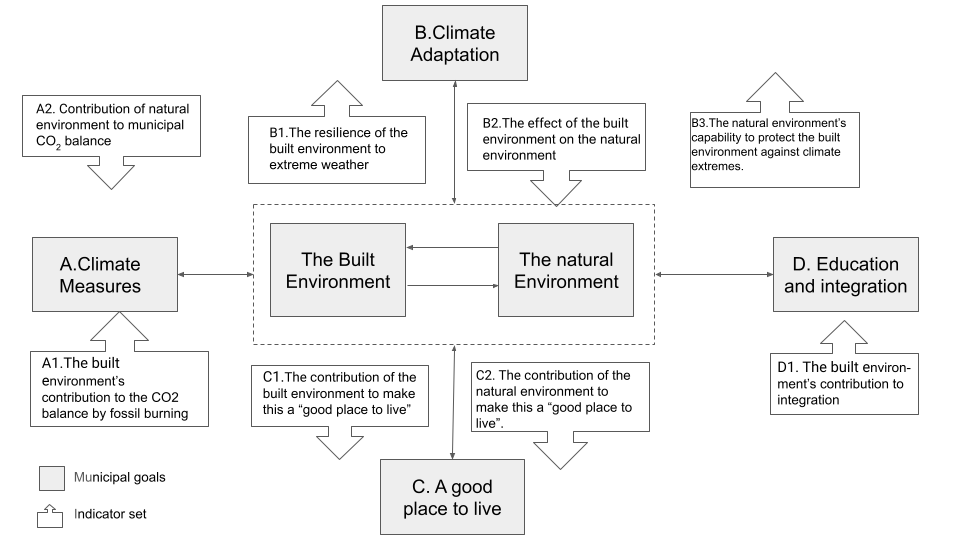
Readers will recall we produced a proposal for indicators for municipalities. A dashboard would help local politicians understand how the built infrastructure was affecting the living environment and how the environment was affecting society. The first proposal is illustrated below.