An important background briefing for all who want to understand sustainability: why the element phosphorus is one of the limiting factors in soil fertility and why we cannot rely on mined sources indefinitely.
For more information on the pollutant fee approach, developed by Höglund, see the white paper.
Signals of Change newsletter monitors the news flow from a wide variety of sources from the last 30 – 60 days for developments that could inform your organization’s social and environmental strategy which in turn could affect your overall business strategy. Signals of Change Newsletter is produced in cooperation between the Open World Foundation, the Institute of Swedish Safety and Security and Stephen Hinton Consulting.
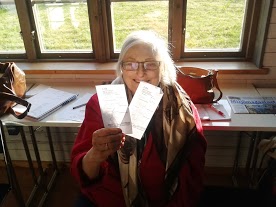
Journalist BirGitta Tornerhielm shows off her environmental currency
PLACE: County of Uppland, Sweden
SITUATION: Despite best efforts, rural areas – even some close to large cities – are experiencing a decline in population, investment and or services. As unemployment is rising, and the production of services is moving away from the area, the ability of the area to handle challenges such as economic downturn, food shortages, freak climate, power failure etc. is decreasing.
When disaster strikes, the authorities and corporations cannot alone be relied upon, it is up to citizens to meet these challenges.
SECONDARY SITUATION: The above applies too, to the task forming the sustainable society. The challenges are similar but the time-frames differ. Firm public engagement, and collaboration between authorities and businesses is needed to meet the nation’s ambitious environmental goals.
FRAMING QUESTION: Are there tools available that can be used to encourage citizens to take part in developing the sustainable society, tools and approaches that can encourage them to contribute their time and skills to developing a local resilient capability? Is so, how can these tools be implemented? How can corporations and authorities be involved? Continue reading “Case Study: using complementary currency to drive volunteering and collaboration”
ECO ISLANDS is a network of Islands that have stated that they are aiming toward sustainability by signing something called the Charter, a statement of intent that over 50 islands have already signed.Continue reading “Learning sustainability from Eco-Islands”
After leaving Ericsson in 2001 I started exploring alternatives to the Industrial Society. During recent years, volunteering for the Water and Food Award, and helping start an Eco -Village were profound experiences. Among others things I had the opportunity to step back and look at what is happening.
Many businesses in going about their business are actually undermining the conditions needed for people to live well. Albeit inadvertently.
No-one means it to be this way, I am sure, but the planet is becoming crowded, our financial systems are leading to uneven wealth distribution and our energy systems are depleting non-renewable energy and climate systems. Several boundaries have already been breached and more are on their way to being exceeded. We are entering into times when we are living outside the safe zone. Continue reading “Why I am starting consulting again”
SITUATION: The Baltic sea is close to a tipping point, where phosphorous trapped in sediment may well start to be released. Regardless of whether emissions stop completely, there is a risk that the living eco-system will be threatened by this influx of nutrients. It may completely destroy all food chains through a massive algal blooming, for example. Continue reading “Case Study: investigating fees on phosphorus to usher in the circular economy”
Reflections on experiences at this year’s Future Perfect festival, designed to bring together sustainability thinkers and doers…
The Future Perfect Festival, held on the Stockholm archipelago Island of Grinda, wrapped up recently. The event, now in its third year, is designed to provide a space for those engaged emotionally and professionally in sustainability; a space where they can gather, engage in dialogue and co-create.
Future Perfect, the brainchild of John Manoochehri, is a unique kind of festival, and it is badly needed. Even if, like myself, you are engaged in sustainability on an almost daily basis, the topic is far too wide for any one mind to take in. We need to listen to each others perspective. If we as a species are going to successfully transition away from the present counter-sustainable culture we live in we need to do it together. This means talking, listening to each other, sparking ideas off each other, trying ideas out, coming up with ideas together, and developing our perspective by reflecting in the company of those who both agree and disagree with us. Continue reading “Speaking of Sustainability in the Future Perfect”
PLACE: Huddinge Municipality, part of Greater Stockholm, Sweden
SITUATION: The Municipality had decided to set up a circular “walk for your heart trail”. The problem is that the municipality is so large, and has so many places that make fine walks it looked like the trail would not have the impact intended, as too few would use it, either because it was too far away or because the options were better and so many. Continue reading “Case Study: Walking maps”
The latest version of the white paper connects the need to exert control of the economy’s handling of carbon, phosphorus and nitrogen as well as ecological maturity with price. Updated from previous versions, this version now connects emissions fees with the transition to the circular economy and offers more in-depth coverage of ecological maturity and the process of introducing the fee mechanism.
Writing in Fast Company, journalist Mark C. Crowley observes that American workplaces are seen in particularly destructive to the human spirit by employees. Has the negativity reached a low point? Mark C Crowley things so. For the last few months he has been looking at companies who actively work to create a good workplace. Pointing to firms like Google and software giant SAS, he says:
If you hold any position in leadership today, you should know this: Companies that authentically value their employees will be (and already are) the big winners in the 21st-century economy.