Newsletter AUGUST 2014 Vol. 2 Issue 7 The funnel, the game change and the dialogue.

Searching for ways to reflect on leadership challenges

HOW DO YOU EXPLAIN THE NEED TO ADAPT NOT JUST OUR CORPORATIONS, BUT OUR WAY OF SEEING THINGS? THIS IS THE LEADERSHIP CHALLENGE SIGNALS TAKES ON AS EUROPE TAKES ITS SUMMER VACATIONS.
Signals: Thinking about the way we think was once popular in strategic circles. No so much anymore. However, at least we question our assumptions more, thanks to the rise of great minds like Peter Senge http://executive.mit.edu/faculty/profile/30-peter-senge and Donella Meadows http://www.donellameadows.org/. We need to sit back and reflect. The signals we are seeing tell us that the collision course with nature we are all bound on will be the trainwreck of the century, and the solutions we need to look for are not on the level of changing light bulbs, but in the very way we perceive the world. We need to redefine what we mean by growth, how we see the economy and how we as strategists advise the organisations we work for. Continue reading “Newsletter AUGUST 2014 Vol. 2 Issue 7 The funnel, the game change and the dialogue.”

Energy and the Economy – Twelve Basic Principles

Reposted from Gail Tverberg’s blog. If anyone was in doubt that the assumptions underlying economic policy are flawed, Gail gives you 12 basics to gain a much clearer understanding.

Gail Tverberg's avatarOur Finite World

There is a standard view of energy and the economy that can briefly be summarized as follows: Economic growth can continue forever; we will learn to use less energy supplies; energy prices will rise; and the world will adapt. My view of how energy and the economy fit together is very different. It is based on the principle of reaching limits in a finite world. Let me explain the issues as I see them.

Twelve Basic Principles of Energy and the Economy

1. Economic models are no longer valid, as we start getting close to limits.

We live in a finite world. Because of this, the extraction of energy resources and of resources in general operates in a way that is not at all intuitive as we approach limits. Economists have put together models of how the economy can be expected to act based on how the economy acts…

View original post 3,498 more words

Making Sense of the US Oil Story

Author Gail Tverberg. has an M. S. from the University of Illinois, Chicago in Mathematics, and is a Fellow of the Casualty Actuarial Society and a Member of the American Academy of Actuaries. This deep analysis of the oil situation is a must-read for all business leaders.

Gail Tverberg's avatarOur Finite World

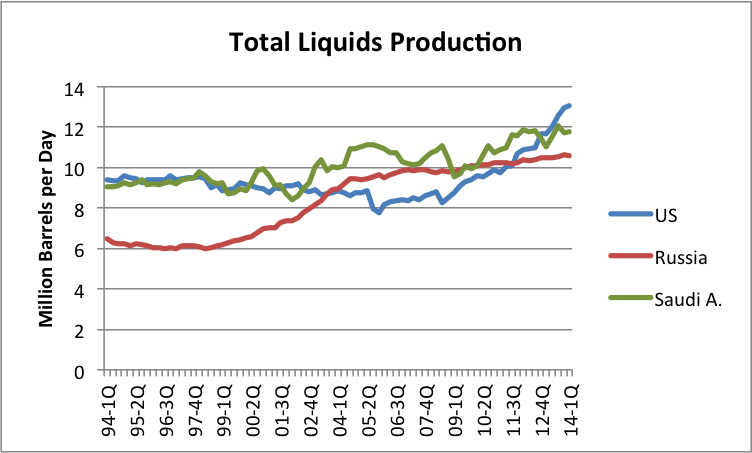
We frequently see stories telling us how well the United States is doing at oil extraction. The fact that there are stories in the press about the US wanting to export crude oil adds to the hype. How much of these stories are really true? If we believe the stories, the US is now the largest producer of oil liquids in the world. In fact, it has been the largest producer since the fourth quarter of 2012.

Figure 1. US Total Liquids  production, including crude and condensate, natural gas plant liquids, "other liquids," and refinery expansion. Figure 1. US Total Liquids production, including crude and condensate, natural gas plant liquids, “other liquids,” and refinery expansion.

Oil “Extenders”

One of the issues is that a few years ago, the US created a new oil-related grouping, combining valuable products with much less valuable (lower energy content, less dense) products. Using this new grouping, the US was able to show much improved growth in total “oil” supply. The US EIA now calls…

View original post 1,641 more words

On Play

antonysheehan's avatarAntony Sheehan

leader can Antony come out to play?

What kid doesn’t love to hear that question? I know I did.

Growing up in the UK, I played a lot of football. You’ll excuse me if I don’t quite make the transition to calling it “soccer”. Even after a couple of years in the US, that word does not automatically trip off my tongue.

I was outside a lot. I ran hard. I kicked hard. I bounced balls off my head. I tried new strategies every time I was out on the field with my team. I made friends. I laughed and experienced the gamut from agony to ecstasy.

The recent World Cup reminded me of how much I loved those days full of play.

Adults sometimes devalue play, both for themselves and their children.

Shouldn’t kids be learning to do chores? Finishing homework? Practicing the piano? And shouldn’t adults be working harder…

View original post 364 more words

Inventing for the Sustainable Planet: The Novel

This  is no ordinary book.

Max Wahlter, a journalist specializing in science and technology, decides to leave his failing career to make money from sustainable technology.  He comes across an innovation technique called Imagestreaming that unlocks the innovative power of the mind to make almost anyone a Leonardo daVinci,. Max proceeds to create a vision of the sustainable society, publishing the results on his blog. Continue reading “Inventing for the Sustainable Planet: The Novel”

Spread the word: Water and Food Award opening for new applications

Are you involved in a water and/or food security initiative? WAF would like to hear from you! The Water and Food Award (WAF) promotes sustainable water and food initiatives around the world. Every year, WAF selects five finalists from a field of applicants and recognize them at our high-profile international award event. Continue reading “Spread the word: Water and Food Award opening for new applications”

The Humanitarian Water and Food Award 2014

Introduced by former BBC correspondent and sustainability journalist Steve Bradshaw along with WAF’s applications manager, Stephen Hinton, the Humanitarian Water and Food Award was streamed live from Central Hall Westminster in London on Wednesday the 18th of June. Continue reading “The Humanitarian Water and Food Award 2014”

Webinar: make sustainable food security the heart of CSR strategy

csrintroSuitable for those curious about CSR or those looking for sound arguments to introduce CSR strategies into the firm, this webinar overviews the CSR approach to fulfilling the human right to water and food  in a sustainable way and explains how this can drive business development.

Fast Facts:

  • CSR level: basic
  • Main Theme: leaving philanthropy
  • Main audience: representatives from corporations and other organisations interested in implementing CSR together with sustainable development
  • Main benefits: holistic approach gives you the basics fast in a down to earth manner
  • Length: 20 mins
  • Register: follow this link
  • Available: NOW! as replay 

Continue reading “Webinar: make sustainable food security the heart of CSR strategy”