
This short video explains the mechanism put forward by the Swedish Sustainable Economy Foundation for solving pollution with financial incentives.
Category: All Recent Updates
Local complementary currency 19th March (in Swedish)
Kan en lokalvaluta göra oss mer självförsörjande lokalt? Och kan den rädda oss om/när det finansiella systemet kraschar?
Vi får lära oss att skapa lokalvalutan ITK praktiskt – sedan är det bara att sätta igång!
Man in mission weekend for men 14-16 February (in Swedish)
Nu är det snart dags för “Man in mission” På Mundekulla (14-16 feb) med inspiration från “The ManKind Project” som bygger på att män stödjer varandra!
Continue reading “Man in mission weekend for men 14-16 February (in Swedish)”
Circular economy in diagrams: where logic breaks down and where financial incentives can work
Are your circle economy diagrams confusing your audience? This article aims to help you communicate clearly. As a staunch aficionado of reaching a resilient economy through sustainability I am all for circle economy thinking- if it ensures people get food on the table and a roof over their heads. Unclear delivery will not help our cause. We talk of circle economy from two angles: economy as a form of housekeeping and economy in terms of monetary flows. These are not always the same thing. The final section suggests a solution.

Transition in the World Conference connects villages around the world
On Sunday the 20th October, the eco-village Gröna Dalen in Ransbysätter, Värmland Country, Sweden, hosted a Transition in the World Conference as part of The Green Planet Festival. Held simultaneously on an Internet video conferencing platform and at the village centre, villagers were connected to liked-minded projects around the world.
Beamed onto the large screen, villages could see themselves on video camera, their guest speakers and speakers in America, other parts of Sweden as well as hear presenters from Romania talking from the Scottish town of Fores.
Continue reading “Transition in the World Conference connects villages around the world”
FLEXIBLE EMISSION FEES EXPLAINED
Externalisation – harmful emissions from commercial and civil activities – represents a negative side of the way business is carried out today. Economic growth on one side brings profits to business owners while externalisation on the other flips the costs of emissions over onto citizens, who via taxes must bear the cost of environmental clean-up. The challenge for economists and scientists is to come up with ways of managing pollution-producing substances in a way that both supports economic activities and preserves the environment.
This workshop covers the reasoning behind the mechanism from scientific, economic and practical angles and then presents the mechanism itself in enough detail for delegates to be able to explore possibilities for introduction of the mechanism in their own work
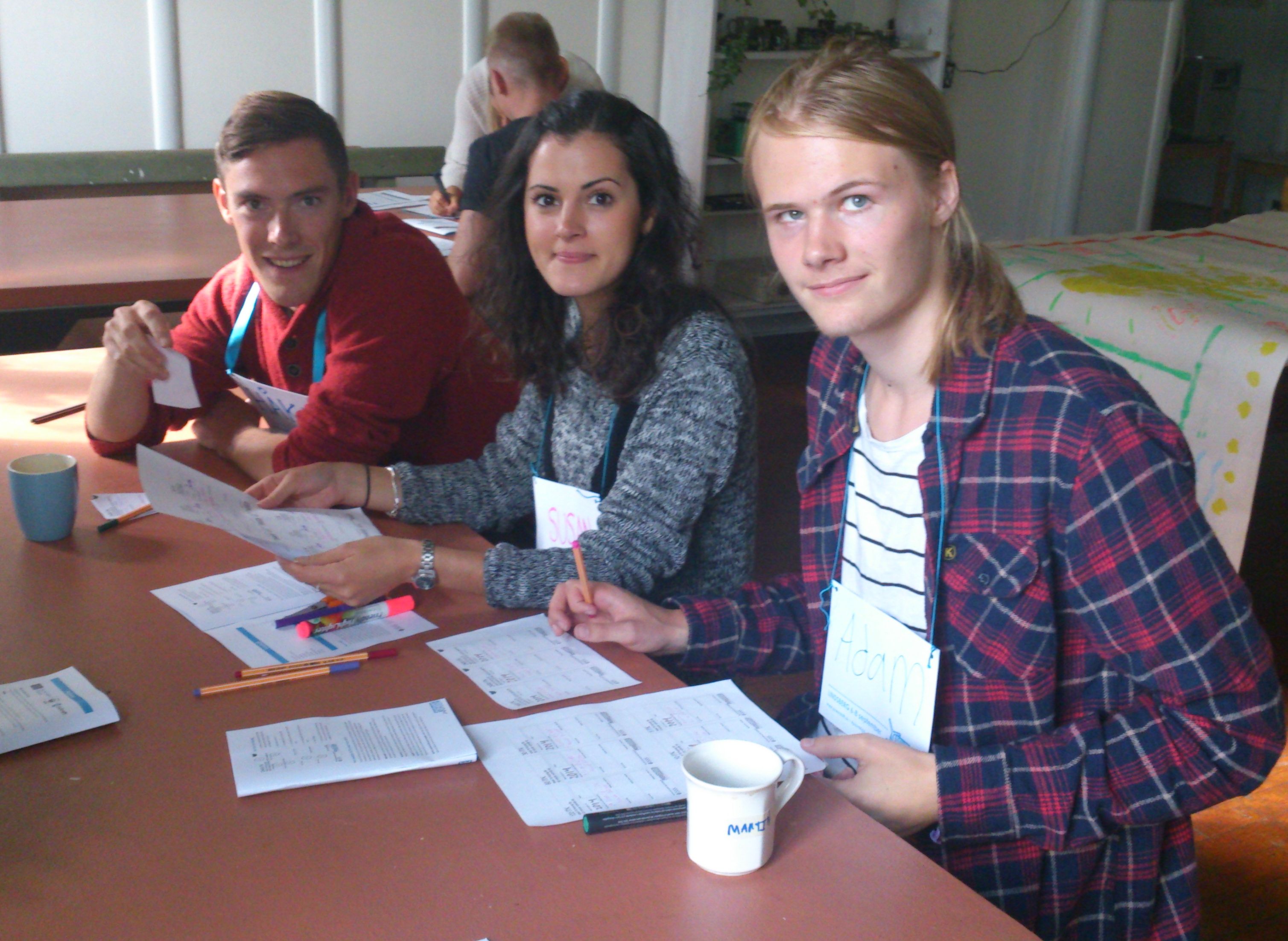
Local currency-driven knowledge exchange workshop at Uppsala University
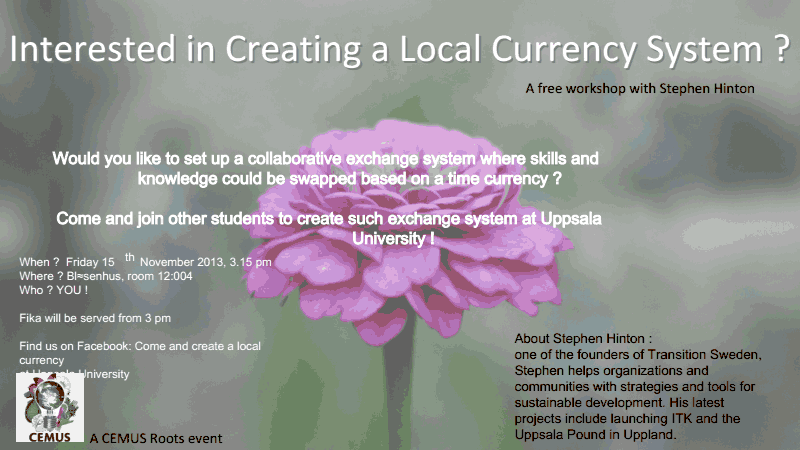 ISSS fellow Stephen Hinton recently led a complementary time-based currency workshop as part of a project to set up a student knowledge exchange at CEMUS, Uppsala University, Sweden.
The students, coordinated with the tireless energy of Jesse Shrage and his friends Christina Fagerlund and Adam Elinder , want to set up a collaborative exchange system where skills and knowledge could be swapped based on a time currency.
Continue reading “Local currency-driven knowledge exchange workshop at Uppsala University”
Lokalvaluta dagen
(Seminarium och Workshop)
LOKAL VALUTA SOM MOTOR I LANDSBYGDS- OCH LOKALEKONOMISK UTVECKLING
Kan en lokal, volontär valuta vara ett sätt att organisera och stimulera landsbygdsutvecklingsprojekt? Tidigare har ISSS utfört pilotstudier och utveckling av modeller för introduktion av lokalvaluta. Dessa studier visade bl.a. stora möjligheter för användning av volontärvalutan ITK. ITK, som står för Ideell Tid Kuponger, introducerades inom projekt som syftar till att stärka den lokala ekonomin och öka den lokala beredskapen inför t.ex. extrem väder, elavbrott, ekonomiska svårigheter mm. Denna workshop ger dig som är involverad i landsbygdsutveckling, beredskap, lokalekonomi, miljöutveckling osv. nya insikter och metoder för att organisera, uppmuntra och finansiera projekt. Continue reading “Lokalvaluta dagen”
Case Study: Envisioning the sustainable city
 PLACE: Stockholm, Sweden
SITUATION: The think tank AVBP took on the challenge of working with the narrative of the sustainable city. Instead of seeing how we live as being a burden on the Earth, and dire prospects of having to give up our comforts, AVBP explored how tell the story of how we can create great places to live sustainably.
FRAMING QUESTION: how can we create a narrative that gives us a positive, feasible view of a sustainable future in a city? Continue reading “Case Study: Envisioning the sustainable city”
Case Study: Creating centers of well-being.
 PLACE: Stockholm, Sweden
SITUATION: The think tank of AVBP was given an interesting challenge: how to develop tourism in areas of natural beauty that have easy access to cities? The need was to encourage visitors to be tourists closer to home. These tourists were looking for active holidays, with high interest and with a high degree of health involved.
FRAMING QUESTION: how can we develop our tourism business using our proximity to cities, areas of natural beauty and focus on health to develop a booming tourist industry, where people come back year after year.
SOLUTION: The Center of Well -being concept was proposed by the think tank. The basic idea is to create and market an area in a way to make it “sticky” offering so much and such a range that the visitor will be enticed back time and again. Continue reading “Case Study: Creating centers of well-being.”

